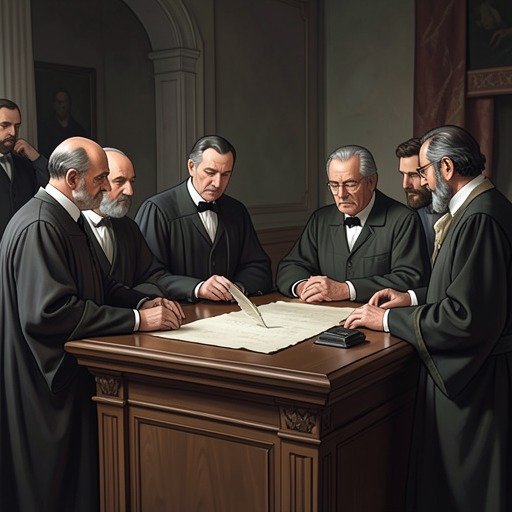
President–Senate Treaty-Making Relationship
Federalist PapersThe President–Senate Treaty-Making Relationship is the proposed Constitution’s shared arrangement for making treaties: the President acts with the Senate’s advice and consent, and two thirds of the senators present must concur. Its significance lies in combining the executive’s ability to manage foreign negotiations with legislative participation in agreements that carry the force of law. The design is defended as a safeguard against both an unchecked President and a Senate acting without the President, while preserving room for secrecy and dispatch where diplomacy requires them.
Constitutional Design and the Nature of Treaties
The treaty provision gives the President power, “BY AND WITH THE ADVICE AND CONSENT OF THE SENATE, TO MAKE TREATIES, PROVIDED TWO THIRDS OF THE SENATORS PRESENT CONCUR.” The requirement is not a simple transfer of authority to one branch: the President and Senate share the work, and the supermajority requirement makes the Senate’s concurrence an express condition of a treaty’s formation.
The argument for this division begins by resisting the assumption that treaty-making belongs neatly to either the executive or legislative category. Treaties do not execute existing laws, enact domestic rules, or themselves employ the common strength. They are contracts with foreign nations: agreements between sovereigns that have the force of law through the obligations of good faith. Because the power has a distinctive character, its institutional placement should be shaped by what treaty-making demands rather than by a rigid classification of governmental functions.
That distinctive character points in two directions. Foreign negotiation requires the abilities and practical agency of the Executive; yet the importance of the trust, and the legal force treaties acquire, argue for participation by the whole or a portion of the legislature. The proposed relationship answers both considerations by making the President the agent in negotiation while requiring the Senate’s concurrence. The arrangement is thus defended not as an accidental mixture of powers, but as a fit between the nature of the task and the different capacities of the participants.
Negotiation, Secrecy, and Dispatch
The President’s part is especially important when diplomacy depends on confidential intelligence. People with useful information may be willing to confide in the President but unwilling to trust the Senate, and still less willing to disclose it to a large popular assembly. The President can therefore manage intelligence and preliminary business in the manner prudence suggests, even though a completed treaty remains subject to the Senate’s advice and consent.
Speed matters as well as secrecy. The course of national affairs can change with the loss of a battle, the death of a prince, the removal of a minister, or another sudden alteration in circumstances. Days, and sometimes hours, may determine whether a favorable opening can be used before it turns against the country’s interests. The argument therefore distinguishes between preparatory and auxiliary measures, which the President can handle to facilitate negotiations, and matters requiring Senate concurrence. If circumstances demand the Senate’s participation, the President may convene it.
The relationship is presented as preserving deliberation without making every stage of negotiation dependent on a numerous assembly. The proposed arrangement seeks the advantages of talent, information, integrity, and careful investigation alongside secrecy and dispatch. In this account, the Senate’s role does not eliminate executive flexibility; it places a constitutional check at the point where an agreement requires approval.
Why Neither Branch Should Act Alone
The case against giving the entire power to the President rests on the risks of entrusting a momentous national interest to an elected magistrate alone. An hereditary monarch might have a substantial personal stake in the government, but an elected President serves a four-year term and may return to private life. A person of moderate or slender fortune could face temptation to exchange the state’s interests for wealth; an ambitious person might seek personal advancement with foreign assistance. The argument does not assume that every President would yield to such pressures. It holds that the possible stakes make sole executive control unsafe.
The Senate alone is also an inadequate arrangement. If it controlled treaty-making exclusively, it could choose whether to employ the President in foreign negotiations at all; pique or cabal might lead it to dispense with his agency. A negotiator serving merely as the Senate’s minister would not necessarily possess the same standing or confidence with foreign powers as the nation’s constitutional representative. The country would lose an advantage in external affairs, and the people would lose the added security created by executive participation.
The House of Representatives is presented as a poor additional participant in treaty formation. Its size and changing composition are said to make it ill-suited to sustained command of foreign politics, consistent policy, sensitivity to national character, secrecy, and dispatch. Bringing more bodies into each stage would also complicate negotiations, require more frequent calls upon the House, prolong its sessions, and increase inconvenience and expense. Against these alternatives, joint possession by President and Senate is defended as safer than vesting the power separately in either one.
Deliberation, Accountability, and Institutional Contrast
The Senate’s participation supplies deliberation and scrutiny to a power whose results bind the nation. The President contributes a constitutional place in conducting negotiations; the Senate’s concurrence prevents him from making treaties by his own authority. The arrangement is therefore described as adding security without discarding the benefits of executive agency. Its rationale joins institutional competence to a concern about divided responsibility: the task calls for both capable negotiation and a check on the official who negotiates.
The argument’s treatment of responsibility elsewhere in government clarifies why visible institutional roles matter. A plurality in the Executive, it warns, can conceal faults: when several actors blame one another, the public may be unable to identify who caused a harmful measure or national misfortune. In contrast, the proposed appointment plan makes the President’s nomination and the Senate’s response public matters. A bad nomination can be attributed to the President; rejection of a good one can be charged to the Senate; an improper appointment can bring discredit upon both, though in different degrees. This is not a claim that treaty decisions always produce perfectly clear blame, but it reflects a general preference for arrangements in which the public can distinguish each participant’s part.
New York’s council of appointment serves as the counterexample. Composed of three to five people, including the governor, it acted in a private room beyond public view. Although the governor claimed the power to nominate, the extent and manner of his exercise of that power, and the occasions on which he was opposed, were not publicly clear. In the account, that uncertainty blunted censure and left room for intrigue. Against this opaque process, the federal proposal’s distinct presidential and senatorial roles are defended as more legible: responsibility for nomination, concurrence, and the final outcome can be more readily assigned.
The underlying constitutional logic also appears in the treatment of federal authority more generally. The Necessary and Proper Clause is defended as authorizing laws to execute powers already granted, while the Supremacy Clause applies to laws made pursuant to the Constitution. Federal laws enacted beyond constitutional powers are characterized as usurpations, not supreme law. This limitation frames shared treaty-making as a defined constitutional authority rather than a general license: the power belongs to the national government under specified conditions, and the Senate’s required concurrence is part of those conditions.
The Broader Principle of Checks
The treaty arrangement belongs to a wider argument about how constitutional design can guard against the concentration of power. The primary control is dependence on the people, but experience also makes auxiliary precautions necessary. Since government is administered by people rather than angels, those who exercise power need constitutional means and personal motives to resist encroachment. The proposed treaty relationship applies that principle through a division of responsibility: neither the President’s negotiating capacity nor the Senate’s deliberative authority is treated as sufficient on its own.
This logic resembles the broader claim that a limited Constitution needs independent courts to preserve restrictions on legislative authority. Courts must be able to treat acts contrary to the Constitution as void; otherwise specified prohibitions and reserved rights would be ineffective. The treaty provision addresses a different governmental function, but the shared structural premise is that public power should operate through defined authority and institutional checks, rather than through an office’s unchecked assertion of its own reach.
The relationship is ultimately defended as a balance tailored to diplomacy. The President can act with speed and manage sensitive intelligence; the Senate can deliberate and withhold the concurrence required for a treaty; the participation of both can reduce the danger of unilateral action while retaining the standing and practical effectiveness of executive negotiation. Its central claim is not that divided authority removes every risk, but that the union of presidential agency and senatorial consent offers greater security than either branch exercising treaty power alone.