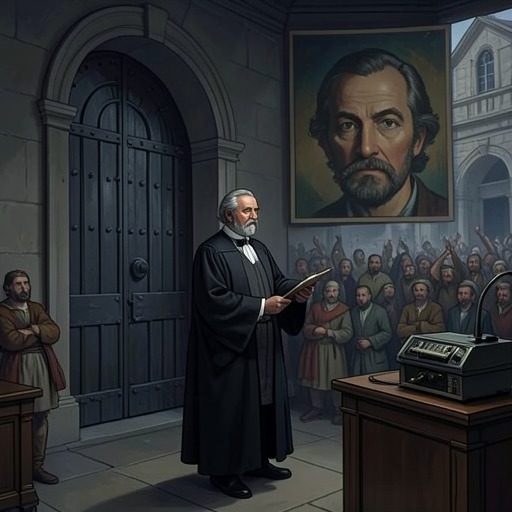
Trial by jury in civil cases
Federalist PapersTrial by jury in civil cases is presented as an important safeguard whose constitutional omission is not an abolition: the proposed Constitution leaves its use in federal civil litigation to legislative judgment, while most familiar disputes remain within state courts and their established procedures. The argument turns on a distinction between requiring juries in criminal cases and forbidding them in civil ones, then grounds its defense of the omission in the diversity of state practice and the difficulty of writing a precise national rule.
The objection and the interpretive dispute
The objection that the proposed Constitution lacked a provision securing jury trials in civil cases had proved especially successful in New York and, the essay suggests, elsewhere. Its proponents portrayed silence about civil causes as a complete abolition of jury trial—not only in civil matters but, through the force of their rhetoric, even in criminal cases. The essay separates those claims: criminal jury trial is expressly secured, while the civil question concerns what follows from the absence of a comparable provision.
Opponents invoke interpretive maxims that a specification of particulars excludes generalities, or that the expression of one thing excludes another. Because the Constitution requires juries in criminal cases but says nothing about civil cases, they infer that civil juries are prohibited. The reply is that a mandate to use one procedure in specified cases does not itself prohibit a legislature from using that procedure in other cases where it already has authority to do so. The argument treats the maxim as a rule of common sense whose force depends on its proper application, not as a mechanical formula that can turn every specific command into an implied ban elsewhere.
The distinction is between excluding an obligation and excluding a power. A criminal-jury guarantee removes legislative discretion in criminal causes by requiring that mode of trial there. In civil causes, silence leaves the legislature free either to adopt jury trial or not to adopt it; it does not compel the legislature to use juries, but neither does it strip it of that authority. On this reasoning, the contention that the national legislature could not submit civil cases within federal jurisdiction to juries has no sound foundation.
Federal authority and the reach of state courts
The essay places the jury objection within a broader account of constitutional interpretation. The proposed Constitution authorizes Congress to make laws necessary and proper for executing its powers, and declares the Constitution, laws made in pursuance of it, and treaties made under its authority to be supreme law. The argument maintains that these clauses do not create an unlimited authority: federal action must rest on powers granted by the Constitution, and action beyond those bounds would be usurpation rather than valid supreme law. Applied to civil juries, the central question is therefore not whether the Constitution silently abolished them, but which courts have jurisdiction and what choices remain within the national legislature’s lawful authority.
The essay argues that the plan does not abolish jury trial in any case. In the great body of controversies between individuals, it says, the institution remains where state constitutions and laws place it because the federal judiciary has no cognizance of those disputes. Land cases ordinarily remain in state tribunals, except when claims under grants from different states are at issue. Other controversies between citizens of the same state also remain there, unless they depend on a positive violation of the union’s articles by a state legislature. Admiralty cases and almost all matters of equity jurisdiction, by contrast, were already decided without juries under the existing arrangements described in the essay. The predicted effect of the proposed change on the institution as then practiced is consequently limited.
The argument also distinguishes the jury guarantee in criminal cases from civil jurisdiction. The Constitution’s express criminal guarantee sets a required procedure for those cases; the general legislative power to constitute courts includes authority to prescribe modes of trial where the Constitution has not specified one. Thus, civil jury trial in federal cases is not guaranteed by the text, but the legislature remains at liberty to provide it. The distinction preserves both the force of the criminal provision and the possibility of civil juries without treating either as an implied rule that the text does not state.
Why a uniform guarantee was difficult to draft
The defense of leaving the matter to legislative regulation depends on the differences among state systems. The essay stresses that civil jury trial varied not only in extent but also in its institutional form. In New York, juries served in common-law courts, with exceptions; probate, admiralty, and chancery courts generally proceeded before a single judge, without a jury. New Jersey had a chancery court operating in a similar manner, while its admiralty causes were not tried by juries. Georgia had only common-law courts and allowed an appeal from one jury’s verdict to another, called a special jury, selected according to a designated method.
Connecticut’s arrangements differed again: it had no separate courts of chancery or admiralty, and its common-law courts exercised admiralty and some equity jurisdiction. In important cases, the General Assembly served as the only court of chancery. Jury trial therefore extended further in Connecticut than in the other states discussed; Rhode Island was described as broadly similar. Massachusetts and New Hampshire also combined law, equity, and admiralty jurisdiction in ways that gave jury trial a different practical scope. In the four eastern states, the essay adds, a distinctive practice allowed an appeal from one jury to another until two verdicts out of three favored the same side.
These variations made a single national formula hazardous. A rule copied from one state could fail to match the institutions and settled practices of others; omitting a provision and leaving the subject to legislative regulation could be no more dangerous, and perhaps less so, than selecting one state’s system as the national standard. The proposed Pennsylvania wording, “Trial by jury shall be as heretofore,” offered no solution: the United States, considered collectively, had no existing federal judiciary or prior federal civil-jury practice to which “heretofore” could refer. Without a determinate antecedent, the phrase would lack precision and might be inoperative.
A guarantee covering every case would not solve the drafting problem. The essay notes that no member of the Union supplied a precedent for such a rule and argues that extending civil jury trial to all cases would be an error. The harder task was to define a provision that neither covered too little to serve its purpose nor too much to be advisable. A rigid guarantee might also open further controversy and obstruct the larger objective of establishing a firm national government.
Liberty, corruption, and the value of juries
The essay does not dismiss the institution while defending the omission of a federal civil guarantee. It recognizes civil jury trial, under proper regulations, as an excellent method for deciding questions of property and says that this value alone could justify constitutional protection if its proper limits could be fixed. It also acknowledges uncertainty about whether civil juries are essential to liberty in every setting. The more decisive protection, in its account, is the criminal jury guarantee, which the proposed plan provides fully; in the largest proportion of civil cases affecting the public generally, state constitutional arrangements would remain untouched.
The jury’s practical value also appears in the account of resistance to corruption. A corrupt decision would, in many cases, require influence over both court and jury: when a jury has plainly gone wrong, the court will generally grant a new trial, while corrupting jurors alone may accomplish little if the court is not also gained. This combined action forms a double security, multiplying obstacles to successful corruption and helping preserve the integrity of both institutions. The jury does not make misconduct impossible; it makes the path to it more difficult.
The conclusion is deliberately qualified. Civil jury trial remains highly esteemed, yet its precise reach cannot be translated into one stable federal rule without confronting differences among the states and the changing requirements of society. The essay therefore rejects the claim that omission means abolition, identifies where existing state practice would continue, and defends legislative discretion in federal civil cases as a response to a real problem of constitutional design rather than hostility to juries.