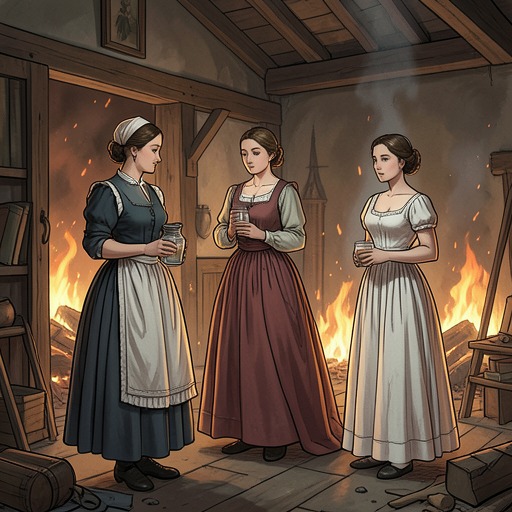
Adèle Anger
Felix AustriaAdèle Anger is Doctor Anger’s pale, delicate daughter, a woman whose dependence on Stefania Tchornenko shapes the intimate life of the household and the novel’s uneasy account of care. Anemia, infertility, and recurrent convulsions mark the limits placed on Adèle’s body, but they do not make her merely passive: she speaks confidently about training servants and understands domestic affection as part of that training. Her closeness with Stefania is at once sustaining and unequal, a bond in which love and service become difficult to separate.
Identity and Physical Vulnerability
Stefania describes Adèle as almost translucent, with a cloud of fine, light hair, and as delicate, dreamy, sensitive, and easily moved. The description establishes a striking contrast with Stefania, who sees herself as sturdy, dark-complexioned, alert, and robust. Adèle’s appearance invites protection: Stefania imagines shielding her from knives, oil lamps, and heavy objects, and caring for her as one would a child. This vision is affectionate, but it also makes Adèle’s vulnerability the organizing fact of their shared life.
Her frailty has practical and medical consequences. Adèle is anemic and suffers weakness and migraines; Stefania massages her, prepares remedies, and worries that she cannot manage even a simple soft-boiled egg without help. When Adèle’s infertility is investigated, two specialists, Vodnetsky and Richter, confirm through chemical and microscopic examination that she cannot have children. The certainty of their findings extinguishes the possibility of a miracle in the eyes of medicine, while the account of Doctor Anger’s own improbable fatherhood leaves that possibility hovering as a family story rather than a clinical expectation.
Marriage, Infertility, and Petro
Adèle’s infertility becomes a test of her marriage to Petro. Stefania privately hopes that Petro will withdraw once he learns Adèle cannot bear his children, and admits to nurturing that hope because she wants some of her former place back. But Petro does not abandon Adèle or change his conduct toward her. Instead, Stefania observes Adèle’s new, doglike fidelity and the way she places her palm on his large, rough hand at dinner, as if the shared knowledge of childlessness has made them more truly close.
The marriage does not displace Stefania from Adèle’s life. The two women have been together since childhood; even on Adèle and Petro’s honeymoon, Stefania accompanies them to Krakow, Budapest, and Vienna. She continues to rise first and empty their shared chamber pot, a childhood arrangement that persists despite Petro’s mockery. The eventual concession is not separation but two chamber pots and a separate bed for Stefania, who gives Petro the warmer place. These small domestic adjustments register how marriage changes the household’s arrangement without dissolving the older attachment.
Care, Service, and Authority
Stefania’s care for Adèle is materially exacting. During Adèle’s periods of distress, she holds her hand, changes the pillowcase wet with tears, applies cold cucumber juice to reduce facial swelling, and presses fresh meat juice with egg yolk and boiling water on her despite Adèle’s protests. She also cooks pigeons, thought useful for anemia, and prepares Maria-Theresienbouillon for weakness. Care is expressed through food, touch, and repeated household work, not simply through declarations of affection.
Adèle also names the power contained in this arrangement. In conversation with Ernest Thorn, she says that servants cannot simply be left to chance: they must be educated, raised, and instructed, a process she compares to training. She presents her father as having begun Stefania’s education from the cradle and herself as having continued it, while insisting that such discipline succeeds only through humane conduct, friendly understanding, and closeness. Her account is revealing precisely because it joins tenderness to control: kindness is not opposed to the servant’s subordination but described as the method by which that subordination is made durable.
Dependence and Change
After Doctor Anger’s death, Stefania recalls his last injunction that she serve Adèle, framing their relationship through the image of two tree trunks entwined. She treats the instruction as a binding charge: her daily tasks become, in her understanding, a continuing prayer for Adèle. When she imagines leaving for a convent or another position, she immediately pictures Adèle unable to feed or protect herself, liable to injury or catastrophe, and unable to endure Stefania’s absence. That fear gives their attachment both emotional force and a practical mechanism of confinement.
Adèle, too, voices dependence, though in a teasing register. While Stefania braids her hair, she asks where Stefania goes each day and whether she has a sweetheart, then says she would not survive if Stefania left. The joke carries the same pressure as Stefania’s more fearful account: Adèle’s need is real, but it is Stefania who performs the labor that makes their shared life possible. At one point Stefania is working in two houses, maintaining order and cleanliness and cooking in both; when Father Josef tells her that her work in his household must be paid, the prospect overwhelms her. The contrast makes visible how care within Adèle’s home is bound to obligation, while comparable work elsewhere can be acknowledged as labor deserving wages.
Narrative Significance
Adèle occupies the novel’s central contradiction between intimacy and hierarchy. She is genuinely cherished and genuinely vulnerable, yet she also articulates a system in which the servant’s education and affection are cultivated for the household’s benefit. Stefania’s work sustains Adèle’s body and domestic world, while Adèle’s fear of losing her makes departure seem morally perilous. The relationship therefore resists a simple division between devotion and exploitation: its tenderness is real, and so is the unequal arrangement that tenderness helps preserve.