Austro-Hungarian Army
Felix AustriaThe Austro-Hungarian Army is a visible instrument of imperial authority in Felix Austria, appearing in the streets of Stanislaviv and in a confrontation at the Anger household. Its men can intimidate and enforce official demands, but the attempt to take Felix ends in retreat: Petro’s theatrical trickery and Adèle’s social tact turn the army’s power aside. Against that comic victory, the novel sets military pageantry and public praise of the emperor, exposing the distance between the language of imperial protection and the force used to maintain order.
Identity and Imperial Setting
The army belongs to a novel set around 1900 in Stanislaviv, a Galician city within the Austro-Hungarian Empire. The city’s inhabitants share a crowded, multilingual world, while the institutions and emblems of imperial rule are woven into everyday life. The army is not presented through a sustained account of its organization or internal structure; instead, its authority becomes legible in encounters with civilians and in the public ceremonies that honor the emperor.
That authority has a celebratory face. In an 19 August 1900 newspaper passage, the emperor’s seventieth birthday is presented as a monarchic occasion for gratitude: the writer credits Francis Joseph with giving the region an equal voice among the Crown lands and freedom to work for its development. The article praises the emperor as protector and insists that the people are not regarded as politically suspect from birth. Such claims make imperial rule appear tolerant and accommodating, but their emphatic defense also draws attention to the region’s remembered history of material destruction, moral degradation, and cultural neglect.
The official image of unity circulates beyond the newspaper. In poor quarters where filth, overcrowding, and distress dominate the surroundings, portraits of the emperor and the crowned double-headed eagle still sway in the wind beside the imperial motto and the words Felix Austria. The contrast is pointed: symbols of indivisible loyalty hang above streets where hardship remains unmistakable. The army’s later appearance in the domestic plot gives this imperial language a harder counterpart in the state’s capacity to send armed men to claim a child.
Soldiers in the City
The army’s presence first registers in the narrator’s movement through Stanislaviv. As she rushes toward Gisèle’s garden, she nearly gets run over by a carriage and hears curses in three languages. Ukrainian cries, Polish mockery, and German reproaches follow her across the pavement. The scene locates imperial authority within a city whose daily life is irreducibly multilingual, rather than depicting a uniform population speaking with one voice.
At another street corner, two soldiers in red kepis appear carrying sabres. One is red-haired and the other stout; both regard the narrator with an invasive, leering stare. Their swollen faces and bloodshot eyes, still foul from a night of drinking, make the encounter bodily and menacing rather than ceremonially grand. Their presence shows the army as an everyday power encountered at close quarters, with the ability to question and intimidate a woman in the street.
The soldiers are also shown arriving in alarm. When the stout soldier and his companion rush toward a disturbance, their spurs jingle and their hair is disheveled; their eyes are wide, their hands tremble on the silver-threaded hilts of their swords. This disordered entrance contrasts with the disciplined appearance suggested by uniform and weapon. Military force is present, but the scene emphasizes the men’s fear and confusion as much as their capacity to command.
The Attempt to Take Felix
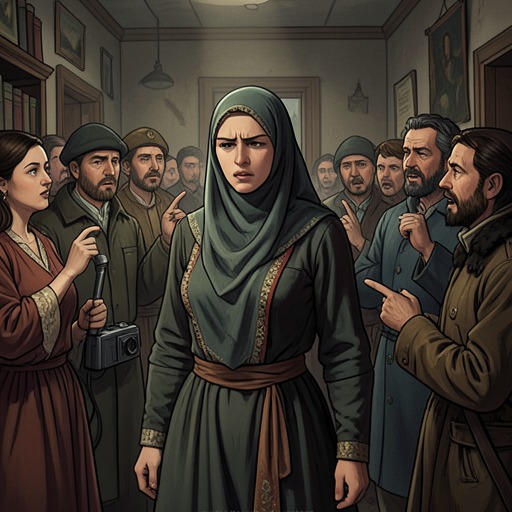
The clearest confrontation between the army and the household comes when court officials arrive with green-uniformed gendarmes, led by the chief of the Lviv gendarmerie, and order Felix to be handed over. Their demand follows the household’s effort to feed him relentlessly and make him too large to fit into an illusionist’s hat. Stefania and Petro have pressed food on him at meals and between them, even waking him at night to eat; his swollen size becomes their improvised defense against the state’s effort to reclaim him.
Petro addresses the visitors with a warning not to risk the reputation of the imperial-royal army and invites them to look at the conspicuously plump child. He argues that Felix would not fit inside a sauerkraut barrel, much less an illusionist’s top hat. The household then stages the test: a barrel and hat are produced, Stefania ostentatiously tries to fit Felix’s calf into the barrel, and the hat sticks on his fat cheeks. The absurd demonstration turns the child’s body into evidence and makes official procedure look ridiculous.
The small, dry-built general responds in fury, cursing his subordinates in German. Adèle intervenes in a white, bare-shouldered dress, wafting violet perfume toward him and offering freshly cellared Lithuanian kvass. The scene makes her intervention distinct from Petro’s performance: where he confronts the demand with a comic physical demonstration, she manages the general through hospitality and social poise. He clicks his spurs, salutes, and leaves with the officials and soldiers. Felix is saved, though Adèle then declares that he must be put on a diet, since she does not intend to live under the same roof as an obese child.
Imperial Force and Its Limits
The army’s authority in the episode is real: its officials arrive with gendarmes and a senior commander, empowered to demand that the household surrender Felix. Yet the demand does not conclude in an arrest or a seizure. It is defeated through an invented practical obstacle, a child’s body altered by overfeeding, and Adèle’s ability to defuse the general’s anger. The outcome is a temporary domestic victory achieved not by matching military force but by manipulating what the visitors can see and how they are received.
The novel places this episode beside broader political language that casts imperial intervention as benevolent. In conversation at the Anger household, Ernest Thorn invokes violence in the Philippines, British ambitions in South Africa, and the suppression of the Boxers in China, while Petro relays Russia’s insistence that its intervention in China is not a war but an effort to crush a revolt with good-neighborly intentions. Thorn’s irony questions the claim that great powers act from love of their neighbors. Although these international arguments do not describe the army’s role in the Felix episode, they sharpen the novel’s attention to how power presents coercion as protection.
The army thus stands between two images of the monarchy: the protector praised in the birthday article and the armed authority that arrives at a private home to take a child. The soldiers’ retreat does not dissolve imperial power; it exposes a limit to its reach in this particular encounter. The novel’s contrast between public loyalty, street-level intimidation, and the household’s improvised resistance makes the supposedly stable imperial order feel contingent rather than invulnerable.