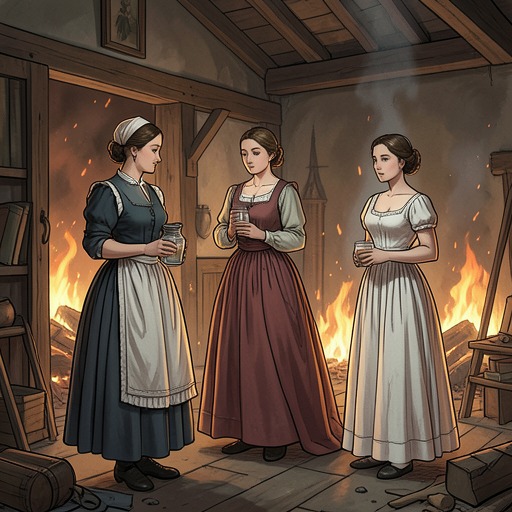
Deux arbres aux troncs enchevêtrés
Felix AustriaThe image of two trees with entwined trunks, expressed as “Deux arbres aux troncs enchevêtrés,” becomes the central figure for Stefania’s bond with Adèle. It carries two incompatible meanings: to Stefania, it confirms a promise of lifelong service and mutual dependence; to Josef and, belatedly, Doctor Anger, it describes an attachment whose closeness prevents both women from growing freely. The image’s force lies in that conflict: what one person takes as love’s duty can be another’s warning about entanglement.
The Doctor’s Deathbed Charge
After Doctor Anger’s death, Stefania recounts to Josef the doctor’s last moments: she had sat beside his bed, listening to the terrible rattle in his chest as he told her to think of Adèle and her own life, warned that the path would be hard, and commanded her to serve Adèle. His words set the image of intertwined trunks beside an instruction, making the metaphor appear to authorize Stefania’s continued devotion.
Josef reacts with surprise and asks whether Stefania is certain of what she heard. She insists that she heard him clearly and does not deceive herself. Josef offers a competing interpretation: when two trees entwine, they prevent each other from growing. Stefania does not understand the correction as he intends it. She holds to the words as spoken and pushes back against any suggestion that serving Adèle is easy. The same image therefore opens a disagreement over whether fidelity means enduring dependence or recognizing its cost.
A Bond That Organizes Stefania’s Life
Stefania later describes Felix and Josef as the two axes around which her life has unfolded. Felix hides in corners from the outside world; she sees herself in that retreat, slipping into refuges, refusing to claim anything as her own, and fleeing herself. Josef, by contrast, can draw her out of hiding with a look or simply his presence. The image of entwined trunks gives this inward account a relational counterpart: Stefania understands herself not as separate from Adèle, but as bound to her through a connection that structures what she believes she must do.
That bond is also an exposure. Stefania fears being seen by the wider world as a servant who has overstepped her place: someone who has taken a strange child as a son and become attached to a priest. She expects people to misread her care for Felix and her feelings for Josef, measuring her by their own assumptions. Against that imagined public judgment, she insists that no one could express in words the light and purity of her world or the contact between open hearts. The tree image helps explain why she experiences the bond as something deeper than a household role, even as her fear of being judged keeps her from standing securely outside that role.
Service, Love, and the Enchanted Prison
Ernest Thorn gives the household’s unequal arrangement a theatrical, almost enchanted description. He argues that each person receives the kind of love they seek: one is born a mistress, another a servant, and the servant would not be happy if freedom came from the mistress’s hands. The mistress’s love, in this account, consists in receiving service and thereby making the servant happy; the servant becomes mistress in an enchanted palace that is also a ship, a distant island, a Venetian palazzo, or a Roman temple. Yet Thorn immediately qualifies the fantasy: the palace can also be a terrible prison, as love itself can be.
His catalogue of ways to love—through food, stone, or prayer—connects Stefania’s practical service to the other forms of devotion in the story. He looks at her intently, and she is certain he is speaking of Josef. The passage does not simply resolve the image of the trees; it makes its ambiguity sharper. A relationship can feel like a whole world, even a palace, while its structure leaves one person dependent on another. The image of entwined trunks stands between these possibilities: it evokes intimacy, but also the loss of room to grow.
The Household’s Material Pressures
The metaphor appears amid more immediate pressures on the Anger household. Thorn explains the obligations, debts, interest, and mortgage weighing on the family, adding that even selling the Colosseum cannot save him. Petro points out that Felix can slip into the smallest spaces and pass through places that seem inaccessible, including churches where there are valuable objects. Adèle then accepts Thorn’s proposal and rises to take his hand.
At that moment, Stefania suffers one of her crises. Her sight clouds, her ears ring, and her skull feels as if it is painfully bursting. She says she no longer knows who she is or what drives her, and describes herself as no longer belonging to herself. Her breakdown interrupts the scene of negotiation and makes the stakes of the entwined-trunks image bodily and immediate: Adèle’s decisions, the family’s dependence on Felix, and Stefania’s service converge in a moment when she feels unable to act as an independent self. The image does not cause the crisis, but it names the relational pressure under which Stefania understands her own life.
The Doctor’s Recognition and Reversal
In a letter to the pastor, Doctor Anger admits that he had been wrong about Stefania’s place in the household and had resisted recognizing the pastor’s objections because he feared admitting fault. He says he neglected both Stefania and Adèle while absorbed in his medical practice, leaving one at the mercy of the other. Though different in origin and destiny, and assigned opposite roles in life, the two women were both pliable and gentle; their roots grew in soft, fertile soil until their trunks became entwined.
The doctor’s account changes the emphasis of the metaphor. What Stefania has carried as a deathbed command to serve Adèle, the doctor now recognizes as the result of his own neglect and a damaging arrangement disguised as altruism. He fears the consequences and says it is too late to repair the harm. As he lies dying, Stefania watches over him, not, he suggests, because she has been taught to choose freely, but because she has learned no other way to act. He accepts the pastor’s offer to take her in, praises her skill and tirelessness in cooking and managing a household, and hopes she will find support for her “deformed trunk” within herself.
The final recollection delivers the decisive reversal. Doctor Anger repeats that Stefania and Adèle are like two trees with entwined trunks, but now tells Stefania to leave Adèle. The repeated image has not changed; its interpretation has. First used to bind Stefania to service, it becomes the reason to separate: a recognition that love and care need not require the erasure of one person’s independent life. Stefania’s later sense of responsibility remains formidable—Adèle may wither without her, while Josef has his own vocation and a sick wife, and Petro and Felix also depend on her. The image therefore offers no easy escape. It gives the story a precise form for the conflict between devotion and freedom, and for the painful possibility that preserving a bond may require refusing the role that has kept it intact.