Ivanka
Felix AustriaIvanka, the wife of Josef, is both a neglected presence in a priest’s household and a woman with vivid enthusiasms of her own. Her account of recurrent convulsions reveals how her father arranged her marriage in hopes of quieting what he feared was a demon, while her shabby home and desperate longing for company show the limits of that attempted cure. Her collapse in public brings the threat of her illness into the open, but Adèle insists that she is alive and claims to have known what to do.
Identity and Household
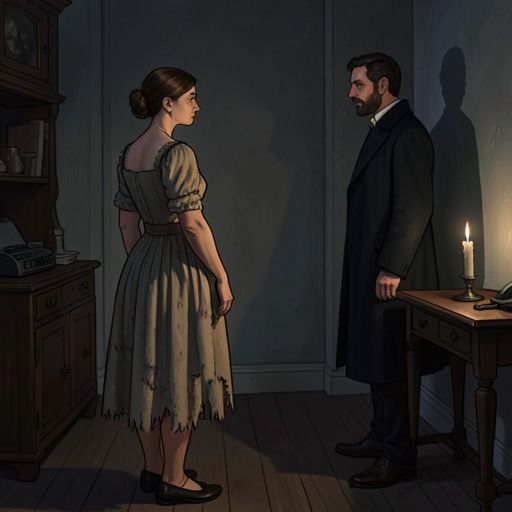
When Adèle and Stefania visit, Ivanka appears at the door in the same dress she had worn on an earlier visit. Her heavy-lidded eyes, damp-looking, freckled skin, and badly undone braid make her seem exhausted and unwell. The disrepair outside continues indoors: the courtyard is black with dust and strewn with rotting boards, old buckets, and other refuse, while blind, emaciated kittens mew beneath one of the heaps. The room that serves as both salon and bedroom contains a chest crowded with old newspapers, postcards, and boxes of accumulated odds and ends.
The disorder is not simply a matter of Ivanka’s inability to receive visitors. She explains that Josef makes coffee, prepares food when he has time, and takes care of the house, but that he is rarely available. He spends much of his time at the penitentiary chapel, returns late and nearly exhausted, and brings home either food from the prison kitchen or whatever people give him. Ivanka says she eats what he brings, while he leaves again in the morning before she wakes. She has asked him to address the dirt and disorder; he dismisses such concerns as superficial and tells her instead to pray more, get fresh air, or visit institutions such as the home for the elderly and infirm or the girls’ orphanage.
The scene makes visible a sharp mismatch between the priest’s devotional work and the domestic life his wife must inhabit. Josef’s service outside the home does not translate into attentive care within it: he is the one who prepares food and maintains the house when he can, yet his absences leave Ivanka isolated amid the neglect. Her distress centers on an everyday need for a livable home and welcome company, while the advice she receives redirects her toward prayer and charitable visits.
Marriage, Illness, and Confinement
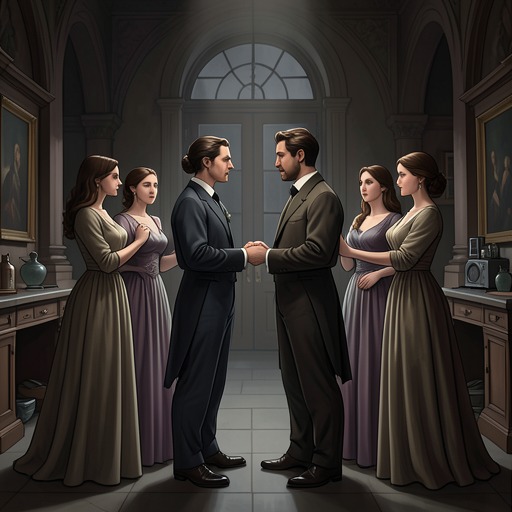
In her account to Stefania, Ivanka explains that her father agreed to her marriage to Josef despite his youth and lack of a beard. He trusted him, she says, and expected the marriage to be steady and free of unwelcome surprises. Josef accepted the wedding gifts, which included Hutsul furniture, tiles, and dishes, and the couple settled into an ordinary life. This description of the marriage as dependable sits uneasily beside Ivanka’s present loneliness and dissatisfaction: security has not provided the full life she once imagined.
Ivanka recalls that her father feared her illness. When convulsions twisted her body, her mother held her head so that her tongue would not slip into her throat. Her father, by contrast, turned pale and left the house; he then read the psalter over her through the night. He believed that someone entered her, and married her to Josef in the hope of calming the demon. Her story therefore distinguishes the family’s religious interpretation from the concrete experience of an illness that required physical care. It also reveals a marriage made partly in response to her father’s fear, rather than solely from Ivanka’s own hopes.
The marriage has not answered Ivanka’s longing for a fuller existence. She remembers imagining that leaving her mountain village for the city would open a more abundant life, but finds the reality boring. Her question to Stefania about why she did not leave with Ernest Thorn and take the boy as far as she could see carries a forceful awareness of escape as a possibility, even as Ivanka remains where she is. The conversation gives her dissatisfaction an outward direction: she can recognize the limits of her own life and ask why another woman has not fled hers.
Fashion Albums and a Moment of Connection
Despite the grim surroundings, Ivanka possesses a collection that she presents as a treasure. She excitedly brings out albums filled with pasted-in ladies and copied flowers, along with images of dresses, hats, fans, and other fashionable objects. Her knowledge is precise: she can explain modern cuts and describe the details of gowns in satin, silk, and gauze, transparent tunics decorated with sequins and rhinestones, trains, lace, embroidery, hats, fans, and corsets. She points out carved cameos, jewel boxes, powder boxes, and reticules for the theatre, and lingers over elaborate ornaments for the hair.
The ornaments turn the albums into a world of imaginative detail: an emerald lizard chasing an emerald fly, an iris of glass mounted on a three-pronged gold comb, swallows, anemones, viburnums, and a flower set on a curved cherry branch. Ivanka’s delight in describing them is almost bodily; she is pink with pleasure and handles the images as if savoring favorite sweets. These pages give her a field of knowledge and pleasure distinct from the neglected household that surrounds her.
Adèle, initially silent, grows increasingly interested as Ivanka displays the collection. Their attention briefly meets in a shared appreciation of fashion. When Adèle becomes absorbed enough to approach Stefania and sharply pull the dragonfly comb from her hair, Ivanka’s display has done more than fill an awkward visit: it has created a moment in which Adèle responds to her enthusiasm. Ivanka is not merely an object of pity or a distressed priest’s wife; she is also an informed presenter, able to command attention through what she loves.
Crisis and Aftermath
Ivanka’s illness returns as the visit continues. When the icy wind rises, Stefania fears she will catch cold. Ivanka begins breathing with difficulty, groaning and rasping; her face turns gray and her eyes look terrifyingly empty. Stefania takes her by the hand and leads her back to the terrace, trying to redirect her attention by pointing out that the sheets resemble sails at sea. This episode connects the earlier account of convulsions to a bodily crisis witnessed by someone outside Ivanka’s family.
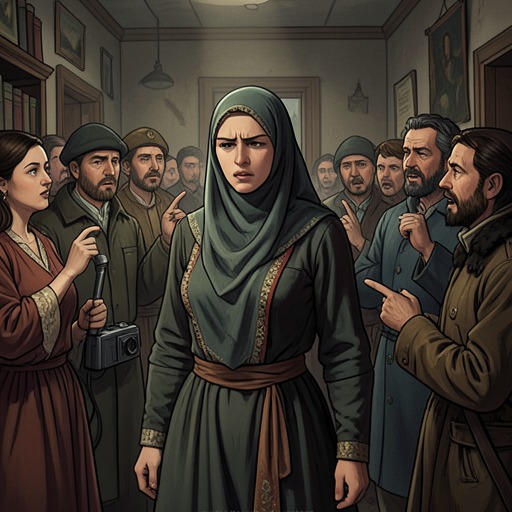
Later, at a gathering, Ivanka again begins to groan and rasp. Her eyes protrude, her skin turns gray, and her tongue hangs from her mouth before she falls rigidly to the floor and goes silent. The people around her react with horror; one woman calls for Ivanka to be beaten. The scene makes her vulnerable body the focus of a crowd’s fear and judgment, rather than a private emergency met with patient care.
Stefania asks whether Ivanka is dead. Adèle strikes Stefania across the face and answers that Ivanka is alive, thanking God; she says that, as a doctor’s daughter, she knew what had to be done. The assurance changes the scene’s immediate meaning: Ivanka’s apparent death is not confirmed, and Adèle presents her intervention as having preserved her life. Adèle then turns her anger on Stefania, accusing her of ruining the celebration and of inventing a lie. The surviving evidence leaves Ivanka’s longer-term condition unresolved, but establishes both the recurring danger of her convulsions and the force with which others interpret and contest what happens to her.
Narrative Significance
Ivanka’s circumstances bring together religious interpretation, domestic labor, and the social treatment of bodily difference without allowing any one of them to explain away the others. Her father’s fear gives her convulsions a demonic meaning; her mother’s hands-on response addresses their immediate physical danger; and her husband’s priestly vocation coexists with a home whose disorder and isolation she repeatedly protests. The narrative presents these accounts side by side, making the difference between spiritual explanations and practical care part of Ivanka’s lived situation.
Her fashion collection further complicates the image of an incapacitated or neglected woman. In the crowded, dirty household, Ivanka can speak with expertise about changing styles and minute ornamental details. The albums let her exercise discernment and share pleasure, briefly drawing Adèle into a world of satin, glass, gold, and vivid decorative invention. That moment contrasts with the later crowd’s response to her convulsion, when her body is treated as a frightening spectacle and a target for punishment.
Ivanka’s story is shaped by confinement and interrupted possibility: her marriage was intended to calm an illness her father feared, city life has disappointed her, and the prospect of leaving is voiced as a question to Stefania rather than an achieved escape. Yet she is not reduced to the conditions that restrict her. Her descriptions of the albums, her candid complaint about domestic neglect, and her recognition of another woman’s chance to depart give her distinct forms of knowledge and speech. The final crisis leaves her immediate survival affirmed by Adèle, but her isolation and illness unresolved.