Josef Ridny’s Return to the Anger Household
Felix AustriaJosef Ridny’s return to the Anger household reunites Stefania with a figure from her earlier life and changes the emotional temperature of an ordinary visit. He arrives as a priest, accompanied by his shy young wife, but it is his recognition of Stefania—and the tenderness she discovers in his altered gaze—that makes the encounter decisive. A carefully prepared welcome gives way to exposure, grief, and the sudden sense that an old connection remains alive.
The Visit and Its Arrival
Before the visitors enter, Stefania is occupied with the small duties of hospitality: arranging flowers, straightening the tablecloth, and polishing the liqueur glasses. Adèle, by contrast, is unusually excited. She rushes to Stefania, grabs her shoulders, and turns her toward the entrance so abruptly that Stefania nearly drops a glass. The domestic scene is thus disrupted before the returning guest is even identified.
The first visitor Stefania sees is Josef’s wife, a petite young woman with a long light-brown braid emerging from a cotton headscarf. Her modest dark-blue flannel dress and flushed face contrast with the room’s polished furnishings. She looks around in wonder at the peacock feathers, purple satin sofa, silverware, lacquered cabinets, and Petro’s wedding portrait of Adèle. Yet her most unguarded admiration settles on Adèle herself: she studies Adèle’s face, clothes, hairstyle, and dragonfly hair comb, then exclaims over the scent of jasmine. Josef gently draws his wife toward him and strokes her head, a quiet gesture that frames the couple’s arrival as affectionate and protective.
Recognition of Josef Ridny
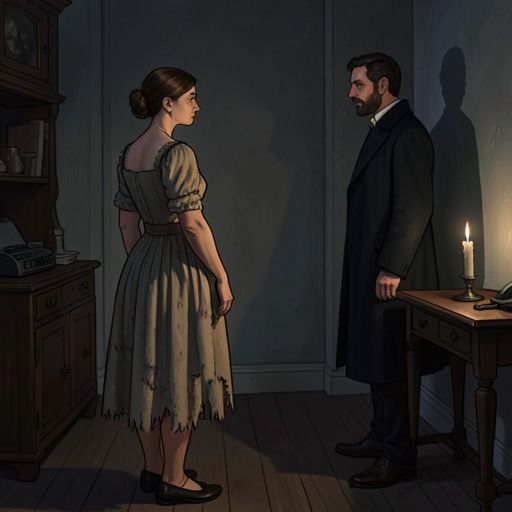
The encounter lasts only a few moments before Stefania’s attention shifts from the young wife to the tall, slightly stooped man beside her. The sight of him, together with the jasmine scent in Stefania’s hair, brings on a sudden wave of nausea. She understands at once why Adèle had been so emphatic: the visitor is Josef Ridny, whom Stefania knew in the past as a medical student and pupil of Docteur Anger.
Stefania recognizes the familiar details of Josef’s face: abundant dark curls, pale skin marked by smallpox, large soft ears, a narrow unfinished-looking chin, and a thin mouth. The narration dwells on his disproportionate nose, making recognition a deliberate inspection rather than a simple announcement. But the decisive difference is not in his features. His eyes are the same, Stefania realizes, while the look in them has changed.
The Changed Gaze and Stefania’s Response
Under Josef’s gaze, Stefania’s defenses fail. She compares herself to a speck of dust in a July sunbeam and imagines her carefully assembled protections collapsing like a rusted suit of armor. The images make the reunion a bodily experience of exposure: she feels defenseless, wounded, and laid open, like an oyster removed from its shell. Her comparison to the oysters Docteur Anger received from Ostend brings the household’s remembered material world into the moment of emotional vulnerability.
Yet the exposure does not feel like an assault. Stefania does not want to hide from Josef. His look seems tender, reassuring, and warm, accepting her without a degrading or sexualized implication. The sunbeam does not drive the dust away or consume it; it passes through and illuminates it, allowing it to remain exactly what it is. This image gives the encounter its central distinction: Stefania is seen completely, but not condemned or forced to become someone else.
The recognition also draws grief to the surface. Stefania is overwhelmed by the goodness, docility, and serenity she senses in Josef, and tears rise before she has time to think. She sighs, only then realizing that the parlor has fallen silent while the two of them have been looking at one another. The room’s silence makes their mutual recognition visible to everyone present, even though its meaning remains concentrated in Stefania’s experience.
What the Reunion Reveals
Josef breaks the silence by calling the visit a pleasant surprise. He had expected to see Adèle because he and Petro had spoken about visiting her, but he had not expected Stefania to be there. He had assumed that she was long married and had left the household. His surprise confirms how much time has passed since he last knew her, while his use of the formal address keeps their exchange within the manners of a public family visit.
Josef also remarks that it is wonderful that Stefania and Adèle remain inseparable, adding that Docteur Anger would have been happy about their fidelity. His words place Stefania’s continuing presence in the household within the frame of loyalty to Adèle and to her father’s wishes. Petro then intrudes on the moment in his characteristically blunt fashion, joking that Stefania cannot make up her mind to make a man happy and that the family feels almost criminal for keeping such a treasure as though in prison. The exchange exposes a contrast between the room’s light social talk about Stefania’s unmarried life and the private force of her reunion with Josef.
As Adèle raises her tulle sleeves, the young wife’s attention returns to her, redirecting the visitors’ wonder toward the household’s hostess. The interruption restores the visit’s social surface after the suspended silence. But for Stefania, Josef’s return has already transformed recognition into an encounter with the past: the man she remembers is present again, and the kindness of his changed gaze has left her more exposed than any spoken confession could have done.