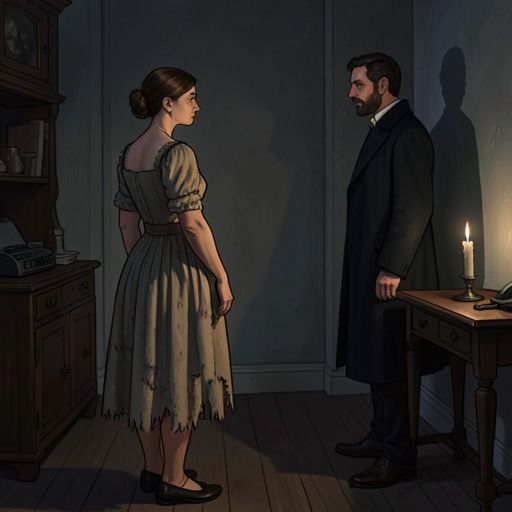
Josef and Stefania’s Pond Accident
Felix AustriaJosef and Stefania’s Pond Accident is a near-drowning at the pond of Romaszkan, where the ordinary gestures of a boat landing become a frightening bodily struggle. Josef first helps Adèle ashore with polished courtesy, then loses his footing as he takes Stefania’s hand and pulls them both into the water. He inadvertently drags her down as she fights the mud and weeds; the rescue leaves both drenched and frightened, while Adèle can barely contain her laughter. The scene makes their recurrent physical misfires consequential: this time the collision of bodies threatens life itself.
Setting and Circumstances
On a languid afternoon in late May, Stefania and Adèle row in a boat, trying to remain as long as possible in the sheltered alcoves beneath drooping willow branches. Adèle admires the beauty of the place but imagines replacing Stefania in the boat with a blond, moustached man. She is then infatuated with a Hungarian corporal of the imperial-royal hussars, whom she has seen twice on walks along Sedelmeyer Street. His cold gaze, military bearing, purple shako, and cavalry sabre attract her; so does his bad reputation as a gambler who has lost absolutely everything at cards. Her romantic fantasy supplies a comic contrast to the danger that follows, but the accident itself centers on the unsettled physical dynamic between Stefania and Josef.
The Fall into the Pond
When the boat reaches the shore, Josef leans over it like a bridge and helps Adèle descend gallantly. He then offers his hand to Stefania. She is surprised by the confidence in his gaze, but the moment of apparent steadiness lasts only until she touches him: Josef suddenly loses his balance on the wet clay bank, instinctively clutches her forearms, and they tumble together into the water. The boat overturns over them, followed by darkness. A courteous landing becomes an abrupt reversal, and contact that might have signaled support instead precipitates their fall.
Struggle and Rescue
Stefania remembers the submerged moments only indistinctly. She was probably thrashing with all her limbs and swallowing water in panic, while weeds and mud tangled around her arms and prevented her from moving. Josef, rather than helping her stay afloat, pulled her toward the bottom and nearly strangled her. The account attributes no deliberate attack to him: the danger grows from his loss of balance and their entanglement, then intensifies in the water, where Stefania cannot free her arms and Josef’s grasp becomes a further threat. The episode’s remembered fragment is physical before it is explanatory—darkness, blocked movement, swallowed water, and the force dragging her down.
Aftermath and Narrative Significance
Stefania begins to recover her senses only once they are in a carriage traveling along the main avenue. Josef is as pale and frightened as she is; Adèle alone can scarcely hold back her laughter. Her response gives the aftermath a sharp tonal split: for the two people who have just nearly drowned, the danger remains visible in their pallor, while for Adèle the spectacle is nearly comic. The carriage marks their return from the obscured water to the ordered grounds, but not a resolution of the awkwardness between Stefania and Josef.
After the accident, Josef disappears for a time once more. When he eventually reappears, it is for the last time Stefania sees him. The pond episode therefore falls within a recurring pattern of mishap, separation, and return, but its stakes are more grave than a social embarrassment: Stefania is nearly drowned by the person whose hand she has just accepted. The scene’s force comes from the gap between the gesture’s promise of assistance and its consequence, and from the contrast between the submerged terror and Adèle’s barely suppressed laughter.