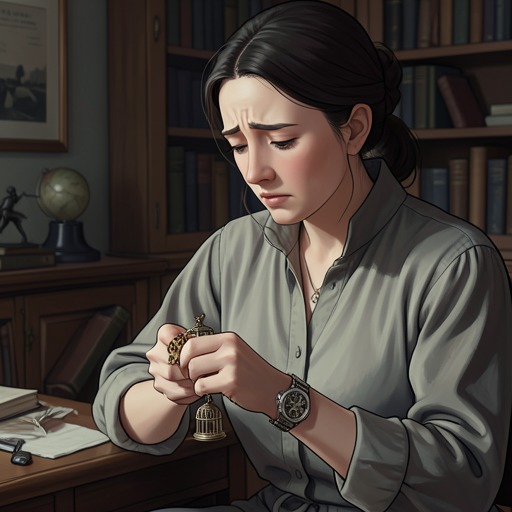
La montre Tissot du docteur Anger
Felix AustriaLa montre Tissot du docteur Anger is an heirloom, a precise mechanical instrument, and the material focus of Stefania Tchornenko’s unspoken love for Doctor Anger. Passed from father to son and kept close to the doctor’s body, it becomes, in Stefania’s hands, a substitute source of warmth and security. Its false appearance in her apron pocket exposes her to an accusation of theft; its eventual loss from a secret pocket near her heart marks a release from the illusion she had built around it.
Inheritance and physical form
Doctor Anger keeps the round Tissot in the right pocket of his waistcoat, though he is left-handed. A fine gold chain connects it to a button, and a tiny birdcage charm hangs from the chain. The watch had come to him from his father on the day they said farewell, as the Swabian families of Neudorf set out in a westward migration toward the Atlantic or eastward toward the Russian Empire. Its private family history thus begins with separation and departure.
The case bears deep scratches and almost imperceptible, web-like lines that remind Stefania of fingerprints. She studies the object closely: its enamel dial, black Arabic numerals, fragile disc that counts the seconds, fine garnet-colored hands, and convex glass. She knows the minute inscription, “Ch. F. Tissot & Fils Le Locle,” and imagines the gold mechanism with its fifteen jewels and interlocking wheels as a guarantee of precision and reliability. The watch’s delicacy is not merely decorative: it is the physical detail through which Stefania makes the object intimate.
A refuge made of metal
When Doctor Anger lets Stefania hold the watch, she feels warmth from its mechanism, pulsing in her hands like a small, valiant heart. She presses it against her cheeks, forehead, or the hollow at the base of her neck. The contact gives her calm, and the watch seems to contain the love for Doctor Anger that she cannot express directly. In her imagination, that feeling vibrates within the solid yellow metal, then surges outward like water escaping its banks.
The comfort is brief and sharply unequal. Doctor Anger reaches for the watch because he is late and preoccupied with the day’s unfinished business. Stefania, by contrast, feels that all his work matters, while her own labor—taking out rubbish, gathering potatoes, mending his underwear—keeps her submerged in daily disorder. She longs for only a few more minutes with the warm Tissot and believes that, nourished by it, even those ordinary tasks might become different. His hand taking it back therefore feels to her like the removal of a piece of love. She sometimes wants to strike or bite that hand, then recoils from her own impulse into helplessness and apathy.
The accusation at school
The watch enters a public scene when Doctor Anger has arranged for Stefania and Adèle to attend the Queen Hedwig Girls’ School. Stefania remembers the admission as another kindness she owes him: an orphan from a poor Ruthenian family might otherwise never have been taught to read or write her name. She would rather have stayed near him at home, bringing coffee and tending to his work, than sit among the carefully dressed girls at school.
There, the watch falls with a crash, and its birdcage charm rings against the floor. A girl declares that Stefania stole it from her father. The charge turns Stefania’s private attachment into a matter of public judgment. Sister Apollinaria returns the Tissot to Doctor Anger; its glass is crossed by a barely visible diagonal crack, but its mechanism still keeps time accurately. Doctor Anger then remembers that he himself put it in the pocket of Stefania’s apron that morning, mistaking the apron’s color for his waistcoat’s. The apparent evidence of theft is thus produced by his own absent-mindedness, not by Stefania taking the watch.
Loss and release
Much later, the Tissot appears among precious objects spilling from a jar as fire licks around them. Stefania recognizes every scratch on its case and acknowledges that it should have been buried with Doctor Anger. Instead, she had continued to carry it in a small secret pocket close to her heart. She had not noticed when a deft little thief took it from her, because she was absorbed in the arabesques of her own illusions.
The discovery changes the watch’s meaning. Its disappearance makes Stefania feel light: the bird has escaped its cage, and her soul is free of a weight. The birdcage charm had once made the watch a treasured emblem of the warmth she sought from Doctor Anger; in the final image, the bird’s escape reverses that association. The object that once seemed to shelter her love has become inseparable from the burden of holding it. Its loss does not undo the care and longing bound to it, but it gives that longing a different ending: release rather than possession.