Nouveau Monde
Felix AustriaThe Nouveau Monde is both a concrete destination across the ocean and an image of release from the cramped, decaying world of the Austro-Hungarian Empire. Velvele imagines it as a place of freshness and possibility; for Stefania, the prospect becomes a way to leave the life in which others have trained her to serve and to begin one of her own.
An imagined escape
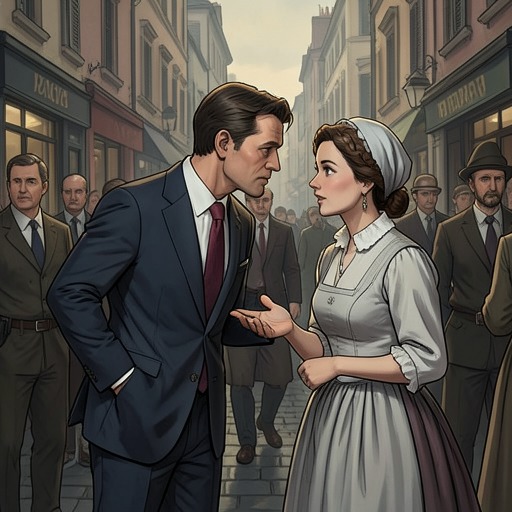
Velvele presents emigration as an answer to a world closing in around them. The city feels narrow, the empire old and misshapen, and its damp, foul-smelling cellars seem to press in from every side. He anticipates upheaval—a possible earthquake, volcanic eruption, or great fissure splitting the earth—and urges Stefania to escape with him to a place where everything breathes novelty and freshness. His apocalyptic imagery makes departure seem at once practical and almost visionary: they might get away before the ground beneath their lives breaks open.
The plan answers an earlier desire Velvele voiced to cross the ocean. He says there is not enough room or light at home and wants to test the Earth’s roundness and travel through wide-open spaces. His mother and Stefania’s friends dismiss the proposal as an attempt to provoke his mother, who had already intervened to keep him from military service. The tension between their disbelief and his increasingly specific preparations marks the shift from a fantasy of departure toward a possible journey.
A proposed partnership
Velvele frames the Nouveau Monde not simply as somewhere to flee, but as the setting for shared work. He has saved a small amount of capital, although some should be left for his mother, and believes he can sell and arrange things because he senses what people want. Stefania, whose cream éclairs have drawn attention even at the fish market, would cook. He imagines them as capable partners and proposes that the restaurant bear her name. The offer directly contrasts her narrow training as a servant with the possibility of a livelihood built around a skill of her own.
The proposal takes material form in two tickets aboard the Taormina, a transatlantic ship built by A. Stephen & Sons. Velvele says they are to leave Hamburg on March 13; the vessel is intended for six hundred third-class passengers, and he assures Stefania that her place will be in the women’s section. He acknowledges that he ordered the tickets without first asking her and says she may refuse. His insistence that the offer is professional and honest, together with his request that she take time to consider it, leaves the plan both concrete and still dependent on her choice.
Departure and unresolved costs
At the novel’s close, Stefania imagines herself sailing through ocean waves with Velvele, fulfilling the prediction associated with Ernest Thorn’s gift of a paper boat. The Taormina and its third-class accommodation recur in this final prospect, along with the assurance that she will travel in the women’s section. The Nouveau Monde has thus moved from Velvele’s expansive talk into Stefania’s envisioned future, but the passage presents a departure rather than an arrival: it does not establish what becomes of the restaurant or whether they reach their destination.
The envisioned escape does not promise an effortless rebirth. Stefania expects her dislocated trunk to hurt at first, then to regain some straightness as the wounds heal. The image makes the journey’s hope inseparable from bodily pain and recovery. The Nouveau Monde signifies room to choose and work differently, but the ending holds that possibility beside the injuries she carries, without declaring them already repaired.