Petro and Adele's villa
Felix AustriaPetro and Adèle’s villa is the ornate, uncanny house Petro builds in place of the Angers’ old wooden home. Its wavering silhouette, concealed stone figure, and glass ceiling map a private imagination onto the street, while Stefania’s everyday work inside it keeps that dreamlike architecture in contact with soot, cooking, and the uncertain light of an oil lamp. The villa is not merely a setting: it makes the boundary between home and spectacle, permanence and vanishing, feel unstable.
Site and Origins
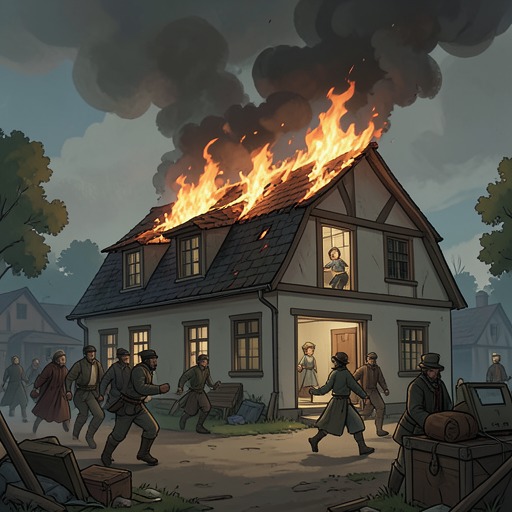
Stefania looks at the villa from Lindengasse and says she has still not grown used to it. Petro built it where the old wooden house had stood, a house the doctor repaired after the fire. Its replacement therefore carries a visible break with the family’s former dwelling, even as the site preserves that earlier history. The new building rises not on untouched ground but over a domestic past marked by fire and rebuilding.
The villa’s origins reach back to Petro’s early career. The doctor encountered him on the twentieth anniversary of his wife’s death, after hearing of a young master who had returned to Stanislaviv from the Academy of Fine Arts in Vienna. Petro had been living in a rented wooden house on Siemiradzki Street: its roof leaked, rats scurried beneath the floor, and a gasometer stood opposite. Yet it also had unusually large windows that served as studio windows and a garden that ran from untamed growth into orderly greenhouses, orangeries, flower beds, and urban vegetable plots. The contrast between that improvised home and the villa’s elaborate design underscores the scale of Petro’s architectural transformation.
The villa also stands within a changing city. Wooden dwellings burn or collapse as brick houses from the modern Ourman brickworks take their place. New construction may display towers, arches, columns, ironwork, plaster ornament, mosaics, and colored glass; decoration alone does not make Petro’s house unique. What distinguishes it is the impression that its forms do not settle into an expected, stable shape.
Architecture and Ornament
The building appears to Stefania like a gigantic snail shell found in a vegetable garden. Although it ought to be rectangular, its blurred, undulating contours and projections suggest a reflection seen in a distorting mirror. Narrow windows sit beneath the slate roofs’ projecting collar, and glossy ceramic tiles in reddish brown, gray-green, and blue wind around windows and doors, continue across the main walls, and decorate columns, cornices, and arches. The ornament does not simply frame the building: its winding movement seems to animate the architecture.
The villa becomes a draw for passersby. For some time, strange creatures have been emerging from the ground, and Stefania has grown accustomed to noticing hats and top hats, lace parasols, and elegant canes turned toward the windows while she kneads dough or strains a herbal decoction. The ordinary work of maintaining a household takes place under a public gaze. Compared with the city’s fashionable but properly grounded brick houses, this one seems to Stefania like a mirage about to dissolve, a conjuring trick whose secret no one has solved.
Petro describes the city as an underwater palace. In his account, the villa’s patterns are sea currents and algae stems, while its window openings resemble fish heads and deep-sea creatures that protect the inhabitants. He had dreamed of becoming a navigator, though he does not know whether the sea he imagined exists or is only a fable. Stefania counters his description by imagining not a palace beneath the sea but a sunken ship. Her alternative captures the house’s double character: it is both a fantastical dwelling and something that seems already lost beneath the element it evokes.
The Hidden Figure and the Glass Ceiling
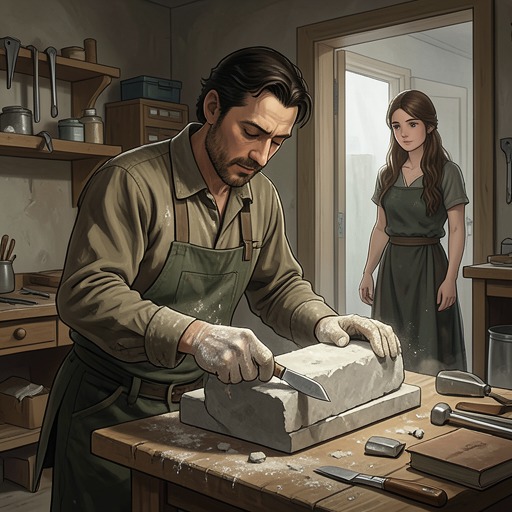
The villa conceals a feature that its curious spectators do not suspect. Behind the chimney, across the street and partly hidden by the crowns of the lindens, a carved sandstone woman sits with her gaze raised toward the sky. Her hands reach forward in a posture that could be waiting or prayer; her hair is loose and untamed. Petro uses the shape of the stone to form a hollow at the back of her neck and upper back, and calls her the jar-woman. At moments when the sunlight is not too bright, the pale sandstone takes on a pink tint, like blood moving beneath skin. The stone figure introduces a suggestion of life into the house’s otherwise carefully made illusion, while the tree cover keeps that suggestive image private.
Petro watches the figure from below through the glass roof of the salon, itself another of his architectural whims. Part of the salon ceiling is colored glass, which Petro says represents a star map. Shades of blue, divided by copper, create constellations among pieces of gold and transparent glass. The design includes a comet with a fiery tail and planets in blue, violet, near-black, red, speckled brown, and gold. Sunlight casts fantastic patches across the salon’s lacquered, multicolored furniture; pale moonlight makes the ceiling seem ghostly. The room turns the sky into an interior surface, joining the concealed figure above the roof to the domestic space below.
Petro says the idea for the ceiling began while he was studying in Vienna. His education had been made possible by his father, who shortly before his death sold a piece of land in the village of Pasitchny, where the railway now runs. The house’s elaborate imaginative world thus has a material history: it is connected to money from a specific family transaction and to Petro’s artistic formation, not simply to an unexplained architectural fantasy.
Dwelling, Labor, and Unstable Ground
The villa’s most persistent effect is that it seems not to remain in place. As its surfaces shine and change in sunlight, merge into shadow, or recede into autumn haze, morning fog, and drizzle, the building appears to float. It seems to be going somewhere rather than sinking into the ground like ordinary structures governed by terrestrial laws. In Stefania’s perception, it rocks with the wind and the movements of lilac and linden branches, twists, and dances; it seems capable of disappearing into the air without leaving a trace. The impression does not depend on a single spectacular occurrence but returns with changing weather and light.
That apparent levitation is set against the repetitive material work of the kitchen. Stefania lights the lamp in a kitchen paved with new pale-green tiles brought from Kossiv. While the stove heats, she sweeps the floor by the light of the oil lamp, unable to tell whether she is clearing dirt or chasing scraps of darkness because the daylight is insufficient. The lamp glass is smeared with tallow, the kerosene smells foul, and the wick burns faster than usual. Recent newspaper reports about adulterated kerosene make her suspect that the household has been cheated, perhaps even by the Gaber brothers, whose role she questions. She roasts coffee beans in a tin ball placed in the stove opening and prepares salted water for oatmeal and a smaller pot for three eggs laid the previous day. The house’s visionary surfaces do not displace domestic necessity; the ordinary effort of cooking and cleaning exposes how people actually inhabit its modern, strange rooms.
Meaning and Narrative Function
The villa’s design suggests that surroundings can do more than answer practical needs. Objects need not be expensive or sublime, Petro’s thinking holds; they can extend thoughts and sensations, becoming a conversation, a question, and an answer. The house embodies that principle at an extravagant scale. Its motifs register Petro’s artistic and maritime imaginings, while its shifting appearance makes the act of seeing part of the experience: in one light it is brilliant and present, in another spectral, obscured, or nearly gone.
The house also organizes a tension between public display and hidden interior. Spectators gather outside to look, but the stone woman remains concealed from them; inside, Stefania’s practical routines proceed beneath the fantastical ceiling. The villa offers no simple choice between the rational building and the supernatural marvel. Its brick-era setting, artistic design, natural imagery, and unstable visual effects remain together, so that the house can be understood as an ambitious work of architecture and still retain the feel of a mystery. Its defining image is therefore not simply beauty or strangeness, but a home that appears to float while continuing to be swept, lit, and lived in.