Petro and Felix began to work together
Felix AustriaPetro and Felix’s work together begins as a quiet alliance around stone and drawing, first noticed by Stefania from a hiding place in the garden. Although she initially sees Petro’s attention to Felix as a way of provoking her, the work grows into a reciprocal bond: Felix learns to assist Petro, and Petro makes room for the boy’s interests. Their shared concentration alters Felix’s place in the household and gives Stefania a new, complicated reason both to resent and to welcome their closeness.
An alliance formed around stone
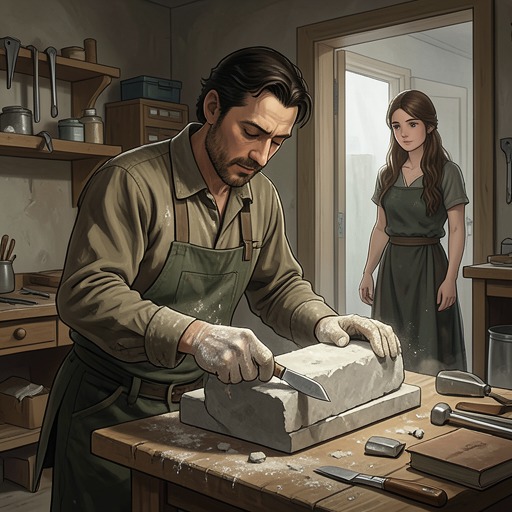
Petro’s attention to Felix begins after the child shows interest in the stone Petro is working on. When Petro draws in his upstairs studio or shapes a large stone outdoors, Felix edges closer to watch. Stefania, exhausted from her own work, has also been secretly observing Petro in the garden. From her vantage among the gooseberry bushes, she sees the stone’s discarded pieces expose a form that had seemed asleep: a boat among waves and debris, with a solitary bird at its prow. The scene makes the act of carving a gradual disclosure, as if work reveals a life already latent in the material.
Stefania first frames Petro’s interest in Felix as deliberate antagonism toward her. But she also recognizes a change in Petro when he notices Felix nearby. Bent over the stone and measuring its uneven surface with a long nail, Petro’s expression remains almost still; nevertheless, Stefania sees joyful sparks in his half-closed eyes and a softening around his moustache. Her close attention to these small signs makes the shift legible without a declaration from either man or child.
Felix becomes Petro’s helper
A few days later, Stefania finds Felix sitting on a stump beneath the plum tree. The boy has moved beyond watching: he passes Petro tools, gathers stone fragments so they will not obstruct the work, and brushes dust from the carved boat. When Petro is absorbed in carving, Felix even removes a cigarette butt from his mouth before it can threaten his moustache. These practical tasks establish the partnership through repeated attention and assistance rather than conversation.
The arrangement also gives Felix a way to approach Petro while maintaining his reserve with Stefania. Earlier efforts by Adèle to draw him close through treats, clothes, grooming, and affection had been rejected; Stefania recalls that Felix pushed away her touch and refused the shoes Adèle bought for him. The contrast is not that Felix suddenly becomes generally demonstrative, but that shared work offers a form of contact he accepts. He can participate on his own terms, with tools, stone, and drawings mediating the relationship.
From carving to shared daily routines
The work expands beyond the garden. Petro spends freely on paper for Felix, and the two often draw together, absorbed enough to bite their tongues in the same way and forget the world around them. Stefania brings them cold meat or cabbage pirozhki while they work, then watches their drawings discreetly. Food and service remain part of her own connection to the pair, while drawing gives Petro and Felix a focused activity that belongs to them together.
Their closeness becomes visible in ordinary routines. Felix begins eating breakfast with Petro—buns and milk, or buckwheat or millet pancakes—and then follows him to the studio or garden as if going to work. He remains capable of startling Stefania by curling into a knot or appearing in cooking pots or the attic, and he continues drawing a map of the city. Yet she no longer forbids the map; she finds herself anticipating new places he might add. The change is therefore not a simple conversion to conventional behavior: Felix remains unusual, but his sustained companionship with Petro makes him seem to Stefania more like an ordinary child.
A bond that changes the household
Stefania’s response to Petro and Felix is deliberately divided. She is angry with Petro, whom she believes began the relationship to spite her, and at the same time glad to see Felix accept another person’s company. That mixture carries the history of her and Adèle’s unsuccessful efforts to reach the boy: their attempts to win him over had required persistence, while Petro’s shared work opens a route that does not depend on coaxing him into physical affection. Stefania restrains her own desire to hug or tease Felix because she fears that touching him might make him flee and stop eating.
The partnership also sits within a household where Stefania’s labor is essential but her position remains unequal. She has long prepared and arranged things for Adèle and Petro, and she describes herself as giving herself through food, hoping that those she serves will eat and thereby accept her. Adèle, meanwhile, has described the shaping of Stefania’s service as an education begun in childhood and continued through a carefully maintained boundary between kindness and discipline. Against this pattern, Petro’s later gratitude to Stefania—he tells her that without her the household could not have become what it is, and calls her family—offers recognition, though it does not erase the servant role she continues to name for herself.
The work between Petro and Felix thus changes more than the use of the garden or studio. It gives Felix a durable point of attachment, makes Petro a figure of patient companionship, and forces Stefania to encounter closeness she neither arranged nor controls. Its quiet materials—stone chips, tools, paper, drawings, and shared meals—mark a new connection taking shape through attention and routine.