Raoul Koczalski
Felix AustriaRaoul Koczalski is a child piano prodigy whose performance makes musical virtuosity newly tangible to Stefania—and makes her feel painfully small beside it. At a concert Adèle takes her to, Raoul’s mastery first seems almost like a trick of will; as he plays, that amusement gives way to shame and awe.
Identity and Early Achievements
Still not fifteen at the time of the concert, Raoul has already accumulated a career of remarkable precocity. At seven he received the Paris Academy of Music’s prize; at eight he composed his first opera; and at eleven he had performed his thousandth concert. By twelve, he had played before Nassereddin Shah of Persia, who honored him as a Court Pianist and awarded him the Order of the Lion and the Sun. The sultan of Turkey and the king of Spain had also bestowed honors on him.
The scale of these achievements unsettles Stefania when she considers them together. The boy she sees is not an imposing adult virtuoso but a fair-haired, round-faced child, with light eyes, pink cheeks, and no sign yet of a moustache. His childlike appearance sharpens the contrast between his age and the public distinction already attached to his name.
The Concert
Adèle brings Stefania to hear Raoul perform. Before he begins, Stefania whispers that he looks so pinchable; Adèle rolls her eyes and jabs her sharply between the ribs with her pointed elbow. The small exchange captures Stefania’s first, irreverent response to the youthful performer—and Adèle’s brisk correction of it.
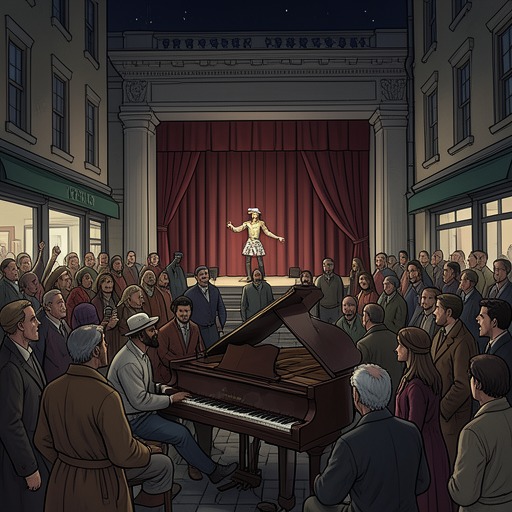
When Raoul touches the piano, Stefania’s joking response collapses into embarrassment. He plays Mozart, Gluck, and Hummel, followed by Chopin’s waltzes and the Fantaisie-Impromptu. Stefania feels she has no right to be there: the music seems so magnificent that her own presence beside it becomes, in her mind, evidence of her insignificance. The performance thus changes not only her estimate of Raoul but also the emotional terms on which she hears the concert.
Musical Mastery and Narrative Significance
Stefania initially imagines that Raoul makes the keyboard obey through his gaze, the force of his mind, and a nod of his head. She compares this apparent command to her own mandolin playing while preparing cumin sauerkraut, bringing the concert’s seemingly magical virtuosity into contact with the practical world of her cooking. The analogy is comic, but it also marks the distance between her everyday skill and the power she perceives in Raoul’s music.
After hearing him, Stefania can no longer laugh at his early honors as a child prodigy. Remembering that he played before the Persian shah and received royal recognition, she wonders how she can sit so close to the blond, plump embodiment of the Lion and the Sun and listen. The titles and decorations that once might have sounded like a list of feats now press upon her as the public measure of a talent she finds overwhelming. Raoul’s limited appearance in the narrative is decisive for this scene: through Stefania’s shift from teasing to reverence, the concert dramatizes how art can expose the listener’s self-doubt as much as it reveals the performer’s skill.