Science and Faith Boundary
Felix AustriaScience and faith meet in the novel not as a simple contest between reason and superstition, but as overlapping ways of seeking causes, healing, and meaning. Josef studies the brain, hypnosis, and medical treatment with the appetite of an investigator, yet is also drawn to miracles and religious devotion. Around him, clinical diagnoses and inherited religious practices answer different questions, while strange occurrences resist a final interpretation. The result is a boundary continually crossed but never conclusively erased.
Josef’s Medical Curiosity
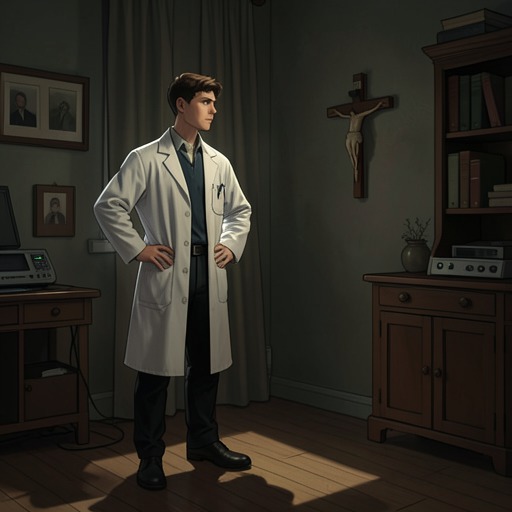
Josef is particularly absorbed by the nervous system and the workings of the brain. He speaks about them with feeling, comparing their operations to magic. His talk ranges from specialized medical terminology to the possibility of reading thoughts at a distance and dreams that come true; the abrupt movement between technical knowledge and uncanny possibility renews Stefania’s attention rather than letting it lapse into incomprehension. Josef is driven to find a key to each enigma and to uncover a logic behind the greatest mysteries.
His reading gives that curiosity a concrete intellectual context. He devours Mesmer’s works in German and French, despite Doctor Anger’s deep skepticism about Mesmer’s apparatus and theories. He follows the research of Jean-Martin Charcot and Ambroise-Auguste Liébeault, and aligns himself with Liébeault’s view that hypnosis is psychological and that the capacity for suggestion belongs, to some degree, to everyone. Hypnosis therefore occupies an unsettled middle ground: it is an object of study, but its effects can seem extraordinary precisely because they arise from ordinary human susceptibility.
Josef’s enthusiasm also exposes the historical limits of medical confidence. He is fascinated by James Braid’s experiments and by the prospect of operations performed under what was called hypnotic anesthesia. Yet Josef himself favors cocaine solutions for anesthesia, especially in ophthalmology and spinal treatment. He attributes to cocaine a remarkable range of benefits, from depression and neuroses to syphilis, alcoholism, and sexual dysfunction, and believes it has no side effects. The breadth and certainty of these claims stand beside his careful interest in research: the novel presents scientific inquiry as active and historically situated, not as a settled authority beyond error.
Hypnosis, Suggestion, and Miraculous Healing
Josef does not treat religious healing as irrelevant to the study of the mind. He is intrigued by parallels Charcot perceived between hypnosis and faith, whether religious or otherwise. In Josef’s account, the mysterious cures attributed to saints may operate by the same mechanism as hypnotic treatment. This does not simply explain away the sacred; it makes religious belief and psychological influence comparable phenomena, each capable of producing effects that invite investigation.
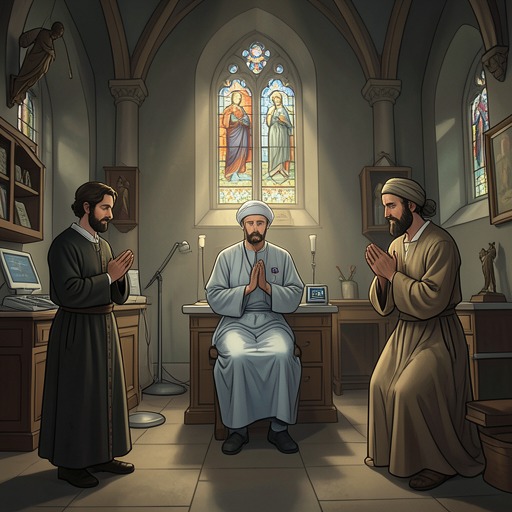
His interest becomes a daily practice at the Armenian cathedral in Stanislaviv, where he studies the venerated icon of the Virgin of Tenderness. Almost every day he walks across the cold floor of the cathedral, built at the order of Józef Potocki with money from the Jewish community. He also examines the detailed register recording the dates and names of people said to have received the Virgin’s grace or witnessed a miracle. The register’s entries give the claims a documentary form: they recount Marianna Yakoubovytch’s recovery after praying before the icon in 1742, a Jesuit priest’s relief from a severe headache, and witnesses who said they saw the icon amid blue clouds during a funeral service.
The records preserve testimony, not a conclusive account of causation. Their dates, names, and reported experiences make the miracles available for scrutiny, while their religious setting gives them a meaning that a medical explanation alone may not exhaust. Josef’s approach keeps both possibilities in view: sacred healing might be understood through suggestion, yet the desire to investigate does not prevent him from attending repeatedly to the icon and its witnesses.
Sacred Objects and Unsettled Explanations
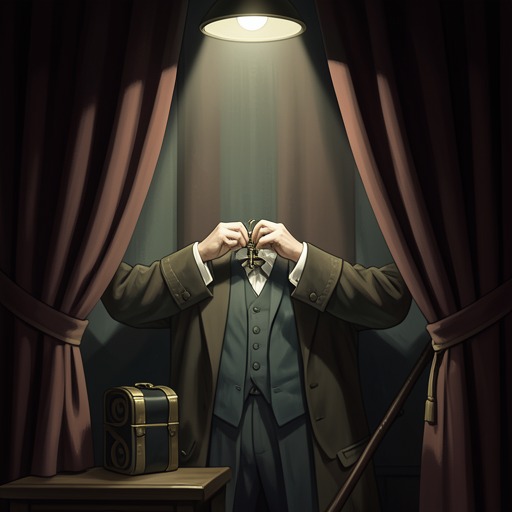
The novel’s accounts of stolen religious objects widen this uncertainty beyond Josef’s personal inquiries. Rabbi Moshe reports that a silver bonbonniere on curved feet, decorated with vegetal patterns and used to hold an etrog, has disappeared from the hidden repositories of the Old Synagogue. He says it contained something else as well, but refuses to reveal the secret under any circumstances. The object’s disappearance is thus accompanied by a second, deliberately withheld mystery: the narrative establishes the existence of concealed knowledge without supplying its contents.
At the synagogue in Brody, the sacred kiddush cup, a hanukkiah ornamented with a walking golden lion, and an emerald-inlaid yad also vanish. The losses recall a Brodersinger pantomime about Yahweh Sabaoth carrying his people toward the heavenly Jerusalem. In the remembered sequence, first objects disappear, then temples, animals, and houses; eventually saints, sages, musicians, and children vanish, until no Jew remains on the sinful earth. The thefts can be read as crimes involving material objects, but their accumulation also gives religious interpretation a compelling shape: local losses appear to repeat a story of collective removal.
That apocalyptic reading is not confirmed as fact. The narrator presents it as the conclusion people draw from frightening events: the world seems to be approaching its final moments, and an immense, elusive presence is imagined as about to wake. This vision turns unexplained disappearances into signs of a cosmic transformation. The movement from missing objects to the imagined disappearance of an entire people demonstrates how communities make sense of uncertainty through inherited religious narratives, even when the narrative cannot prove what caused the events.
Bodies, Diagnosis, and the Limits of Clinical Knowledge
Medical examination elsewhere in the novel offers both practical knowledge and visible limits. When a thin, silent boy is brought to Doctor Vodnetsky, the doctor says he is neither mute nor deaf and appears healthy, though exhausted by hunger. The diagnosis identifies an immediate physical condition, but the boy’s unusual bones leave the doctor unsure what to make of them. After examining his heart, pulse, throat, eyes, knees, and elbows, and bending his wrists and fingers, Vodnetsky wonders aloud whether the child has cutis hyperelastica or Ehlers-Danlos syndrome. He calls him special, but the terminology marks a possibility rather than a complete account of the boy.
A different boundary appears in the account of Adèle’s infertility. Doctor Anger describes Thérèse’s pregnancy as a miracle because he believed there was no chance it could have occurred. For Adèle, specialists Vodnetsky and Richter conclude that pregnancy is impossible, their assessment supported by chemical and microscopic methods. The narrator’s hope that Petro might withdraw if he learned of Adèle’s infertility makes the diagnosis consequential within the household as well as medically significant. Scientific findings shape intimate expectations, but they do not dissolve the emotional and relational stakes attached to them.
The novel also places bodily suffering within religious interpretation. Ivanka’s recurrent convulsions frighten her father: while her mother holds her head to keep her tongue from falling back into her throat, he turns pale and leaves the house, then reads the Psalter over her through the night. He believes someone is entering her and marries her to Josef in the hope of calming the demon. The same bodily crisis is therefore lived through immediate care, fear, prayer, and a supernatural explanation. These responses are not interchangeable: the practical effort to protect Ivanka’s body does not settle what her illness means.
Prayer, Ritual, and the Unresolved Boundary
Religious practice in the novel is not merely a theory about extraordinary events; it structures what people may do and where. When Stefania seeks confession, Josef tells her that he cannot perform the sacrament outside a church, while she cannot enter because the church is in a prison. She answers by appealing to the essentials as she understands them: a sinner, a priest, and God. The scene sets personal spiritual need against a rule governing the proper setting of confession. Neither the rule nor Stefania’s plea makes the other disappear; their collision leaves her overwhelmed and weeping.
Josef’s religious discourse likewise makes service and devotion part of the problem of knowledge. He speaks of the commandments and the Law of Moses, the Lord’s ways, service with all one’s heart and soul, the holiness of suffering, and the magnificence of submission. He describes love of God as transcending the identity of the person who serves and the manner of service, and says that human beings are created in God’s image and likeness, with the possibility of becoming like God dependent on human will. For Stefania, the words arrive with the force of music: her chest tightens and her temples feel constricted. Faith here is not an abstract proposition but an experience that acts upon the body and places moral demands on human conduct.
Across these episodes, the novel avoids an easy verdict that either rational inquiry explains away faith or religious belief renders investigation pointless. Josef’s medical reading makes him more, not less, attentive to miracle claims; the icon’s archive records experiences without resolving their cause; diagnoses describe conditions but leave personal meaning and uncertainty in place; and ritual rules can both express a religious order and obstruct an individual’s urgent request. Science and faith meet through observation, testimony, healing, illness, and prayer, but their intersection remains a productive uncertainty rather than a final synthesis.