Stanislaviv
Felix AustriaStanislaviv is the Galician city—present-day Ivano-Frankivsk—in which Felix Austria unfolds around 1900. Seen largely through Stefania Tchornenko, a young woman employed as a cook in an affluent household, it is at once a concrete provincial community and the setting for a collapsing ideal: a prosperous, tolerant, multicultural imperial world whose surface of order cannot contain the disruptions gathering beneath it.
Setting and Social Life
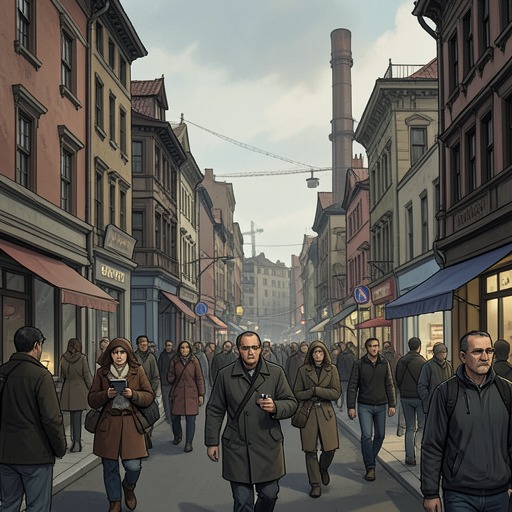
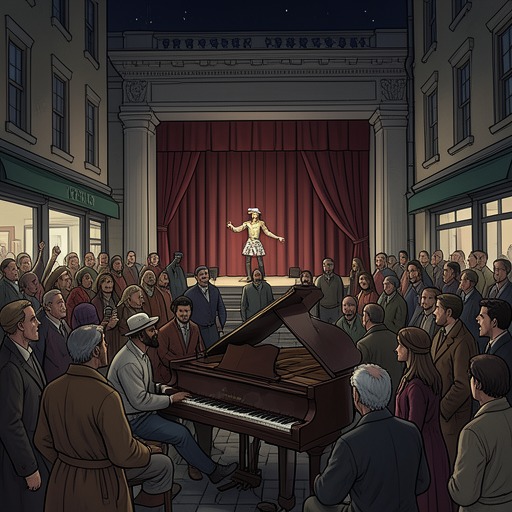
A cultural capital of Galicia within the Austro-Hungarian Empire, Stanislaviv is described as peaceful at the edges yet remarkably diverse in its peoples, languages, and religions. Its inhabitants pursue ordinary desires and private intrigues alongside public amusements: they conceal secrets in cupboards, fall into unrequited love, take an interest in science and magic, and attend balls and carnivals. The novel’s domestic viewpoint brings this broad social world down to the scale of meals, gossip, and household obligations, while the crowded calendar of festivities shows how thoroughly public sociability shapes city life.
During the year-end season, one carnival follows another: a technicians’ ball at the theater, an evening at the Moniuszko Musical Society, an academic gathering at the casino, and a costume event organized by the local Sokil. At the municipal casino on New Year’s Eve, the quadrille draws only twenty-eight couples, while other venues attract larger crowds. Adèle Anger enjoys these occasions and takes Stefania with her. Stefania would rather avoid them because she knows the young women whisper about Adèle bringing her servant to the ball and marrying a Ruthenian coffin-maker; Petro is in fact a sculptor of cemetery statues, whose mournful angels and marble vestals move visitors to tears. The scene joins social prejudice to the spectacle and intimacy of the city’s entertainments.
Household, Street, and Modernization
The city’s changes are visible in its buildings. As wooden shacks burn or collapse, they give way to brick houses made at the modern Ourman brickworks, embellished with turrets, arches, columns, ironwork, plaster ornament, mosaics, and colored glass. Petro begins constructing the Anger household’s home after Adèle’s relationship with him changes: she lays a hand on his rough palm at dinner, and Stefania sees the couple behaving as though, unable to bring a third person into the world, they had become one being. The resulting house rises on Lindengasse in undulating, distorted forms, with ceramic patterns winding around its windows, doors, columns, and arches. Its strange appearance draws passersby; unlike the fashionable houses around it, it seems almost a mirage.
Modern development does not erase the city’s harsher spaces. Behind the illuminated town hall, Stefania encounters narrow blind alleys sunk knee-deep in foul mud, pigeon-stained wells, tangled galleries, and heaps of rags that seem never to dry or disappear. The contrast between new construction and neglected courtyards makes modernization uneven: the city can display technical and architectural ambition while leaving poverty and squalor starkly exposed.
Imperial Pageantry and Political Contradictions
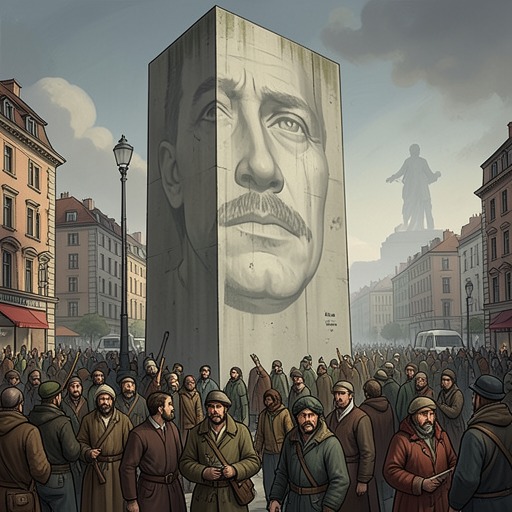
Imperial identity is present even in the poorest quarters. Portraits of the emperor and the crowned double-headed eagle appear above streets of mud and refuse, accompanied by the dynastic mottoes “Indivisibiliter Ac Inseparabiliter” and “Felix Austria.” The emblems promise unity and stability in surroundings that expose how little such assurances can say about the inhabitants’ material conditions.
A newspaper account of the seventieth anniversary of Emperor Franz Joseph I’s birth records a city dressed with flowers and banners. A military parade sets out from the barracks at 8:30 p.m., passes through central streets, and stops at the municipal building and Krona restaurant before proceeding along Lindengasse toward the bishop’s residence. Adèle, Petro, and Stefania are drawn into the crowd; Adèle wears a narrow sky-blue dress, Petro is uneasy at the event, and Stefania carries a child in her arms. The celebration makes imperial loyalty a shared public performance, even as the characters’ differing responses qualify the image of unanimity.
Political argument also unsettles the festive surface. At a gathering where men discuss municipal and parliamentary elections, an advocate alleges conspiracy and vote-buying involving a Solotvyn oil magnate and the mayor, while complaining that some of those arguing about politics will not be entitled to vote for years. Petro’s discussion of the international intervention in China further exposes the gap between official benevolence and force: he reports Russia’s insistence that the intervention not be called a war, and Ernest Thorn challenges the claim that the great powers act simply from neighborly concern. Local electoral disputes and international events thus enter the same social world, giving the city’s conversations a reach beyond its streets.
The City as an Image of “Happy Austria”
The ideal of “happy Austria” evokes a vanished society imagined as tolerant, prosperous, and multicultural. Stanislaviv gives that ideal its human scale through interwoven households, entertainments, and communities, but the novel also sets the motto against poverty, political exclusion, social judgment, and a sense that apparent stability is already carrying the seeds of dissolution. The city’s modernization and its lingering deprivation, like its ceremonies and arguments, prevent nostalgia from becoming a simple portrait of harmony.
At the novel’s end, Stefania compares the permanence of her love with that of the Austro-Hungarian Empire just as the house Petro designed begins to crack, fill with smoke, and collapse into fire. The juxtaposition turns the city’s imperial promise into an unstable measure: what Stefania imagines as eternal is placed beside a home—and a political order—coming apart. Stanislaviv therefore functions not merely as scenery but as the material form of a disappearing world, at once cherished, diverse, and unable to secure its own permanence.