Stone angel appears as Felix
Felix AustriaThe episode in which a stone angel seems to become Felix is a staged appearance and disappearance whose explanation remains concealed in the scene. In a workshop crowded with damaged religious images and unfinished sculpture, Petro wakes beside a living child dressed like an angel. The onlookers call it a miracle; when the child disappears, Stefania finds him beneath a black top hat at the threshold. The revelation changes what the crowd has seen without resolving how the illusion was made, placing theatrical uncertainty beside religious awe.
The Workshop and Its Witnesses
The scene begins with a shared cry of “Petro!” Adèle and Stefania seize hands and run toward the workshop where Petro has recently been making sculptures for Father Josef’s chapel. Stefania has brought him food almost every day at the places where he worked, including the cathedral and the Bembnowycz workshop; the rescue-like urgency of their arrival is therefore grounded in an established routine of care.
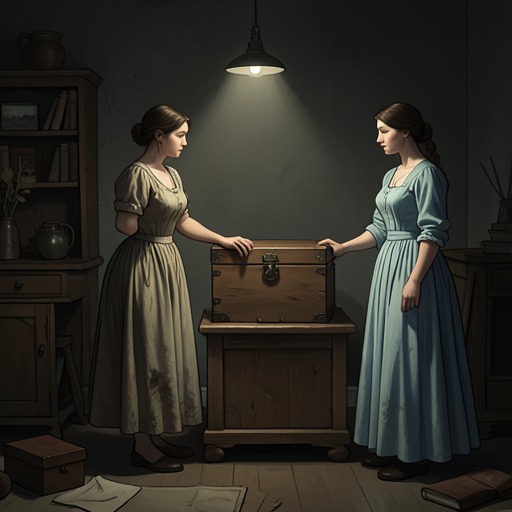
The workshop stands against another wall of the prison, nearer the shops, separated from it by a massive wall. Only minutes earlier, the singing of angels had come through that wall. Inside, harsh sunlight enters through gaps between the boards and broad, misshapen windows, whitening the marble fragments among tools, planks, and ladders. The space is not a polished sanctuary but a disorderly worksite filled with wood, damaged cloth, stone debris, and destroyed wooden icons. The carved eyes, marked with white dots, seem to watch from the wreckage, making the room feel already crowded by images that might be mistaken for presences.
Two imperial-royal guards have left the door wide open, apparently terrified, though the scene does not establish what they were searching for. Adèle and Stefania stop at the threshold, frozen by fear; Stefania does not want to enter or learn what has happened to Petro. Father Josef pushes past them and goes in. He picks up a black top hat, shakes marble dust from it, and carefully sets it on a heap of wood. Adèle and Stefania follow with their hands still entangled, as the old prison guard breathes close behind Stefania and a crowd gathers outside, drawn by the commotion.
Petro and the Living Child
Petro is asleep under a coating of marble dust so thick that it has hardened into a cracked crust of fine lace. His stillness makes him difficult to distinguish from a marble body. One powerful arm, its muscles and veins sharply defined by physical labor, rests on dark-green cloth; his hand remains clenched around a chisel even in sleep. The sculptor is thus framed alongside his material, as though work and worker have briefly collapsed into the same pale, motionless surface.
Beside him lies a child described as a living angel: flesh and blood rather than white stone, fair-skinned, rosy-cheeked, with softly waved hair and a long robe embroidered with shining pearls. The child’s appearance echoes the marble angels scattered throughout the workshop, but the contrast is exact and bodily. The carved figures are fragments in a sunlit jumble; this one has warm color, a damp brow and upper lip, and a presence that can look back.
Petro and the child open their eyes together. Petro stares at the child in fear and incomprehension, then looks across the gathered witnesses. He springs up, breathes deeply several times, drops the chisel with a crash, and falls to his knees before the child, as if afraid the figure might vanish back into his dreams. His response moves from startled recognition to reverence without explaining what he believes he has seen.
The Miracle and the Disappearance
One of the people present cries, “Look, a stone angel has come to life!” Prayers, muttering, and strained whispers break out, followed by repeated cries of “Miracle!” The workshop’s crowded disorder becomes a public religious spectacle: the people name the appearance before they can establish its cause. Petro crosses himself and weeps silently, while the child sits up and watches the assembly without speaking. The child’s face shows no readily identifiable fear, astonishment, or joy, withholding the emotional reaction the witnesses might expect.
The dark-green cloth rises into the air and settles over the child’s thin body. As its folds fall, something small rolls beneath it. Father Josef bends to pull at one end, while an old man in a caftan tugs from the other; bystanders press forward, and their grasping hands disappear under the covering. This sudden movement turns the cloth into both screen and contested object. The crowd’s desire to see, touch, or uncover what lies beneath intensifies the scene, but the child is gone when Petro decisively tears the cloth from the floor. The dirty, trampled ground is empty.
Stefania’s Discovery
The disappearance breaks the scene’s apparent certainty. Stefania feels the ground give way beneath her and wants to leave. Still pale, Adèle holds on to her with firm hands, but Stefania pulls free and makes her way through the entranced crowd toward the exit. The bodily sequence—frozen at the entrance, bound to Adèle by their joined hands, then wrenching herself loose—registers the episode as an experience of shock rather than a settled interpretation.
At the doorway Stefania stumbles over the black top hat, now lying on the threshold. She bends, picks it up gently, and pushes it aside. The angel is in her arms. The discovery reverses the crowd’s empty-floor revelation: the child has not simply vanished from the workshop but has been concealed at its edge, under the very object Father Josef handled near the beginning. The hat’s changed position links the opening action to the final reveal, although the scene does not say who moved it or how the child passed beneath it.
Spectacle, Belief, and Concealment
The episode is constructed around a shift in what can be seen. Marble fragments first make the living child legible as an angel; the crowd turns that resemblance into a miracle; the lifted cloth appears to confirm a supernatural disappearance; and Stefania’s discovery supplies a material hiding place without disclosing the mechanism. The sequence lets religious interpretation arise from a real, bewildering spectacle, then interrupts the crowd’s certainty with a private counter-image.
The difference between the public response and Stefania’s final discovery is decisive. The onlookers gather around the cloth and the empty floor, while Stefania alone finds the child at the threshold. The event therefore preserves both wonder and concealment: it does not affirm a supernatural transformation, but neither does it explain the child’s appearance, the floating cloth, or the movement of the hat. The workshop’s angels remain caught between carved matter and living bodies, while the audience’s competing acts of looking—prayer, reaching, retreat, and careful lifting—become the scene’s true action.