Thérèse carved in marble
Felix AustriaThérèse carved in marble is Petro’s memorial to Doctor Anger’s deceased wife, Thérèse: a white-marble figure whose serene, intimate pose preserves the memory of her as a person rather than reducing her to a conventional emblem of mourning. Created in the garden workshop of Petro’s ramshackle house and eventually placed beneath the lime trees of the cemetery, the sculpture holds together two apparently incompatible truths: Thérèse seems tenderly present, yet the stone will outlast every living imagination that looks upon it.
Commission and Making
Doctor Anger found Petro on the twentieth anniversary of his wife’s death. The young sculptor had just returned to Stanislaviv after studying at the Academy of Fine Arts in Vienna, and the doctor commissioned him to make a monument for Thérèse. Petro chose white marble so pure that its brightness seemed transparent, like a piece of ice from the Alpine peaks. The stone was at once a resistant block and the material from which an individual likeness would gradually emerge.
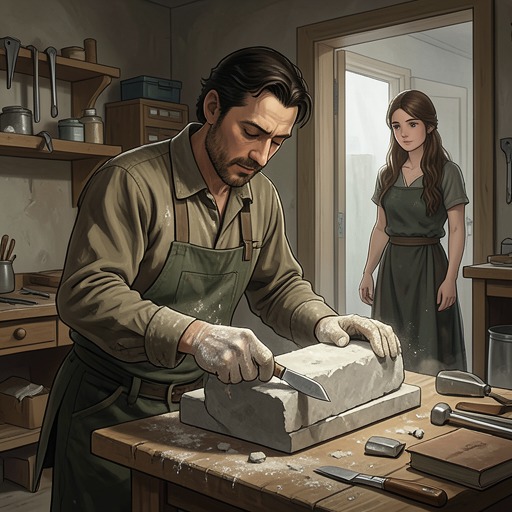
Petro worked in a shed at the back of a greenhouse on Siemiradzki Street, where his rented wooden house stood opposite a gasometer. The greenhouse was a practical choice: carts passed through to collect tomatoes, and the sculptor made use of the same route for his work. A large block, marked with Petro’s black guide points, lay on a wooden workbench. He moved around it with forceful, exact hammer blows, his face powdered with marble dust and tightened by concentration as chips fell and fine dust rose like smoke.
The domestic disorder surrounding the workshop sharpened the contrast with the careful labor at its center. Doctor Anger once lost his footing on the slope, slid through thick grass and wild hops, tore himself on sharp stems, and arrived tangled in thistles before the tomato greenhouse. His formerly immaculate three-piece suit and white shirt were ruined, and his boater had gone missing. There he found Petro patiently freeing the doctor’s wife from her block of marble. Afterward, the doctor picked his way down the path as cautiously as if learning to walk, even buying a cane with a comfortable handle. His comic fall becomes the prelude to a more vulnerable ritual: each visit brings him closer to the image of the woman he has lost.
The Doctor’s Memories in the Sculpture
The doctor comes to watch Petro’s hands and speak about Thérèse. His recollections are particular and unidealized: she cried over happiness, misfortune, or apparently nothing at all; she ate peaches with a spoon and embroidered what he considered foolish patterns. He remembers their arguments about corsets, which he believed compressed the organs and might contribute to her infertility. Thérèse resisted because the subject was not considered proper to discuss, then agreed to wear only a lightly tightened corset at costume balls and receptions because she longed for children.
He also recalls returning late from the hospital, knocking softly at her bedroom door, and entering by candlelight after hearing her invite him in. She lay among soft quilts and pillows, smiling tenderly. As Petro adjusted the marble cheekbones with the gestures of a jeweler, the doctor recognized the likeness not merely in the face but in the bedlike arrangement around it. The sculpture’s intimacy comes from this remembered scene: Thérèse is not posed as a distant public monument but seems to rest in a familiar domestic space, approached through the habits and details of married life.
Form and Final Setting
After Doctor Anger’s death, the marble Thérèse remains in the cemetery beneath the lime trees. She lies on a stone bed among quilts and pillows, her head carelessly resting on her right shoulder and her slender arms arranged on the rumpled folds of the bedding. Beside her head, a grieving angel raises a hand to its brow and turns its eyes toward the sky. The angel’s acute sorrow sits strangely beside Thérèse’s calm expression: the figure appears neither pained nor unhappy, but peaceful enough to invite prolonged contemplation.
The sculptural scene therefore distributes grief between two figures. Thérèse’s resting body carries the quietness of the remembered woman, while the angel makes mourning visible beside her. The stone bed and carved bedding preserve the posture of repose without pretending that marble is flesh. Even the contrast between the angel’s anguish and Thérèse’s serenity resists a simple equation between death and visible suffering: the monument’s emotional force comes from their juxtaposition, and from the silence that seems to pass from the calm face into the viewer’s soul.
Petro’s Art and the Limits of Animation
The narrator identifies Petro’s talent as more than the extraction of a graceful, realistic form from stone. His sculpture compels the viewer to stop, become still, and allow emotion and thought to rise. That arrest is also an encounter with material duration: the viewer imagines becoming an apple, a horse, a river, or a fish, while the stone remains stone for longer than the imagination can readily conceive. The work appears to animate the marble, but it does not erase the difference between living bodies and enduring matter.
Instead, the narrator imagines fragments of stone and fish becoming parts of something else: a flower bulb, electricity, or another person. Meaning gathers through transformations and connections rather than through a claim that the sculpture has literally come alive. The image expands like concentric circles across a lake, while clouds dissolve into the sky as watercolor dissolves in water. Thérèse carved in marble thus embodies Petro’s particular power: he makes the viewer feel the movement between matter, memory, and life while leaving the cold stone intact.