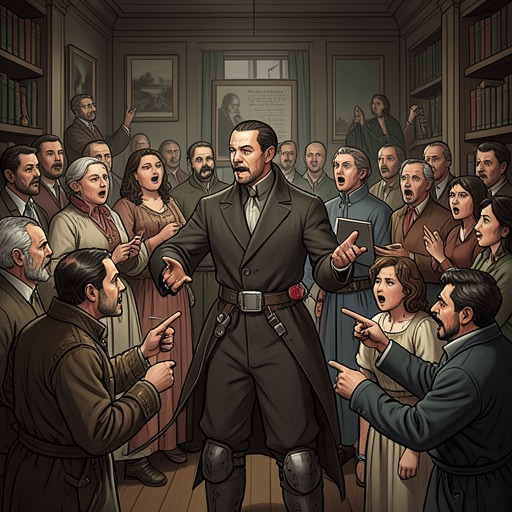
A collideorscape!
Finnegans WakeA collideorscape is the phrase given to a vision of existence in which apparent opposites meet, identities blur, and change is inseparable from recurrence. It gathers the book’s dream logic into a compact image: the world is not a stable scene observed from outside, but a moving composition whose parts continually collide and rearrange.
The phrase and its immediate context
The expression appears as the answer to a question about what a dreamer might perceive in a suspended, half-exanimate state: a panorama of past and future, of change and return, in which one thing meets and melts into another. The passage moves through rising sap and falling leaves, the womb’s restlessness, rivals turning toward the sea, and a sequence of colors that pales and changes—rose-red and orange giving way to yellow and green, then blue and violet. Its answer, “A collideorscape!”, names this shifting totality rather than resolving it into a single stable picture.
The compound makes collision and landscape sound at once. Its force lies in joining the sense of things striking or meeting with that of a whole field coming into view. The dreamer does not receive a clear, orderly panorama: the vision is full of transformations, pairings, reversals, and uncertain boundaries. The phrase gives that unstable spectacle a name without pretending to make it simple.
A world of change and recurrence
The thought leading to the expression places human life within a cycle of persistence and alteration. A fatigued person, imagining the course of existence across dream-time, would encounter hopes and experiences to which life repeatedly returns. The vision turns on the question of how one thing meets another and melts into it; change is therefore not merely a sequence in which one state replaces another, but a process of interpenetration.
The passage’s changing natural images make that process concrete. Sap rises while leaves fall; growth and decline occur together. The restless womb places becoming beside the possibility of loss, while the changing colors make transformation visible as a succession that does not settle into permanence. The collideorscape is thus neither pure chaos nor a fixed order: its patterns emerge through continuing motion, and every apparent ending can feed another beginning.
The book’s broader verbal method
The phrase also offers a way to understand the book’s language. Its opening passage makes words collide across sounds, languages, allusions, and identities: “Sir Tristram” arrives in a sentence where historical, geographical, and familial references flow into one another, while a dialogue between Jute and Mutt turns a meeting into comic exchanges of speech and hats. Elsewhere, the book calls its protean text a polyhedron of scripture and describes its documents as carrying multiple personalities. These passages do not present meaning as a single message waiting intact beneath verbal disorder; they make interpretation part of the continual recombination.
That method is especially visible in the account of a damaged, shifting document. Its marks may be blots, bars, initials, underlinings, omissions, or signs that permit the words to be taken in different orders; even the identity of the writer and the status of the text remain unstable. Elsewhere, a script without punctuation is interpreted through patterns of holes and punctures. In such instances, material marks do not simply transmit a settled statement: their arrangement and alteration participate in producing what can be read. The collideorscape names this larger condition, in which a world and its record are both made through intersections, transformations, and competing interpretations.
A compact statement of dream logic
The phrase’s decisive role is to turn the book’s recurring transformations into an image of perception. Its dreamer sees not isolated things but relations in motion: one element meeting another, colors changing, generations and forms echoing across time. Even an embedded fable, introduced by Shaun as a tale of the Ondt and the Gracehoper, begins within the book’s wider pattern of juxtaposition and shifting registers. The collideorscape does not settle these collisions into a final verdict. It makes their simultaneity—their capacity to create a changing whole—its subject.