Antediluvian period
Finnegans WakeThe Antediluvian period names a time before the Flood, but Finnegans Wake does not treat it as a securely bounded historical era. It is invoked through contradictory chronologies, legendary events, legal and political accusations, and documents whose meanings have to be reconstructed. The period’s importance lies less in a settled account of what happened than in the way claims about the past are transmitted, contested, and made to resemble the present.
A Chronology That Will Not Settle
The text places the copyist’s disappearance somewhere in the gap between the antediluvian and the annadominant, then offers several incompatible possible causes: a rising flood, a charging elk, a blow from above, or another abrupt interruption. The alternatives make the loss of the source itself part of the story. What survives is not a continuous record but a text whose beginnings and transmission are uncertain.
Other dates supply the appearance of chronology without resolving that uncertainty. The account places one episode in 566 A.D. and another in 1132, while associating the latter with the birth of two sons called Caddy and Primas. Historical numbering thus coexists with legendary and comic materials; the dates mark points in a temporal collage, not a stable sequence that explains it.
Legend, Accusation, and Public Judgment
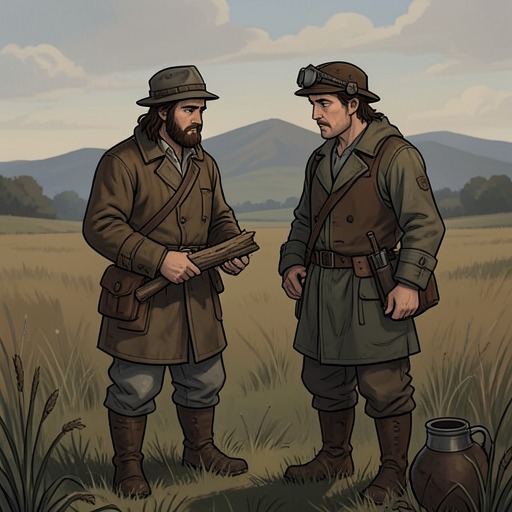
The period is also a setting for the ballad’s accusation against Humphrey Chimpden Earwicker. It presents him as a man who courted a young woman and turns that allegation into public ridicule, linking the supposed offense to an antediluvial world of legendary creatures. The episode shows how a claim about the past can acquire force through performance and popular judgment, even when the narrative does not offer a neutral, verifiable account.
Elsewhere, the narrative asks whether reports of planned outrages against a staunch covenanter are merchant-tales, whether the events were seen and then forgotten, and whether those who report them use the truth sparingly. The questions make testimony itself unstable. Accounts of flight, violence, and political danger accumulate, but the text withholds a final authority that would separate confirmed history from rumor.
A further case is framed as a prosecution of Festy King, whose origins, disguise, clothing, and alleged actions are presented through a jumble of competing details. The legal scene makes the period’s central problem concrete: an accusation can be organized into formal counts, yet the evidence and the story built around it remain difficult to disentangle. Law supplies a public framework for judgment, not an uncomplicated guarantee of truth.
Documents, Marks, and Reconstructed Meaning
The period’s past reaches the reader through material traces as well as spoken reports. In one episode, the identities of people associated with a Tiberian household are said to emerge from a document written without punctuation. Held against a lit rush, its reverse is described as revealing wounds made by a pronged instrument. The marks are interpreted as four distinct requests to stop, and that reading becomes a clue in identifying the people involved.
The document’s meaning is therefore not simply read off the page: it is produced through handling, visual comparison, and interpretation. Its damaged surface can be treated as evidence, but that evidence requires an explanatory account. The passage echoes the larger problem of the Antediluvian period, where a lost text, a fragmentary report, or a physical mark may preserve the past while also leaving room for competing reconstructions.
A Past Re-entering the Present
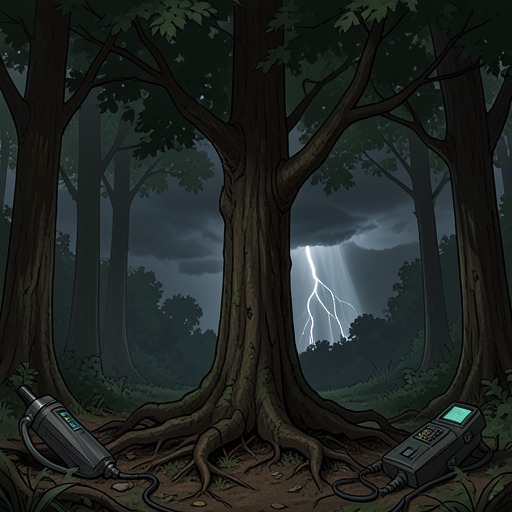
Antediluvian time does not remain safely remote. The text connects the old period to continuing systems of communication and recall: a huge envelope written in seven stages of ink, a proposed receiver called The Mole, and a device described through its battery, tuning system, and capacity to gather distant signals. These technologies give the past new routes into the present, but do not make its messages transparent; transmission still depends on channels, marks, and acts of interpretation.
The period’s temporal force is consequently recursive. It gathers legendary beginnings, dated episodes, public allegations, legal proceedings, and textual remains into a past that is repeatedly reopened rather than conclusively settled. The Antediluvian period is both a before-time and a method of narration: every attempt to recover what happened produces another version, leaving history audible in the present but never wholly secure.