Battle of Waterloo
Finnegans WakeThe Battle of Waterloo is staged as a visit to the Willingdone Museyroom, where an exuberant guide converts the battle into a sequence of exhibits, reversals, and jokes. Wellington’s victory is first arranged as museum instruction and then unsettled by the retreat of the opposing troops, the comic handling of a captured hat, and a final sound burst that makes the battle less a settled record than a story continually performed and reworked.
The Battle as Museum Display
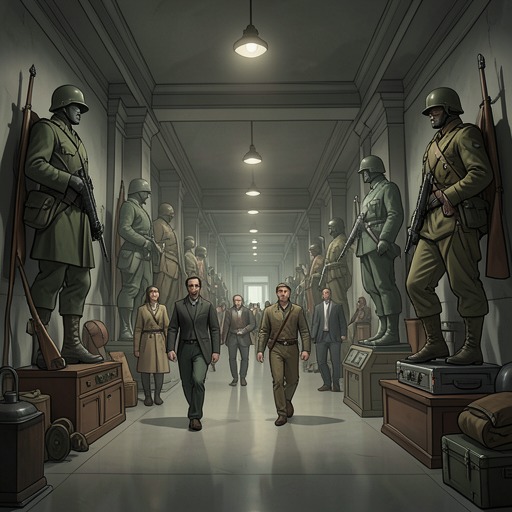
The guide ushers visitors into the Willingdone Museyroom and asks them to mind their hats. Its exhibits are presented with the repetitive formula of a tour: a Prussian gun, a French gun, a flag, and the bullet that struck it. The guide identifies the French gun as the one that fired on the bull that struck the flag, making the supposed clarity of labels wobble from the start. Weapons and national symbols are not explained in a continuous history; they are pointed out as objects in a show, punctuated by the recurring instruction, “Tip.”
The central exhibit is Arthur Wellesley, Duke of Wellington, mounted on his white horse. The tour enlarges him into a monumental figure, listing his spurs, boots, garments, and other military finery, while the horse receives almost equal attention. The display also includes three soldiers crouching in a trench, a sequence of named troops, and a small soldier who is neither one side nor the other. The guide’s inventory makes military hierarchy visible, but its playful labels refuse the clean distinctions that an official display might promise.
Reversals and Comic Combat
The battle’s action unfolds through opposing volleys and counter-volley. The opposing troops send a dispatch across the front of Wellington’s ally; Wellington’s side answers with its own dispatch. The guide calls this exchange the first joke of Wellington, reducing the retaliatory rhythm of battle to a comic tic for tac. The spectacle then shifts to Wellington’s ally moving forward to make camp, while the opposing troops’ attacks are described as attempts to annoy him. The formations answer each other in repeated cries and gestures, and the opposing troops eventually run away.
Retreat does not conclude the scene in solemn triumph. The guide points to a silver plate associated with the camp, a keepsake left behind by the fleeing troops, and Wellington flourishing a memorial scoop in celebration. A small soldier spies on Wellington from the great white horse; Wellington picks up half of a three-cornered hat from the mud and places it on the horse’s tail. The horse wags the fragment toward a Hindu onlooker, who cries out and then blows it off. The guide calls this the last joke of Wellington and declares the contest a game, turning victory’s trophy into a prop in a comic exchange.
The Tour’s Unstable Record
The episode offers no detached account of causes, chronology, or consequences. Instead, its mock-guide voice makes the battle legible as a series of things to look at: guns, flags, uniforms, dispatches, a horse, a hat, and a monument. Repeated demonstratives and the clipped “Tip” imitate the pace of pointing through a gallery, while the names and descriptions mutate into wordplay. The reader is placed among visitors being instructed, but the instruction itself keeps scrambling what each object means.
That instability is sharpened by the museum’s framing. The scene begins by declaring the visitors inside the Willingdone Museyroom and ends by directing them back out, as if the entire battle had been a completed tour. Yet the closing sound burst interrupts that neat boundary with a cascade of syllables. The museum can contain the battle only provisionally: the remembered conflict escapes its labels as noise, performance, and renewed narration.
Recurrence and Public Memory
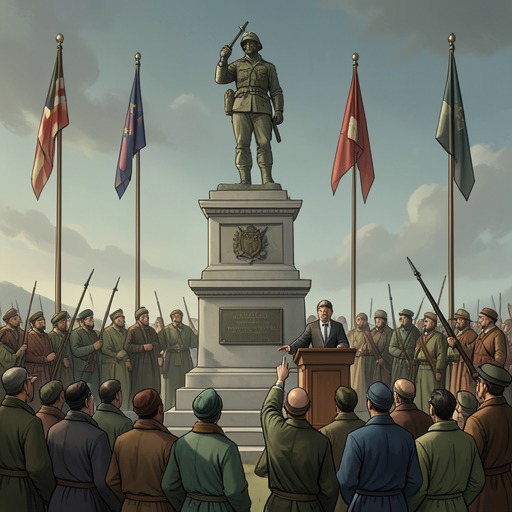
The museum scene belongs to a book in which remembered falls, battles, and public stories recur in altered forms. Here the Battle of Waterloo is connected to the monumental presence of Wellington and to the possibility that historical memory is assembled from exhibits, jokes, and competing names rather than preserved as a single stable account. Its repeated reversals—attack and reply, advance and flight, trophy and insult—make victory a performance that can be retold from several angles.
The surrounding narrative reinforces the gap between a supposedly fixed past and its circulation among people. A later passage depicts a crowd gathering for a ballad associated with public scandal, while another presents familiar goods, shortages, school routines, and household life as things that keep going “the same.” These broader recurrences do not supply additional facts about Waterloo; they place its museum performance within a world where public memory is repeatedly sung, displayed, and reshaped. The battle’s ending is therefore not a final historical verdict but the close of one noisy exhibit, ready to be reopened in another telling.