Dublin
Finnegans WakeDublin is the novel’s central urban landscape, but it is never a stable backdrop. It appears through a shifting multitude of names, routes, districts, landmarks, and public scenes: a city to be crossed and inhabited, a civic image assembled by crowds and monuments, and a place whose geography keeps dissolving into sound and wordplay. The repeated returns make Dublin both particular and cyclical, recognizable in its streets and waters yet continually transformed by the voices that describe it.
Names, Scale, and Urban Form
The city announces its unstable identity in a single question: “So This Is Dyoublong?” Elsewhere it is abbreviated as “Dbln,” addressed as “Publin,” or rendered through other variants including “Dubblenn,” “Dybblin,” “Dublinn,” “Deublan,” “Dyfflinsborg,” and “Dupling.” These forms keep the place audible even when its spelling shifts. They also make naming part of the city’s geography: Dublin is not simply labeled from outside but repeatedly remade in the act of speaking it.
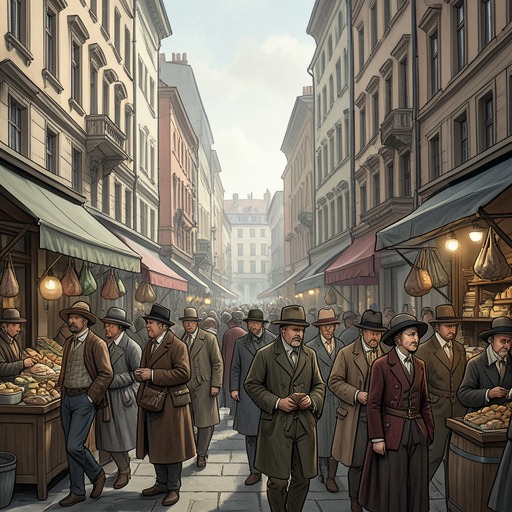
That linguistic movement ranges from broad civic panoramas to closely specified routes. A passage traces a sequence of fancifully renamed avenues and squares, passing along Livius Lane and Mezzofanti Mall, through Lavatery Square and Berkeley Alley, and toward “Old Vico Roundpoint.” The itinerary evokes a city experienced by movement, but the route’s transformations prevent it from becoming a straightforward street directory. Dublin’s urban form is at once traversable and dreamlike, assembled from the names a voice can carry along the way.
The city’s spatial imagination also includes its outskirts and crossings. One passage places a waterside settlement among leased marshes and shoals, while another evokes a route from the eastern coast through Dublin water toward a western destination. In the recurring soundscape, Clontarf becomes a compressed civic emblem of “one love, one fear.” City and region thus meet through waterways, roads, and shifting boundaries rather than through a fixed map alone.
Monuments, Memory, and Public Gathering
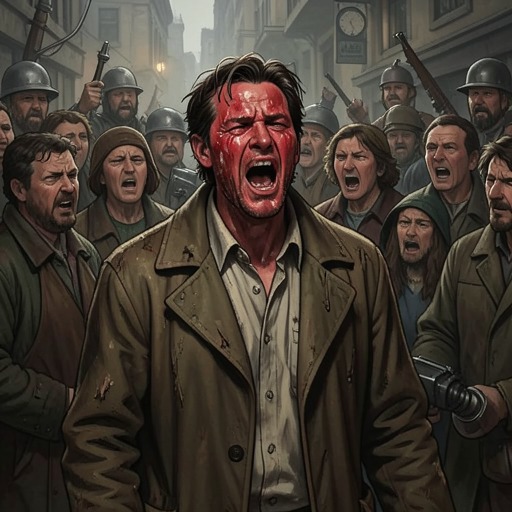
Dublin’s landmarks serve as supports for collective memory. A crowded meeting takes place under the shadow of a monument to a “shouldhavebeen legislator,” with people from the city and beyond assembled in an overflowing public space. The crowd is imagined as representative of many sections of society, its diversity registered through faces, masks, trades, and origins. The scene turns the city into a civic stage where local identity is made visible through gathering and observation.
Other passages make that public landscape more uneasy. The city’s old walls and memorial surfaces appear as images that have been blurred, worn, or overwritten; a mausoleum wall becomes a setting for a funeral procession and a recurring sound of music. The narrative’s attention to what remains on a wall—an engraving, a trace, a half-legible civic image—connects urban memory with the novel’s larger concern for damaged and revisable writing. Dublin preserves its past, but not as a perfectly readable record.
The city is also measured by its religious and ceremonial abundance. A passage lists church after church, with bells pealing until the number of sacred places seems to exceed the possibility of private prayer. The crowded catalogue turns the urban skyline into an auditory and civic inventory, at once festive and overwhelming. Dublin’s monuments, churches, and public assemblies make collective identity perceptible, while the exuberant language complicates any claim that the city can be reduced to a single official account.
Waterways, Parks, and Traces
Water repeatedly gives Dublin a changing edge. The narrative places it beside river and marsh landscapes, associates it with the flow of water through the city, and makes movement along the shore part of its imaginative map. In a passage recalling a return toward the city by water, an easterly and westerly journey frame the approach to Dublin; elsewhere, the river is associated with the laundresses and with news that circulates through the urban community. The city is consequently not only built ground but also a passage through which stories and people move.
The parkland on Dublin’s edge carries a different kind of record. A tract near the Serpentine is described through a succession of marks—footprints, bootmarks, finger signs, and other traces—and imagined as a place where a lost document or love letter might be concealed. The passage joins landscape to uncertain evidence: the ground seems to preserve signs, yet those signs do not settle what happened. Dublin’s outskirts become a repository for stories whose traces can be followed, disputed, or reinterpreted.
A later urban complaint turns attention to traffic, shops, and public administration. The speaker directs a listener to look at a shop window and return after about thirty-two minutes, when traffic crossing the area will have left the city’s surface coated with slush. A demand for the complaint book and the search for a named street-cleaning woman place municipal inconvenience beside the more mythic city of monuments and rivers. The contrast gives Dublin an everyday material life of congestion, dirt, rent, and civic accountability.
The City as Social and Narrative Space
Dublin’s streets and gathering places bring together people who would otherwise remain separate. The city’s crowd includes local residents as well as travelers and visitors associated with different regions and political affiliations. A park scene likewise gathers groups around shared recreation, while passages about the city’s neighborhoods distinguish one district and trade from another. Such details make urban space a social arrangement: crowds, routes, work, leisure, and public institutions distribute people across the same landscape.
Yet Dublin’s public life is also a life of circulation. A postal passage imagines a carrier bringing a large envelope written in seven stages of ink, its layered surface making the document difficult to read. The letter’s journey belongs to the city’s broader traffic of messages, while its changing marks echo the city’s own unstable names. News, writing, and rumor move through Dublin much as people do; neither the message nor the route guarantees a single, final interpretation.
At the book’s close, the city remains entangled with recurrence rather than reaching a definitive portrait. A passage imagines the eras turning until people recognize themselves looking forward to what will soon appear again, and the final city references return to sleepers, the river, laundresses, rents, and domestic lodging. Dublin’s local particulars endure, but they re-enter a cycle of repetition and change. The city’s importance lies in that double condition: it is specific enough to be mapped through named places and civic routines, yet open enough to become the recurring stage on which the novel’s histories, identities, and stories are continually replayed.