Earwicker’s tomb
Finnegans WakeEarwicker’s tomb is a provisional burial place at Moyelta, first prepared while Earwicker’s body still persists and then elaborated into an underground stronghold. The passage makes the grave both a civic monument and an unstable threshold: its elaborate protections promise secure repose, yet the buried figure is also imagined as returning through the structures and materials of the world above.
Commission and provisional burial
The tomb begins not as a private undertaking but as a public gift. Conservative civic bodies, acting through committees empowered to enlarge their own membership, pass a resolution that removes the town, port, garrison, and Earwicker from ordinary political existence. While Earwicker’s body remains, they present him with a temporary grave at Moyelta, modeled on the much-admired pattern of Lough Neagh. The formal public act makes burial an instrument of civic honor and exclusion at once: Earwicker is memorialized even as the resolution places him beyond the community’s active life.
The passage first introduces a teak coffin fitted with a glass panel and oriented with its feet to the east. The coffin is expected to arrive later, so the grave precedes its central furnishing. That delay gives the provisional resting place an unfinished quality: the public ceremony and its architecture take shape around a body whose final enclosure has yet to be supplied.
A grave designed as an underground refuge
The planned tomb is called an underground heaven or a mole’s paradise. Its design is linked to agricultural and commercial purposes: it is meant to encourage wheat crops and attract tourists. The architect, Mgr Peurelachasse, is prevented from completing his work, while the contractors, Messrs T. A. Birkett and L. O. Tuohalls, are made invulnerably venerable. Even the account of the grave’s origins therefore mixes construction with obstruction, turning the making of a refuge into a story of thwarted design and protected builders.
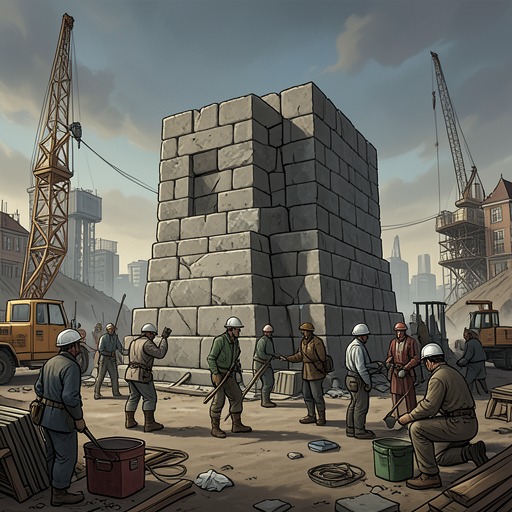
A later stage of the account describes a fortified structure rather than a simple grave. Its ferroconcrete is lined with rotproof bricks and mortar, and it is surrounded by seven towerettes: the beauchamp, byward, bull, lion, white, wardrobe, and bloodied. The work is presented as an incremental descent, step by step, as Earwicker’s strength fails and he approaches the place prepared for him. The defensive vocabulary makes the burial site resemble a stronghold, though its apparent security is set against the continuing uncertainty of what burial will mean.
Civic honors and funeral furnishings
Public councils continue to gather around the tomb after its construction. Among the bodies named are the Breeders’ Union and the Guild of Merchants of the Staple. They present Earwicker with a stone slab bearing a conventional funerary inscription, described as a carefully worded but misleading elegy. Its polished form offers the public appearance of a settled farewell, while the passage’s surrounding language keeps the meaning of that farewell in doubt.
The tomb attracts an extensive inventory of funerary goods: coffins, winding sheets, bier cloths, urns, glass vessels, snuff chests, tubs, vases, and other objects for the adornment of a glazed stone memorial. The catalogue expands burial into a whole commercial world of equipment and display. It also imagines a wandering traveler passing by and continuing to live comfortably through old age, while Earwicker remains embalmed in a state of anticipated death. The contrast makes the tomb simultaneously a monument to mortality and an elaborate setting for life’s continuation elsewhere.
Burial, return, and the unstable ending
The grave’s meaning does not end with interment. The passage invokes time’s preservation and a rise after a fall, then pictures the buried figure returning from the underworld and spreading through its depths, seam by seam. From that hidden realm he revisits the upper world, where his descendants proliferate as an abundance of pots, pans, pokers, and puns. The image joins physical objects to verbal generation: what is buried does not simply disappear but re-emerges in altered, dispersed forms.
This return complicates the tomb’s promises of permanence. Its underground architecture appears to seal and protect Earwicker, but the closing movement carries him back toward the upper world through both material abundance and language. The passage thus treats the tomb less as a fixed endpoint than as a passage within a recurring pattern of burial and renewal, where public memorial, bodily persistence, and imaginative proliferation remain inseparable.