Four Old Men
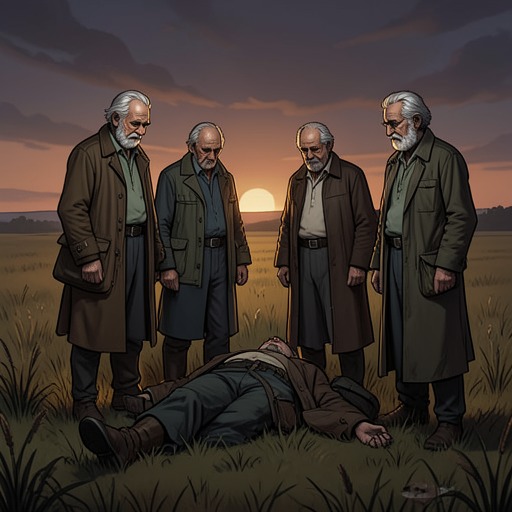
Finnegans WakeThe Four Old Men are identified in this episode as the four gentlemen whom the troubled figure wishes to mourn and to whom he imagines presenting a corpse. The passage does not individuate them; instead, they function collectively as mourners and witnesses within a fractured account whose shifts of sound and meaning leave the circumstances uncertain.
Identity and Appearance
The Four Old Men enter the passage under the description “the four gentlemen.” They are named as the intended recipients of a “presence (of a curpse),” but no personal histories, distinguishing traits, or separate actions are supplied. Their identity is therefore defined by their number and their place in the imagined scene: they are the company before whom the corpse is to be presented.
The Projected Mourning
The account proceeds through a series of itemized statements about the figure’s changing condition. He is “hardset,” wants to go somewhere while “weeting,” and wishes to grieve for the four gentlemen. The passage then moves abruptly through other, garbled descriptions of himself before returning to his thought of giving them the corpse. This sequence makes the proposed mourning less a clear, completed action than an intention entangled with distress and unstable narration.
Stones, Illness, and Aftermath
The imagined presentation is followed by a compact chain of consequences: the figure “fould the fourd”; the Four Old Men “found the hurtled stones”; they “fell ill with the gravy duck”; and the figure “sod town with the roust of the meast.” The wording resists a single certain reconstruction, but it places the group among the episode’s concrete signs of disturbance—stones, illness, and the remains of a feast. The Four Old Men are not described as recovering or acting further, and the passage offers no settled account of what became of them.
Narrative Role
The Four Old Men give the episode a collective audience for its obscure drama of grief and corpse-presentation. Their appearance also exposes the passage’s instability: they are first the people the figure means to mourn, then those who find the stones and fall ill. The reversal turns an apparently straightforward act of mourning into a disjointed sequence of intentions and consequences, leaving the group’s role suspended between witnesses, mourners, and participants in an uncertain calamity.