HCE’s house
Finnegans WakeHCE’s house is a domestic setting repeatedly recast as a public address, a half-finished building, and a scene of family life. Its details range from a bedroom prepared for two to a chequered staircase with only one square step; surrounding it are stories of visitors, trade, debts, and public spectacle. The house matters not as a stable backdrop but as a place where private household arrangements and the book’s wider social world continually overlap.
Identity and Setting
The house appears under several names, including House of the Cederbalm of Mead, Garth of Fyon, and the Porter house. A stage-like inventory locates it on the outskirts of a city and specifies an ordinary bedroom: salmon-colored walls, an empty grate, a window with its blind drawn, and a bed for two with a strawberry bedspread. A wicker chair, a cane-seated stool, a shrine for books, a towel, and one chair for a person establish a lived-in interior rather than a grand residence. Clothing is arranged around the room: a woman’s garments on a chair, a man’s trousers and collar near the bed, and a corduroy coat with ornamental details hanging nearby.
The room’s objects mix domestic use with theatrical or symbolic suggestion. Above the mantel is an image of Michael defeating Satan and a dragon; near the bed sit a lamp, scarf, newspaper, tumbler, water, and a small pot. The inventory also notes a pink item among the props, while describing the bed and its spare furnishings. The brisk cataloguing makes the home feel simultaneously specific and arranged for display, as if its private contents have become a set for observation.
A House Still Becoming
The dwelling is also presented as unfinished. Its old structure seems incomplete, yet is expected to become a fine lodging house once construction is finished. A builder has installed a chequered staircase, but it has only one square step; movement upstairs is imagined as a game of backgammon played by skipping over trestles and corners. The building’s incompletion is therefore not merely a defect in the setting: it turns the house into a work in progress, its intended use and final shape still unsettled.
A second description treats the residence as an ideal property for a real-estate agent and piles up images of construction, bells, lamps, beds, and people for whom the house has been made. The language of blessing and rebuilding gives the domestic structure a communal as well as commercial aspect. The house can be admired as a property, inhabited as a home, and narrated as a place associated with those who have been wronged; the passage does not reduce these meanings to a single, settled history.
Household and Family
The Porters are introduced as a family whose roles are made legible through costume and domestic titles. Mr. Porter, also identified as Bartholomew, is described as a heavy man wearing a mackerel shirt and a peruke; Mrs. Porter appears in a nightdress and a distinctive headdress. The passage presents him as a forefather and her as a mother, emphasizing their paired authority within the household. Their family is called united, and their coupling is figured through the relation between a key and a lock, an image that presents domestic partnership as a fit between complementary parts.
The household’s family structure extends to children’s rooms upstairs. The account imagines two rooms prepared for young Porters and turns to a child named Buttercup, who sleeps in one of the beds. She is described through affectionate kinship terms as a daughter and prospective bride within the family’s future. This material makes the house a setting for generations as well as for the adults’ present domestic arrangement, although the passage’s playful, unstable descriptions do not provide a straightforward family chronology.
Visitors, Commerce, and Public Life
The house is repeatedly crossed by economic and social traffic. One account recalls a visitor who arrives at HCE’s home, leaves a stump outside, and tries to attract attention through the keyhole before delivering a series of threats from beyond the door. The incident gives the household a boundary that can be approached and challenged, while the visitor’s long complaint turns the exterior of the home into a stage for public accusation. Other passages likewise connect the house to dealings beyond the family: a traveler or correspondent is described in connection with lodging, weekly conscience money, and an account of a case for a newspaper.
The house also belongs to a world of wages, credit, and exchange. A scene of public celebration follows stops at a pawnbroker, where a singer’s false teeth are redeemed, and at licensed premises where drinks are bought. Elsewhere, a speaker plans to collect overdue postage payments from a named debtor and threatens to keep pressing for payment. Such details keep domestic and social relations close to commercial ones: lodging has a weekly price, personal possessions can be pawned and redeemed, and a debt can dictate what happens at someone’s doorstep. The house is thus embedded in a practical economy rather than isolated from it.
The House in the Book’s Recurring World
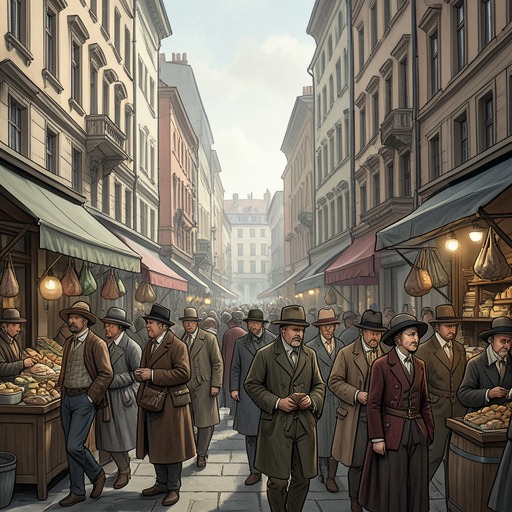
A bustling account of everyday life places the house within a broad civic routine of meals, schooling, shop goods, and changing prices. Breakfast has its horn, lunch and dinner their chimes; familiar products remain in shop windows, while meat and coal supplies fluctuate. Children attend school, and their writing and arithmetic sit alongside the ordinary business of purchasing food and fuel. The house belongs to this recurring world of household provision and routine, where repetition coexists with small changes in prices, products, and family life.
Across its appearances, HCE’s house shifts between bedroom, unfinished building, lodging, family home, and a point on the route of public and commercial encounters. Its furniture and clothing anchor it in domestic particulars, while the unfinished stairs and changing descriptions deny it the solidity of a fixed, fully explained setting. The result is a house that gathers private life and public narration under one roof: a home whose rooms can be inventoried, whose thresholds can be tested, and whose identity changes as the surrounding stories return to it.