Isolde
Finnegans WakeIsolde is Tristan’s beloved in a shipboard encounter that the Four Old Men secretly watch. Her scene is not presented as an isolated romance: the lovers’ physical intimacy, the observers’ remembered past, and the passage’s many-layered allusions make the encounter recur across legendary and historical time.
Identity and Introduction
The passage names Isolde through several forms, including Usolde and Iseult, and casts her as the woman Tristan embraces aboard a slowly moving ship. She is dressed in maiden blue under a gold-flecked net overdress, and the narration calls her the hero’s chosen beloved. These details establish her as the focus of the scene, while its shifting names place her within a deliberately unstable field of retelling.
The Shipboard Encounter
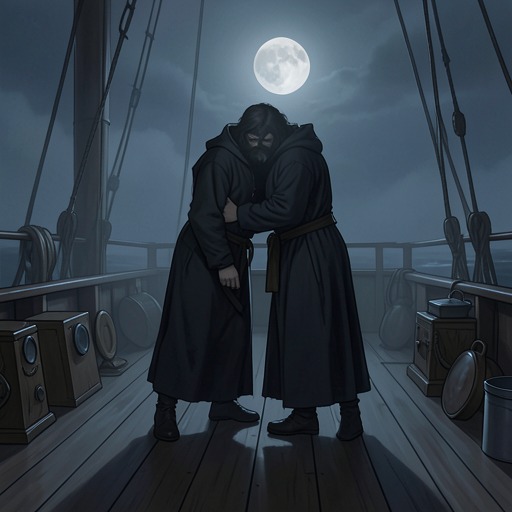
Tristan cuddles and kisses Isolde on a small loveseat behind the chief stewardess’s cabin. The narration presents the intimacy as palpably improper, describing his dexterous handling of her clothing and his movements around her; the lovers’ closeness is thus both tender and transgressive. Their encounter unfolds while the ship moves slowly under light winds, with seabirds wheeling above it.
The scene’s language turns the lovers’ exchange into a chain of verbal transformations. Tristan speaks in playful, entangled wordplay about one, two, and three, so that kisses and lips become part of the passage’s unstable counting. The lovers’ private intimacy is consequently absorbed into the book’s broader pattern of words that mutate as they are repeated.
The Four Old Men as Witnesses
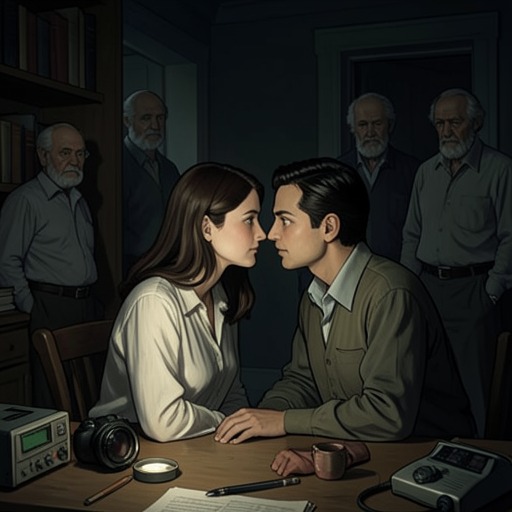
The Four Old Men listen from a distance, straining their ears as the ship passes through darkness. They are identified as Matt Gregory, Marcus Lyons, Luke Tarpey, and Johnny MacDougall, and the narration calls them the four master waves of Ireland. Their repeated recollection of being four, including the grace they once said before fish, gives their vigil a ritual, cyclical quality: old companions listen together as though the present scene has returned them to earlier days.
Their watching also links the shipboard encounter to their memories of youthful mischief and earlier scenes of courtship. The narration recalls them as collegians and natural lovers of nature, then makes the present intimacy bring those prehistoric scenes back with the freshness of the past. Isolde’s encounter with Tristan therefore becomes a point where private desire and the observers’ collective memory converge.
Legendary Echo and Narrative Significance
The closing appeal to hear Iseult the fair and Tristan, the sad hero, recasts the scene in the register of public lament and performance, accompanied by the Lambeg drum, reed, fife, and brass. Isolde’s identity is therefore not fixed to one private moment: she is at once the beloved watched aboard ship and a figure repeatedly summoned by legend, music, and memory.
That recurrence is central to the passage’s effect. The watchers, the lovers, and the birds occupy a single scene, but the narration continually folds it into older times and other tellings. Isolde is less a fully elaborated personal history here than the enduring center of a scene whose meanings multiply as it is overheard and remembered.