Jute
Finnegans WakeJute is a questioning traveler whose encounter with Mutt makes the book’s shifting, multilingual language audible as a negotiation between strangers. He arrives through a landscape of invented words and unstable identities, tests whether the other can be understood, and proposes an exchange; later, his short interventions frame reflections on burial, recurrence, and the legibility of a world imagined as a clay book. His role is less a conventional character arc than a listening and responding presence through whom the text stages the effort to make meaning together.
Identity and Introduction
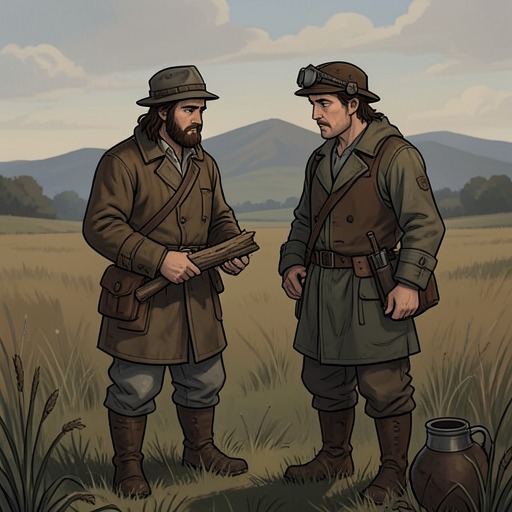
Jute appears in an early dialogue with Mutt, introduced after a passage crowded with allusions, mutations, and interrupted beginnings. The encounter opens with a description of a strange figure, then identifies him as Jute; the surrounding speech makes even recognition provisional. Instead of establishing a stable biography, the scene gives Jute a place in a pair: he is the speaker who addresses Mutt, answers his sounds, and attempts to set their exchange in motion.
The first meeting is built around the difficulty of naming. Jute tries several languages or language-like registers in succession, receiving refusals or negative responses, before clearing the way for a simpler conversation. The sequence makes his identity relational and performative: he is recognizable not through an account of his past, but through the questions he asks and the terms of contact he offers.
Encounter and Attempted Exchange
Jute’s opening greeting is answered by Mutt with a distorted expression of pleasure. The exchange does not settle into transparent communication; its sounds keep bending familiar words into something strange. Jute responds by asking whether Mutt is a particular sort of person, continuing to test the limits of recognition rather than treating the first reply as proof of understanding.
He then tries to cross the gap by proposing that they swap hats and exchange a few words. The gesture joins a material object to speech: a hat can change hands even when language remains uncertain, and the proposed trade makes conversation itself seem like something negotiated between two parties. Jute’s effort is practical and comic at once, but the scene does not grant him complete command of the encounter. Mutt’s replies remain as opaque and mobile as his own.
The exchange develops through a further symbolic offering. Jute urges Mutt to move past hesitation and presents a piece of oak as sylvan coin, linking a woodland object to currency and to the commercial value of Guinness. The offer turns the encounter into a miniature economy of signs: wood, money, drink, speech, and recognition overlap without collapsing into a single fixed meaning. Jute does not simply explain the world to Mutt; he proposes a shared token by which they might continue in it.
A Voice Among Ruins and Signs
Jute returns in brief interventions as the dialogue approaches images of burial and historical recurrence. When Mutt speaks of the dead lying under the mound and life continuing through the night, Jute answers with an exclamation of disgust. The reaction is sharply limited, but its placement matters: it punctures the solemn language of burial and leaves the exchange between irreverence and ritual unsettled.
Later, Jute asks a short question in response to Mutt’s hushed reference to the giant Forficules and the fairy Amni. The moment again casts him as a listener whose questions invite continuation without resolving what has been said. His presence helps the dialogue move by interruption, echo, and partial comprehension rather than by a continuous explanatory account.
That listening role opens onto a larger meditation on reading. The text asks its addressee to stoop toward a clay book of signs and wonder whether its world can be read, insisting that it is the same tale told many times. It then describes a chain in which impression produces knowledge, knowledge finds names, and contact leads through sensation, desire, attachment, death, birth, and existence. The passage does not identify Jute as the sole reader or author of this world; instead, the dialogue’s uncertain understanding prepares for a text in which meaning must be approached as a process of contact and interpretation.
Narrative Role and Significance
Jute’s exchanges with Mutt provide a compact dramatic form for the book’s broader language-making. Their speech draws on recognizable sounds and phrases while deforming them, so that comprehension is neither simply present nor absent. Jute’s language tests, questions, proposed hat-swapping, and oak token make that instability an encounter between voices rather than an abstract feature of the prose.
This pattern resonates with the book’s account of the proteiform graph: a document that takes on multiple personalities and whose traits coalesce into a temporarily stable someone. The text’s writing, like the meeting between Jute and Mutt, holds shifting readings in tension; apparent contradiction and verbal mixture are not noise to be cleared away but conditions of interpretation. Jute is one of the figures through whom that principle becomes conversational and material.
Later, Shaun introduces the fable of the Ondt and the Gracehoper, another episode in which a story is offered within the book’s unstable, multilingual performance. Jute is not identified as the teller of that fable, and the dialogue scenes do not supply a concluding account of his fate. His significance lies instead in the recurrence of a basic situation: a voice addresses another, tries to be understood, and turns words and objects into provisional bridges across difference.