Jute–Mutt dialogue
Finnegans WakeThe Jute–Mutt dialogue stages an encounter in which recognition is attempted but never secured: Jute asks who Mutt is and what has happened to him, while Mutt answers through unstable speech, allusion, and images of a landscape marked by history. Their conversation is at once comic and epistemological. Its speakers cannot fully understand each other, yet their failed communication opens onto the book’s larger concern with how language carries, distorts, and continually remakes the past.
Meeting and Misrecognition
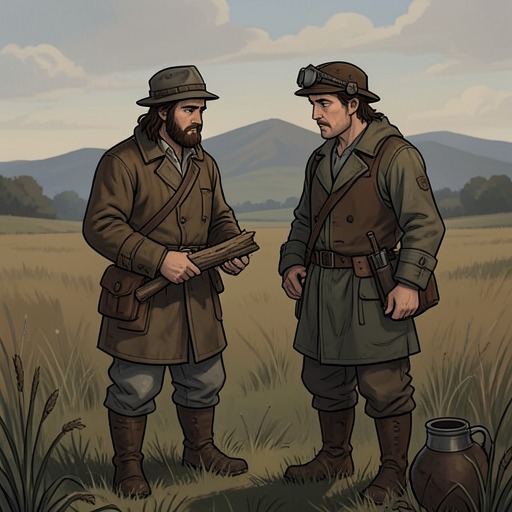
The exchange begins with a narrator’s elaborate portrait of a solitary figure: short-shinned and physically distinctive, eating from a skull-like vessel and compared to a dragon. He is identified as a Jute, but the introduction makes identity feel less like a settled fact than a performance assembled from sound, pun, and visual impression. Jute is invited to exchange hats and verbs with his companion, a gesture that makes their conversation a reciprocal game even as their words remain difficult to parse.
The first exchanges establish the imbalance between asking and understanding. Jute greets Mutt, asks whether he is deaf, and follows with questions about what troubles him. Mutt’s replies are brief and equivocal: he says that he has become a stammerer, and later describes his voice as nearly inedible to Jute. Jute’s questions seek a clear identity and account; Mutt’s answers foreground the difficulty of producing and receiving speech. The dialogue does not resolve that difficulty through explanation. Instead, it makes imperfect comprehension the condition of their meeting.
Voice, History, and Landscape
Mutt’s account points toward the Inns of Dungtarf and an earlier landscape, while the pair’s speech keeps slipping between recognizable words and transformed forms. Jute’s request that Mutt become more intelligible gives the scene a practical surface, but the fractured language also resists the idea that meaning can simply be recovered by asking the right question. The speakers share an encounter without sharing a stable code.
The landscape they invoke is not merely scenery. Jute remarks that a taciturn authority has dumped a whole store of refuse onto the soil; Mutt likens the resulting trace to a pudding stone in a brook beside a river pool. The exchange associates speech with sediment: words and histories accumulate, mingle, and remain only partly legible. Their surroundings are described as an old plain and later as a place where generations are tombed into the mound, with dust returning to dust. These images make burial and inheritance part of the dialogue’s account of the past.
Jute’s exclamation of disgust and Mutt’s reply, a compressed play on what has been and what is, sharpen the contrast between present speech and buried time. The encounter does not present history as a continuous, transparent record. It surfaces in fragments—names, ruins, remains, and altered phrases—which the speakers can touch but not completely reconstruct.
Reading the Claybook
The dialogue expands from conversation into an invitation to read. The text describes a claybook whose signs ask to be stooped over and deciphered, and asks whether its world can be read after the two speakers have already disputed it. The answer is paradoxical: this is a tale repeatedly told, many stories at once, formed through successive mixtures. The book’s material image joins writing to earth, while its layered signs turn reading into an encounter with both inscription and archaeological residue.
A long chain traces how impression knits knowledge, knowledge finds names, and names lead through sensation and desire toward attachment, death, birth, and continued existence. This sequence makes the act of reading part of a larger cycle: signs do not stop at a single interpretation but connect perception to life and recurrence. The dialogue’s dense wordplay therefore performs the problem it describes. Its language invites decipherment while multiplying the possible routes through the text.
The claybook’s small figures and objects make that principle concrete. Bellicose figurines are shown mounting and arming; a small effigy stands for a weapon, while tiny pellets become part of a figurative payroll. The passage also inventories aged eggs, household odds and ends, and snakes that appear to swarm through a rubbish heap. These details bring the grand history of conflict and civilization down to fragments and discarded things. The reader is asked to stoop, inspect, and assemble meaning from a collection whose pieces do not yield a single, simple account.
A Relation Made of Uncertainty
Jute and Mutt are defined less by a settled biography than by their contrasting positions in an ongoing exchange. Jute presses for answers and reacts when Mutt’s voice frustrates understanding; Mutt answers, redirects, and supplies images that widen the discussion from personal difficulty to landscape and history. Neither speaker becomes an all-knowing interpreter. Their interaction instead exposes the limits of any claim to possess the whole story.
The scene’s significance lies in the way that limit becomes productive. Their inability to communicate plainly does not end the encounter; it generates a richer field of associations involving speech, earth, memory, and interpretation. The Jute–Mutt dialogue thus introduces a characteristic relation in the book: two voices meet across difference, exchange partial meanings, and leave the reader to negotiate the unstable signs between them.