Kersse–Norwegian tailoring bargain and voyage
Finnegans WakeKersse–Norwegian tailoring bargain and voyage is a brief commercial encounter that expands into a sea journey. Kersse agrees to make clothing for the Norwegian’s lady, and the ship’s husband then departs with his vessel; the transaction joins the measured language of tailoring and payment to the open-ended movement of a voyage.
The tailoring bargain
The exchange begins with a question about finding a suit and tailoring it. The ship’s husband identifies a tailor, and the bargain specifies trousers for his lady, patterned after a cassock. Kersse demonstrates the work through gestures associated with measuring and preparing cloth, then promises a suitable result. The conversation’s procedural details make the encounter concrete even as its language continually transforms ordinary terms through sound and verbal invention.
From payment to departure
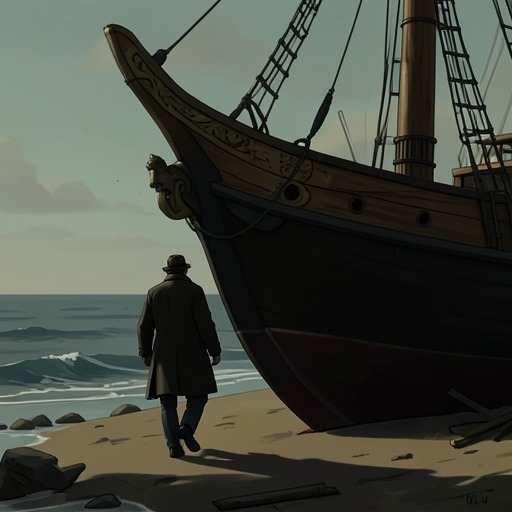
The scene shifts from the agreement to the ship’s departure. The ship’s husband calls for the lugger and sets out on a northern route, while the narration traces a journey across named seas and coasts and gives its duration as forty days and forty nights. The earlier tailoring exchange thus becomes part of a larger movement: a local commission is followed by a voyage whose route opens outward across the water.
Trade, language, and movement
The passage binds commercial exchange to travel. Cloth, a promised garment, and the ship’s departure occupy the same narrative sequence, while a later image of coins being passed and goods stored aboard a ship extends the scene’s association between money and maritime movement. The bargain is not presented as an isolated business transaction; it belongs to a world where value, work, and passage repeatedly change form.
The scene’s multilingual, punning diction makes that transformation part of its method. Tailoring vocabulary, negotiation, and nautical language run into one another, so the practical bargain is legible without settling into a single stable register. The voyage carries the scene beyond its immediate exchange, leaving commerce and movement intertwined rather than neatly concluded.