Marcus Lyons
Finnegans WakeMarcus Lyons is one of the four old men who listen as Tristan and Isolde embrace aboard a ship, and one of the voices through which their scene returns as memory. He belongs to a quartet whose repeated self-identifications, recollections, and listening turn individual witness into a collective act of retelling.
Identity and the Four Old Men
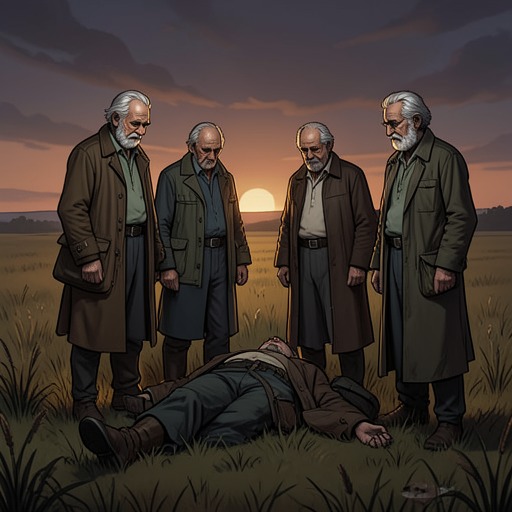
Marcus is named among the four old men alongside Matt Gregory, Luke Tarpey, and Johnny MacDougall. They call themselves the four waves of Erin and recall saying grace together before fish in Miracle Squeer, where their effort to count themselves repeatedly circles back to the same four companions. Their communal speech presents Marcus not as an isolated observer but as part of a tightly bound company whose identities are carried in a refrain of names and shared habits.
The quartet’s “four waves” identity joins their human presence to the sea surrounding the ship. They listen from the dark while the vessel moves slowly, and the narration repeatedly returns to all four of them hearing the lovers. Marcus’s place in the group is therefore both social and structural: he helps make the scene a remembered story told by several witnesses at once.
Witness to Tristan and Isolde
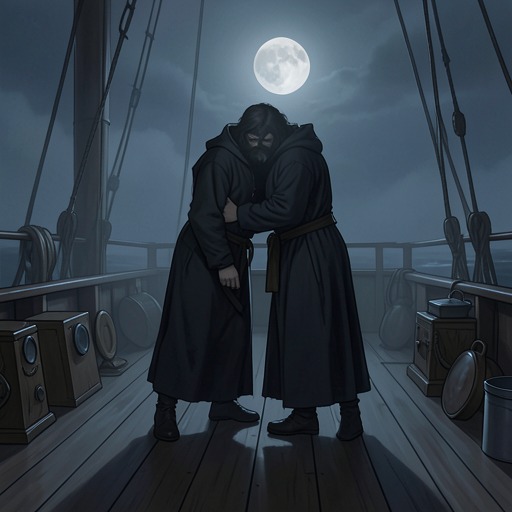
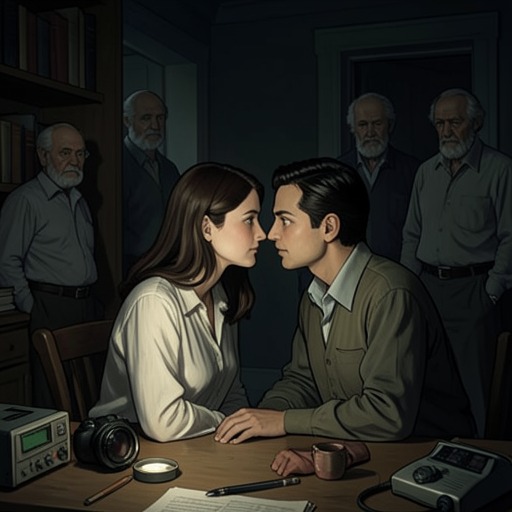
The four men listen while Tristan cuddles and kisses Isolde in the ship’s cabin. The scene is presented through a densely shifting, comic register that makes their listening conspicuous: their eyes glisten, their ears strain, and the intimate encounter becomes the object of a shared, almost ceremonial act of recollection. Marcus is not assigned a separate response from the others; his significance comes from witnessing as one of the foursome.
The narration draws the lovers’ shipboard intimacy into older memories and historical-sounding recollections. The four men remember the scene as something that has happened before, linking the present listening to bygone times and familiar communal rituals. Marcus thus participates in a narrative in which an intimate episode is never merely private: it is overheard, remembered, and absorbed into the company’s repeated account.
Memory, History, and Repetition
When the narration identifies Marcus as speaking, his voice joins the quartet’s broader recollection of histories, lectures, and inherited accounts. The old men’s listening is set beside expansive retellings of Ireland and the past, while the narration folds in dates such as 1132 and 1169 and images of drowned figures and remembered losses. These materials do not settle into a straightforward chronology; they accumulate as fragments in the old men’s shared memory.
Marcus’s narrative role is consequently defined less by an independent biography or a personal arc than by his position in a chorus. The foursome listens, recalls, and repeats, and the story’s movement between shipboard intimacy, communal remembrance, and historical echoes makes repetition itself part of his characterization. His presence anchors the scene in a group, while the group’s unstable recollections keep the scene open to recurrence and reinterpretation.