Mutt
Finnegans WakeMutt is the halting, interpretive speaker in the opening dialogue with Jute, a figure through whom Finnegans Wake turns an encounter between strangers into a test of language, memory, and historical recurrence. He begins as a disoriented observer who names himself only as an “utterer,” but becomes a guide to the landscape’s buried traces and to a book of signs in which generations of human life seem to repeat. His speech is not a transparent report: its puns, phonetic distortions, and language-mixing make the act of understanding part of the scene itself.
Identity and Introduction
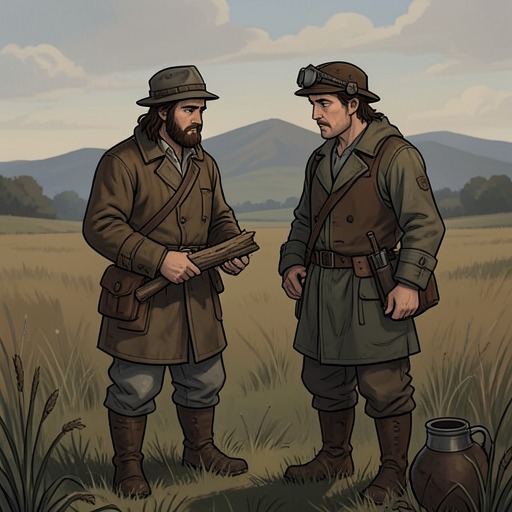
Mutt first appears as a markedly misshapen figure seen from outside. The description gives him a distorted head, a short foot, locked toes, short shins, and conspicuous chest muscles; he is eating from what is figured as a brainpan. The observer calls him dragon-like and associates him with a “fief” nearby. This grotesque introduction establishes Mutt as a body to be interpreted as much as a person who speaks.
The encounter then shifts from description to dialogue. Jute greets Mutt, who replies with a mangled version of a courteous welcome. Asked whether he is a particular person, Mutt gives an uncertain answer; when Jute presses him to explain himself, he says he is “Only an utterer.” The self-description is modest but also programmatic: Mutt’s presence in the episode is chiefly vocal, and his identity emerges through the unstable language with which he tries to meet Jute.
The Dialogue with Jute
Jute and Mutt do not share an easy conversational ground. Jute asks questions about Mutt’s identity and condition, while Mutt’s answers repeatedly twist the expected words. When asked what is the matter, Mutt says, “I became a stun a stummer.” Jute treats this as a bewildering condition and asks how it came about; Mutt answers with another compressed, punning phrase. The exchange presents speech as both the means of contact and the source of confusion.
The pair make a small effort toward accommodation. Mutt recognizes Jute’s pleasure, and the two agree to exchange hats and try out verbs in the region of their “blooty creeks.” The proposed exchange makes their encounter a kind of language lesson, though no stable common idiom follows. Mutt’s talk remains a sequence of near-recognitions, sound-play, and awkward recoveries; Jute’s questions provide a countervoice that keeps asking for clarification without resolving the words into a single meaning.
A fragment of intelligibility arrives when Mutt recognizes a “greytcloak” associated with Cedric Silkyshag. The recognition turns a piece of clothing into a clue, but the naming remains as distorted as the rest of the conversation. The cloak, like the hats they propose to exchange, belongs to a world where objects can trigger recognition while leaving the identity behind them unsettled.
Landscape, Burial, and the Claybook
Mutt directs Jute toward a surrounding landscape that he describes as a plain belonging to “my Elters.” His invitation to walk around the island promises that they will see it for themselves. Elsewhere he speaks of what lies beneath: “Hereinunder lyethey.” The landscape thus becomes both a visible place and a ground marked by those who have been buried or have passed away. Mutt’s brief “Fiatfuit!” compresses the making and passing of things into a verbal turn, before he evokes a large, old, and continually renewed world.
The most sustained account of Mutt’s interpretive role comes when the dialogue turns to a “claybook” and its signs. The text asks whether its signs can be read and whether the world they make up can be understood. Mutt’s answer is neither a single key nor a settled history: it is “the same told of all,” a tale of repeated beginnings, mixtures, loves, departures, deaths, and births. The sequence links impression to knowledge, naming to sensation, desire to attachment, and death to birth, presenting existence as an ongoing chain rather than a straight line.
Mutt’s account also gives that recurring history a material form. The earth is probed at all hours, figurines are armed and mounted, and small signs or objects can stand in for wholes. A “middenhide hoard” contains an accumulation of named things, among them olives, beets, eggs, and old, worn objects. The list makes the past feel less like an orderly archive than a heap of fragments whose meanings must be recovered by stooping and looking closely. The signs are at once the remains of earlier lives and the raw material from which another telling can be made.
Snakes complicate this account of inheritance. Mutt describes the island as swarming with them, arriving from elsewhere and being caught in garbage cans; the passage ends by turning from their capture to “Racketeers and bottloggers.” The movement from snakes to human schemes folds natural infestation into social disorder. In Mutt’s landscape, history returns not as a pure repetition but as a changing mixture of relics, creatures, and exploiters.
Voice and Narrative Role
Mutt’s language makes him a guide who cannot simply translate what he guides the reader toward. His speech bends recognizable words into hybrid forms, and its repeated collisions of sounds make meaning feel both recoverable and perpetually unstable. Even a line such as “How wooden I not know it” makes the material world participate in the difficulty of knowing. The conversation asks for interpretation while continually showing how interpretation can produce more verbal transformations.
That method connects Mutt’s opening exchange to the wider book. Elsewhere, the text describes its “proteiform graph” as a polyhedron of scripture: a document bearing multiple personalities, whose contradictions can coalesce into one figure. Mutt’s claybook scene works in the same spirit. It treats signs as traces of many lives and histories, but refuses to separate them into a single, final account. His encounter with Jute therefore introduces not an authoritative explanation of the world, but a recursive practice of reading in which the reader, like Jute, must keep asking what the words have become.