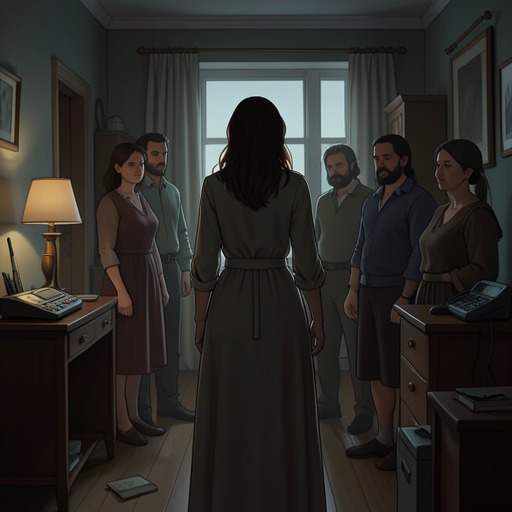
Nuvoletta
Finnegans WakeNuvoletta is a solitary girl who watches the Mookse and Gripes, tries in vain to draw either figure out of his absorption, and disappears into the river after their encounter ends. Her episode gives a sudden, personal shape to the passage’s paired failures of attention: the contestants remain fixed on their own pursuits, while the girl who watches them finally becomes part of the current that carries the narrative onward.
Identity and Introduction
Nuvoletta appears in a light dress described as spun from sixteen shimmers. She leans over the balustrade and listens to the Mookse and Gripes, alone while her companions sleep. The domestic details around her place this dreamy figure amid an ordinary household: her mother, Mrs Moonan, is away scrubbing the back steps of Number 28, and her father is upstairs in Norwood’s sitting room. Yet Nuvoletta’s attention is directed elsewhere, toward the two figures across the scene and toward her own reflected image.
The narration makes her simultaneously a listener, an observer, and a self-conscious performer. She watches the Mookse and Gripes, but the heavenly figure between them seems to obstruct her view; she also reflects upon herself and tries to make her reflection, Nuvoluccia, part of the encounter. Her identity therefore takes shape in a divided field of attention: she looks outward at figures who will not respond, and inward at an image that cannot answer her either.
Attempts to Be Seen
Nuvoletta tries to attract the Mookse and Gripes by performing the gestures and expressions available to her. She tosses her hair, rounds her arms, smiles at her image, and sighs as though she were destined to marry Tristis Tristior Tristissimus. The passage presents these actions as deliberate attempts to make herself noticed, but the two figures remain absorbed elsewhere. The Mookse is too far-seeing to look up; the Gripes is too intent on hearing his own concerns to attend to her. Her effort is not met with a competing claim or a direct rebuff so much as with indifference.
Her sigh compresses the discovery into a small declaration: “I see, she sighed. There are menner.” The word suggests that there are other people, or other ways of being, beyond the private world in which the two men are enclosed. But recognition does not open a path into their attention. Even Nuvoletta’s likeness cannot make them turn from their preoccupations, and the passage’s repeated contrast between seeing and hearing becomes a limit she cannot overcome: the Mookse can see but cannot fully hear, while the Gripes can hear but can scarcely see.
The Fable’s Dusk and the Girl’s Departure
As the scene darkens, the Mookse and Gripes cease their contest and continue to imagine what they may do next: the Mookse thinks of fathoming the depths, while the Gripes anticipates escape. Their attention remains turned toward their own intentions. The dusk deepens along the banks, and the two figures are eventually taken away separately by women from opposite sides of the river. One carries off the Mookse; another removes the Gripes. The unequal, divided ending of their encounter leaves only an elm tree, a stone, and Nuvoletta.
At that point, she gathers her many drifting thoughts into one, cancels her engagements, climbs over the balustrade, and gives a childlike cry. Her light dress flutters, and she is gone. The decisive change is abrupt: the girl who had watched and tried to intervene does not secure a place in the scene but exits it. The passage does not explain her departure as a resolved choice with a stated motive; it presents the gesture and disappearance, leaving their emotional meaning to the sequence around them.
The River and Narrative Significance
Nuvoletta’s fall transforms the stream into a river through the accumulation of tears. A single tear is distinguished as the loveliest and as a “leaptear,” linking the girl’s leap with the water’s growth. Her name is also muddied into Missisliffi, so that her disappearance is figured not as a clean break from the scene but as a change of form within its flowing landscape. The river continues, lapping as though it had a heart, and speaks the canonical line “Why, why, why! Weh, O weh I'se so silly to be flowing but I no canna stay!” The line is the passage’s closing cry of grief and motion: the river cannot remain still, just as Nuvoletta cannot remain the watcher on the bank.
The episode thus binds a personal disappearance to the work’s recurrent river imagery and its concern with unstable identity. Nuvoletta passes from girl and listener to a name associated with the river, while the water takes her tear into its continuing course. Her brief effort to be seen contrasts with the Mookse’s and Gripes’ absorption in themselves; when their contest dissolves into separation, her own exit carries the scene’s most intimate consequence. The narration closes not with an explanation of her fate but with the river’s ongoing voice, leaving loss and movement inseparable.