Ondt–Gracehoper
Finnegans WakeThe Ondt–Gracehoper relation is staged as an insect fable of radically different habits: the Gracehoper moves through life in play and pleasure, while the Ondt makes cold spaces, guards his standing, and enjoys the comfort the other lacks. When the Gracehoper arrives hungry and destitute before the Ondt at ease in his sunny room, their contrast sharpens into a comic reckoning over work, debt, and time. Yet the encounter does not settle into a simple lesson: the Gracehoper both accepts reproof and turns the final challenge back on his prosperous rival.
The fable’s opposing figures
The episode is introduced as a fable of the Ondt and the Gracehoper, one of the “grimm gests of Jacko and Esaup.” The Gracehoper’s defining motion is restless play. He is “always jigging ajog,” drawn into games, flirtations, and the company of Floh, Luse, Bienie, and Vespatilla. The account makes pleasure expansive and bodily, a succession of invitations and dances rather than a settled occupation.
The Ondt is fashioned as the contrary figure. He makes “chilly spaces” in his windhame and refuses the invitation to join the Gracehoper’s party, reasoning that the other is not on his social list. His repeated wish that his reign should flourish gives his caution a note of ambition: he imagines a domain growing in scope and height, while the Gracehoper’s days spill across diversions and acquaintances.
Want and the reversal of fortune
The Gracehoper’s pleasure does not protect him from need. After his passage through love, debts, and the doubts of life, he becomes sick and poor, without food or shelter. His lament that he has not a pickopeck of money to obtain even a little beebread brings the fable’s economic contrast into focus: the lively abundance of his earlier social world has not left him materially secure.
His appetite for experience is rendered as consumption of things that cannot sustain him. He has eaten “all the whilepaper,” swallowed lustres, devoured forty flights of staircases, and chewed up mensas and records. Even time and place have been figuratively consumed, yet none of this yields nourishment. At Christmas, with bare branches, he leaves Tingsomingenting; winter weather follows him through a distorted landscape of snow, sleet, and noisy disturbance. The seasonal turn makes his change from exuberance to exposure visible without turning it into a straightforward, realistic moral tale.
The encounter in the Ondt’s sunny room
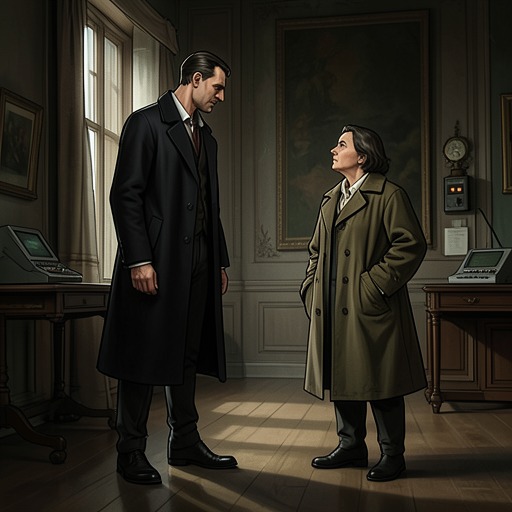
The Gracehoper eventually finds the Ondt enthroned in comfort. The Ondt is sated before a plate of food, surrounded by the very insects who had been part of the Gracehoper’s former company. Floh bites his leg, Luse clings to the other, Bienie kisses him, and Vespatilla attends him. The scene reverses the earlier social pattern: the Gracehoper once solicited their company, but now they cluster around the Ondt, who receives their attentions from a position of ease.
The Ondt’s performance of prosperity is also an assertion of rank. He appears on a throne in elaborate dress, smoking cigars and taking pleasure in his room, while the Gracehoper confronts him in his own diminished state. The contrast is sharpened by the Ondt’s apparent self-command and the Gracehoper’s physical and financial distress. But the language keeps turning pomp into comic excess: the throne, the grand self-display, and the heavily ornamented names do not provide a stable courtly or social world so much as a shifting stage for their rivalry.
Reproof, forgiveness, and unfinished challenge
The Gracehoper does not answer the Ondt’s comfort with simple accusation. He weeps, forgives him, and asks him to teach the other insects their dances and to see that Vespatilla has food. The request recalls the Gracehoper’s earlier life among them, but now speaks from a condition of loss. He also acknowledges a debt: having once played the piper, he must now pay the count. The fable makes pleasure and obligation inseparable; the Gracehoper’s generous, playful existence has left him exposed to the reckoning he names.
His words accept the Ondt’s reproof as a friend’s “horsegift,” while recasting the Ondt’s saving of him as something with a price. The exchange is therefore neither an uncomplicated reconciliation nor a victory for either figure. The Gracehoper recognizes what he owes, but he also keeps speaking in riddles, reversals, and paired terms. Near the end, he praises the Ondt’s worldwide genus and sublime spaces, then asks why he cannot “beat time.” The closing challenge exposes a limit within the Ondt’s apparent mastery: security and order may flourish, but the fable leaves open whether they can answer the Gracehoper’s sense of rhythm, duration, and change.
Form and significance
The relation is carried by a language that refuses to stay still. Insect names, social titles, economic terms, seasonal markers, and fragments of other registers collide in the fable’s sentences. That verbal abundance mirrors the Gracehoper’s dispersal into experience, while the Ondt’s insistence on chilly spaces, social exclusion, and a flourishing reign supplies an opposing image of separation and control. The contrast is real, but its expression continually mutates, preventing either character from becoming a plain, single-minded moral example.
The fable also makes its ending part of its argument. The Gracehoper can confess want and accept correction without surrendering the right to question the Ondt’s way of being. His final appeal to time returns the conflict to movement: the creature who seemed ruined by his restless life still possesses the rhythmic question that the settled, prosperous Ondt cannot readily answer. Their opposition remains unresolved, suspended between the costs of pleasure and the barrenness that may accompany order.