River Liffey
Finnegans WakeThe River Liffey is more than a named waterway in the book: in the river imagery associated with Anna Livia, it becomes a moving voice that travels through the landscape, carries news, and joins local geography to the dream’s restless transformations.
River and Landscape
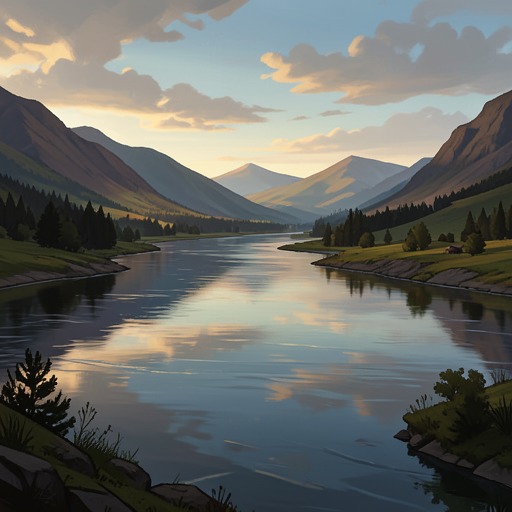
The river is evoked through the movement of Anna Livia, whose course passes under bridges, over weirs, around bends, and by bog and hillside. The sequence names Tallaght’s green hills, the pools of the phooka, Blessington, and Sallynoggin, mapping her passage through a recognizably Irish landscape while making that passage feel continuous and changeable. The water does not simply frame the scene: its turns and currents give the landscape its motion.
The river’s physical movement is also rendered as speech. Anna Livia is described as babbling, bubbling, and chattering to herself, and the river’s journey becomes inseparable from the voice that tells it. Water, woman, and narration overlap: a place can be heard as well as seen, and the river’s course gives verbal form to circulation and change.
Waters in the Dream World
Elsewhere, the river appears within a much stranger aquatic field. Fish in Liffeyetta’s bowl stop squiggling as the passage gathers together images of Junoh, the whale, and the limits of knowledge. This stillness contrasts with Anna Livia’s earlier rapid movement: the water-world can carry ceaseless motion, but it can also fall quiet within the dream’s shifting scene.
The name Liffeyetta turns the Liffey into a diminutive, intimate presence, at once a river and an image refracted through the book’s fluid wordplay. Its appearance among fish and other transformed creatures places local water within a larger, unstable imaginative environment rather than fixing it as background scenery.
Human and Legal Echoes
The river also enters the book’s social and legal language. In a mock trial, the jury is described as a jury of the Liffey, bringing the waterway into the court’s crowded satire of contractual claims, marriage proposals, and property law. The judgment invokes the principle that a corpse cannot be owned as property, and the river’s name lends the imagined jury a local, collective character.
Across these appearances, the Liffey connects landscape, voice, aquatic imagery, and public judgment. It is both a route through named places and a recurring medium through which the book turns geography into movement, language, and social imagination.