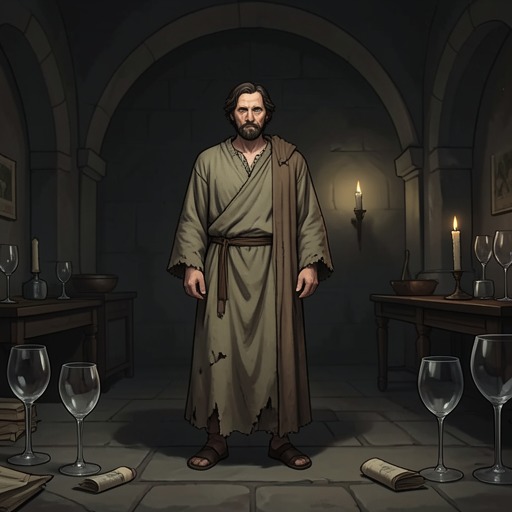
Roderick O’Conor drinks the banquet leftovers
Finnegans WakeRoderick O’Conor drinks the banquet leftovers in a burlesque aftermath of kingship: after his guests have departed, the aging ruler wanders through the abandoned drinking vessels, consumes their dregs, and ends collapsed on his throne. The scene makes a king both the last remnant of a feast and its most diminished participant, while its winding, multilingual narration converts royal solitude into a performance of bodily excess.
The Feast and Its Abandoned King
The episode follows a long gathering at Glenfinnisk, held on a day described as both a thanksgiving get-together and the anniversary of Roderick’s first communion. Its host is presented as a hospitable former king, around fifty-something years old, whose house is crowded with the material signs of abundance: a hundred bottles, a radio-beamer tower, hangars, chimneys, and other architectural appendages. The feast is over, however, and the company has dispersed to its own castles and homes. The scale of the occasion gives way to a single man among its remains.
The narration’s mock-historical account complicates Roderick’s title. He is called the paramount chief and the last pre-electric king of Ireland, yet the account immediately qualifies the claim: another king had preceded him, and Roderick is still, in a sense, king in his own time. This unstable succession makes sovereignty less a settled historical fact than a role passed between comic, exaggerated figures. Roderick’s isolation therefore follows not a formal abdication but the dispersal of the social world that had temporarily gathered around him.
Drinking the Remnants
Once alone in his grand house, Roderick picks his way through spilled wine and discarded corks, described as deep around the royal table. The image reduces the scale of the feast to its disorderly residue. Dressed in a motley assembly of garments and accessories, he moves through the wreckage like a solitary survivor of the gathering, his regal status set against the vulnerability and pathos of the body the narration invites the audience to pity.
The drinking is not confined to one favored beverage. Roderick collects the surplus left in the bottoms of the guests’ vessels, taking it from a jumble of drinks that includes Guinness, Phoenix Brewery stout, Jameson whiskey, Coca-Cola, and Dublin ale. The narration estimates the total at considerably more than the better part of a gill or naggin. The quantities and brands give his solitary excess a concrete, domestic scale: he is not presiding over a fresh royal banquet, but consuming whatever the departed drinkers have left behind.
His thirst is described as sudden and urgent, and the narration lingers over the act through repetitive, tumbling language. The movement from scattered dregs to a single accumulated drink turns the aftermath into an inverted feast: the guests have gone, but their half-finished abundance is gathered into the king’s private, indiscriminate consumption. What remains of communal hospitality becomes an episode of solitary appetite.
The Fall Back to the Throne
The ending joins collapse to enthronement. After drinking, Roderick comes down onto an accommodation seat and finally slumps to the throne. The throne survives as a symbol of rank, but the king who occupies it has been overcome by the feast’s leftovers and his own drinking. His return to the seat of power is thus not a triumphant restoration; it is a bodily slump, with the grandeur of the royal setting measuring the indignity of his condition.
The episode’s comic reversal depends on the contrast between public majesty and private depletion. Roderick has been introduced in extravagant historical terms, yet his last action is to drink remnants and fall back onto his throne. The scene grants him neither a political decision nor a renewed command: it closes on the image of a ruler reduced to the final, exhausted participant in a celebration whose other guests have already disappeared.
Narrative Form and Significance
The telling repeatedly circles, interrupts itself, and piles titles, names, brands, and verbal distortions around a comparatively simple action. Its digressive momentum makes the reader wait while the narrative enlarges Roderick’s supposed royal stature and the circumstances of his solitude; then the long verbal procession resolves in the plain physical fact of his slump. The delay is part of the joke: the language raises a king into legend only to return him, through drink and bodily fatigue, to the floor-level disorder of the feast.
Roderick’s solitary drinking also echoes the book’s larger recurrence of fall and return, but here the return to the throne remains deliberately compromised. He occupies the royal seat again, yet only as a collapsed drinker amid what the company has left. Kingship, hospitality, and appetite meet in one after-hours tableau: the ruler’s authority endures as an object and a title, while the scene’s final force belongs to the residue, the body, and the fall.