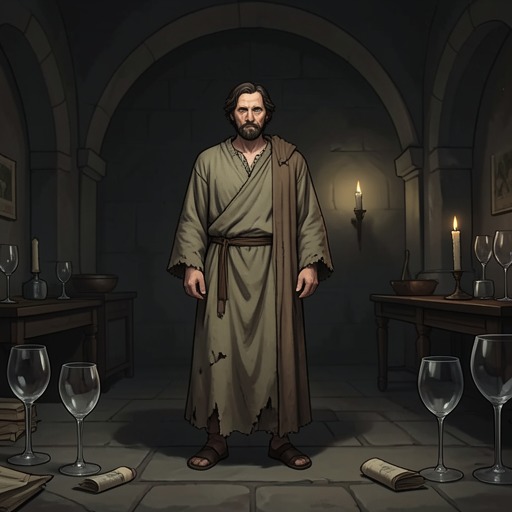
Roderick O'Conor
Finnegans WakeRoderick O'Conor is the former king of Ireland whose ceremonial abundance gives way to solitary drinking after a communal feast. Introduced as a paramount chief and the last pre-electric king, he is left behind when his guests disperse; he then scavenges the dregs of their drinks, consumes more than a measure of liquor, and finally slumps onto his throne. The episode makes royal authority both a spectacle of titles and a body overcome by its own appetite, ending with Roderick’s image receding into a mock-voyage of departure.
Identity and Background
At the gathering at Glenfinnisk-en-la-Valle, described as a Thanksgiving get-together and the anniversary of Roderick’s first communion, he is introduced as the hospitable host and an Irish king. The narrator calls him the paramount chief polemarch and last pre-electric king, then complicates the title: Roderick is not literally the last king of all Ireland, since an earlier ruler had preceded him. His royal status is thus narrated through qualification, inheritance, and comic correction rather than presented as a stable historical fact.
Roderick is said to be somewhere between fifty-odd and fifty-even years old at the time of the feast. His house is an immense, shadowy residence associated with a hundred bottles, a radio-beamer tower, hangars, chimneys, and other architectural features. The grand setting magnifies the contrast that follows: the scene’s kingly abundance can persist in the building and its furnishings even after the company that animated it has gone.
The Feast and the Empty House
The narration first establishes the scale of the gathering through its many departures. The guests go off to their own castles, on foot or horseback, in an extended procession; the account sweeps in named peoples, legendary groups, and local wanderers before dismissing them collectively as people of little importance to Roderick. Their departure empties the house and leaves the king alone in the aftermath of the meal.
The feast’s remains are not merely a backdrop. Wine spillage and discarded, weevily popcorks lie knee-deep around the royal table, converting hospitality into debris. Roderick’s solitary action begins among these remnants: he moves through the scattered drinking vessels, picking up the leftover contents after the homegoers and other drinkers have departed. The sequence turns the public banquet into a private inventory of what has been abandoned.
The King Drinks the Leftovers
Roderick’s clothing and bearing retain the materials of a royal caricature: a pull-on hat, shirt, collar, gloves, swaggering garments, ready-made clothes, and a pan-European poncho. Yet the narration sets this decorated figure against the sight of a man overwhelmed by ruin, comparing him to a sponge out of water. His clothing advertises status and theatrical presence; his physical condition suggests depletion.
Alone, he sings and strums for himself, moving through varied tongues and an old, plaintive drawl. A regal belch punctuates this self-entertainment, after which the narration makes thirst the immediate force of the scene. Roderick lowers his throat and drinks the surviving liquor from different vessels, swallowing whatever is left rather than selecting a single prized bottle.
The remains include several named kinds of drink: Guinness’s stout, Phoenix Brewery stout, John Jameson and Sons, Roob Coccola, and O’Connell’s Dublin ale. The narrator estimates the mixed quantities at considerably more than the better part of a gill or naggin, using the language of imperial dry and liquid measure. The detail makes his consumption both grandly catalogued and unmistakably scavenged: the king’s final drink is assembled from the bottoms of other people’s glasses.
Collapse and Narrative Significance
After drinking, Roderick comes down hard onto a makeshift seat or accommodation among the objects around him. The narration folds the landing into a mock-heroic sea image, bringing in a stout ship and the calls of a crew, before giving its decisive physical result: Roderick slumps to the throne. The throne remains the emblem of his kingship, but the body on it has yielded to exhaustion and excess.
His episode closes not with a restoration of royal command but with a sequence of farewells and departure. The ship sails away; the narration gestures toward a return and bids farewell, while the next episode begins. Roderick’s story therefore turns a king’s house into a temporary harbor: first crowded by guests, then occupied by the solitary host, and finally left behind in language that sends the scene onward. The comic contrast between inherited sovereignty and drinking the leftovers is the episode’s central image of a ruler whose title endures even as his feast, company, and bodily composure disappear.