Shaun’s postman colloquy
Finnegans WakeShaun’s postman colloquy brings the messenger into view as both a public figure and a divided brother: summoned in a dream, he appears in elaborate postman’s dress, defends his own reputation by attacking Shem, and then rolls out of reach as his lamp expires. The scene turns a performance of confidence into a farewell, while its shifting voices and dreamtime make arrival and disappearance parts of the same unstable event.
Dream Summons and Appearance
The scene begins in a sleeper’s uncertain time, at the “zero hour,” when laughter seems to ring from a church belfry and dim lights glimmer on moving water. The setting is not firmly fixed: the speaker is dropping asleep, dawdling along in a dream, and trying to distinguish an approaching figure from a shadow. From that indistinctness comes a summons for Shaun to post the post, voiced by the earth, the woodfires, and other elements of the sleeping world. The call makes his office seem at once ordinary and cosmic: he is a postman, yet the dream itself appears to require him as its messenger.
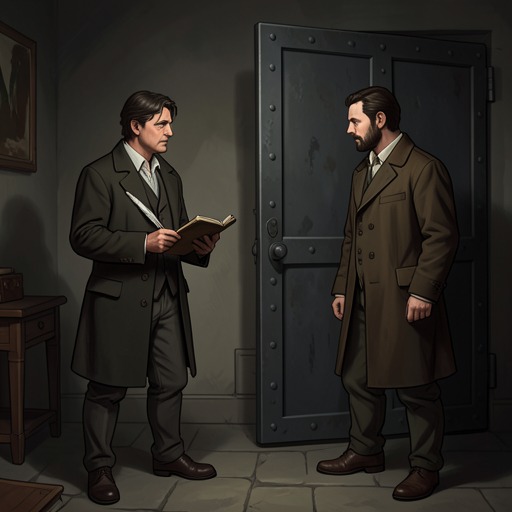
At first Shaun is only a wavering presence, then the light of his belted lamp makes him recognizable. His appearance is rendered through a catalogue of clothes and accessories rather than a simple identifying gesture: a rugged coat, thick-soled brogues, conspicuous red buttons, a burlap waistcoat, and a decorated overshirt bearing a postal motto. The outfit presents him as carefully equipped and ceremonially visible, a figure dressed for service and display. The narrator’s exuberant attention to his appearance turns the arrival into a formal entrance, as though the messenger were being dressed before an audience as well as recognized by one.
The vision insists that this is Shaun himself, not merely a shadow. Its narrator invokes learned witnesses and then swears to the reality of what has been seen, even while acknowledging the vision’s dreamlike unreliability. That insistence does not settle the scene into realism; rather, it makes recognition part of the performance. Shaun’s identity is confirmed through costume, light, and repeated naming, while the terms of that confirmation remain openly subject to the dream.
The Messenger’s Burden and Rehearsed Address
Shaun’s own address begins with a yawn and a weary complaint. He presents himself as exhausted by the load of his work and by the number of messages he must carry in the service of authority. The postal role is therefore more than a costume: it gives his speech its central image of duty, a burden of missives borne by a tired servant who describes himself as a mere messenger of peace. The contrast between the grandeur of his entrance and his account of fatigue punctures the ceremonial portrait without removing its importance.
The address is also a rehearsal shaped by accumulated time. Shaun’s words mingle memories of previous days with the present moment and anticipated futures; the account links his tiredness to what has already happened and to the demands still awaiting him. His speech keeps changing registers, turning official service into comic self-description and solemn complaint into verbal play. The messenger who seemed to arrive fully formed is thus shown composing and recomposing his public identity as he speaks.
Shaun and Shem
When the assembled voices challenge Shaun about his use of money and language, they contrast him with his “cerebrated brother,” Shem, whose writing is described as hesitant and marked on the page. Shaun sharply rejects that favorable comparison. He disparages Shem’s writing as illegible and attacks his character and reputation, presenting his brother as a contemptible figure rather than accepting him as an equal. The quarrel makes the brothers’ opposition explicit through competing claims about speech and writing: Shaun speaks as an accomplished public performer, while Shem is cast as the discredited writer.
Yet Shaun’s denunciation does not produce emotional distance. He becomes moved by love for his mother, with tears caught in her hair, and then breaks into an apologetic, self-conscious effort to recover his composure. The tenderness unsettles the bravado of the earlier exchange. His feeling for his mother is expressed through the same excess and instability that shape the rest of the scene, so that affection and mockery, grief and laughter, cannot be cleanly separated.
The scene’s portrait of Shaun consequently resists a single verdict. He condemns Shem in sweeping terms, but the intensity of the performance coexists with a capacity for tenderness and with visible weariness. His public confidence does not erase his dependence on family ties or his vulnerability to emotion. The colloquy makes those contradictions part of his character rather than resolving them into a final judgment.
Collapse, Disappearance, and the Extinguished Lamp
After looking upward through an expansive vision of time and the heavens, Shaun loses his balance and falls into a backward roll. The movement carries him away through named routes and landmarks, including Rattigan’s corner and Killesther’s lapes, until he is out of earshot and disappears. The text gives no settled account of his destination: it emphasizes the peculiar motion and the vanishing, leaving departure as an event witnessed in fragments rather than explained as a deliberate journey.
The lamp’s fate completes the retreat. After a brief passage in which Shaun and those around him are bound together by an affectionate dreamlike feeling, the light goes out because it cannot remain alight. That extinction echoes the way his entrance depended on the lamp to distinguish him from a shadow. The scene first makes visibility the sign of his arrival, then lets the light fail as he vanishes.
Shaun’s postman colloquy thus ends not with a resolved message or a stable public identity, but with disappearance. Its sequence—summons, recognition, self-defense, emotional exposure, upward gaze, rolling retreat, and extinguished lamp—turns the messenger’s appearance into a temporary illumination. His departure leaves the scene’s competing images intact: Shaun is at once celebrated and exhausted, hostile toward Shem and vulnerable to family feeling, present as the bearer of messages and absent before their delivery can provide a firm conclusion.