Shem
Finnegans WakeShem is the book’s writing brother: an elusive figure who appears as Jhem, Shen, O’Shem, and Shem Skrivenitch, and whose work becomes the target of Shaun’s elaborate denunciations. Yet the opposition is never clean. Shaun condemns Shem’s writing as theft and contamination while acknowledging that his own words derive from it; the brothers are divided by shame and folly, but remain joined in a shared verbal and familial identity.
Identity and first appearances
At the opening, Shem is already difficult to separate from Shaun: the names Jhem and Shen occur as paired figures, imagined as brewers whose malt has not yet been made into a finished product. The passage places them in a world where identities, histories, and language are still forming. Shem is not introduced through a stable biography but through this unstable pairing, which anticipates the book’s repeated treatment of him as both an individual and one term in a larger family pattern.
The text later supplies a more explicit genealogy for the writing associated with him. A document is described as carried by Shaun, written by Shem, and spoken for their mother, ALP, and their father, Hek. Its layered authorship and transmission make Shem’s role concrete while refusing to make it simple: he writes, but the text circulates through another brother and is voiced in the name of the mother. The document’s grotesque, fragmentary addresses and notices turn writing into a material record that has passed through many hands and has become difficult to read as a single coherent message.
Shaun’s attack on the writer
Shaun gives Shem the most sustained characterization, though it comes through hostile testimony rather than neutral description. He calls him “Mr O’Shem the Draper” and depicts him as a disreputable, illegible scribbler whose work is fit for censorship and confinement. The insults cast writing as a public offense: Shaun imagines Shem’s language being judged by courts, restrained by institutions, and shut away for its verbal unruliness. His denunciation makes Shem’s writing seem socially dangerous precisely because it resists ordinary standards of propriety and clarity.
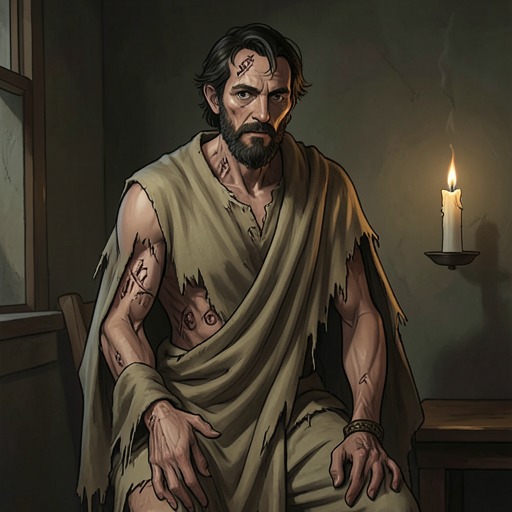
Shaun’s account turns bodily and biographical, accumulating mock diagnoses, punishments, and humiliations. He describes Shem as prematurely aged, grey at three, and publicly exposed before repenting at seven; he recalls his being pushed out of school by Miss Garterd and connects him with a series of supposed illnesses and exclusions. These claims belong to Shaun’s invective, not an impartial record. Their piled-up contradictions and grotesque wordplay reveal how the brother’s public identity is assembled through accusation: Shem is made into a scandalous figure by a speaker who insists that he is merely reporting facts.
The hostility is also intimate. Shaun says that Shem cuts his prose to please his own phrase, and remembers the writer as peculiar, shabby, and repellent. He blames him for turning personal experience into language and treats that transformation as an injury to the family. The accusation does not establish that Shem has literally stolen a settled story; rather, it exposes the brothers’ struggle over who may speak, shape, and claim their shared material. Shaun’s attack is itself a performance of the verbal power he denies Shem.
Borrowing, authorship, and the threatened book
When challenged about the relation between speech and writing, Shaun defends the money and words he has used while contrasting them with the hesitant penmarks of his “cerebrated brother.” The distinction quickly collapses. Shaun protests that he has no room for Shem, yet his own language repeatedly borrows, twists, and imitates; his denunciation depends on the very verbal abundance he treats as Shem’s offense. The quarrel therefore concerns not simply which brother writes better, but whether either can claim an uncontaminated voice.
Shaun makes the contradiction explicit in his discussion of the hundredlettered name and Shem’s writing. He describes each letter as a copy, with syllables and whole words drawn from a common store, and accuses Shem of “stolentelling.” At the same time, the claim that every letter is copied undermines the idea of a wholly original speaker: the brothers’ language is made from repetitions and borrowings that cannot be assigned neatly to one owner. Shaun’s performance both condemns this condition and demonstrates it.
He then boasts of a book of his own, the Book of Lief, claiming that it could surpass his brother’s work if he ever took the trouble to bring it into daylight. He says he holds its contents in his mind and promises, conditionally, to put them down with pen and pencil. The promise is followed by a vow to burn anyone who would set their mother on fire. The sequence joins authorship to both display and refusal: Shaun proclaims a potential literary achievement, postpones its realization, and turns his protective feeling for ALP into a threat against destructive speech. His claim to be a writer-in-waiting keeps the rivalry open rather than resolving it.
Kinship, division, and narrative significance
Shaun’s contempt repeatedly breaks into evidence of attachment. After his boast about the unwritten book, he nearly breaks down with grief and emotion over his mother, then wipes his face and laughs the moment off. That tenderness does not reconcile him with Shem, but it shows that Shaun’s denunciations arise within a family bond that also includes shared dependence on ALP. The writing dispute is therefore nested inside a household drama: the brothers contest one another while speaking from a common inheritance.
The book gives the brothers’ relation a compact formula: Shem and Shaun are “the shame that sunders em,” yet they are also “Wisdom’s son, folly’s brother.” The phrasing holds division and kinship together rather than choosing between them. Their difference is real, but it is also structurally paired: wisdom and folly, writing and speaking, shame and brotherhood become mutually defining positions. Shem’s significance lies partly in this instability. He is the brother Shaun tries to expel from respectable language, but also the source against which Shaun defines his own voice.
A later scene projects the same pattern into the image of twins. Frank Kevin sleeps peacefully, with a lifted hand, while Jerry Jehu cries in his sleep, marks shapes with his “inscissors,” and soils himself as though with ink. The passage identifies Jerry Jehu as an alias in its shifting account of paired children and refers to a story whose details the speaker withholds. This dreamlike double image is not a straightforward biographical episode for Shem; it echoes the book’s broader method of redistributing identities and futures among paired figures. Across these transformations, Shem remains legible less as a fixed personality than as the contested writer in a family where every voice may be another voice’s copy, rival, or continuation.