Shem the Penman
Finnegans WakeShem the Penman is the book’s outcast writer: mocked for his conduct and appearance, distrusted as a taker of other people’s words, and yet endowed with the resourcefulness to turn exclusion into a writing practice. His most consequential act is to make ink from his own waste and cover his body with writing, transforming the condemned body into a manuscript of history. The text never settles into a single stable account of him; instead, accusation, self-display, family mythology, and theatrical doubling make his identity as unstable as the texts he produces.
Identity and Reputation
The narrative introduces Shem through a deliberately discrediting account. He is described as a notesnatcher, a figure who appropriates rather than originates, and is linked to a succession of comic and condemning names, including Maistre Sheames de la Plume and Shem Macadamson. The account frames his life as something that will not withstand being written down, even as it proceeds to write him in extravagant detail. His reputation is therefore inseparable from the act of narration: the portrait condemns him, but its excess also makes him impossible to reduce to a simple moral label.
His bodily description compounds that instability. The catalogue of his features presents a body assembled from deficiencies and incongruities: one shoulder higher than the other, a tongue described as artificial, no dependable footing, and internal organs rendered through comic inversions. This is not a measured portrait of an individual so much as a verbal construction that makes the body itself part of the book’s argument about misrepresentation. The grotesque inventory turns physical description into a kind of unstable text, where detail accumulates without yielding a settled likeness.
The narrative also associates Shem with a private and public life marked by evasion. It imagines him as vulnerable to creditors and describes the expectation that he might destroy himself, then emphasizes that he refuses several such possibilities and continues to survive. His continued existence frustrates the predictions made about him: even when he falls into debt, the anticipated end does not arrive. The passage connects that survival to his persistent attention to other people’s words, suggesting that collecting and retaining language is both the habit that makes him suspect and one means by which he endures.
Writing, Materials, and the Body
Shem’s writing is repeatedly presented as a material problem. The book asks who composed the document and offers an extravagant range of possible circumstances: posture, writing implement, state of mind, interruptions, weather, and movement. Rather than supplying a definitive answer, the passage makes composition inseparable from the uncertain conditions under which a text is made. The writer’s identity cannot be cleanly separated from the marks, materials, and circumstances that survive on the page.
The manuscript likewise bears traces beyond its words. Its paper is imagined as stained and accumulated upon during its passage through time; terminal marks, possible thumbprints, and other physical features may help establish a complex of writers, though a single hand cannot guarantee a single mind. The text notes that letters were not invariably signed, so handwriting and habits of touch become possible evidence where formal attribution fails. Even then, the inference remains provisional: the document carries signs, but those signs do not deliver an uncomplicated author.
That uncertainty sharpens when the narrative describes a document without punctuation whose reverse side is examined against a light. Its marks are interpreted as four kinds of interruption, and the clues are used to identify people associated with the writing. The process is presented as a difficult investigation rather than a transparent reading: paper wounds, punctuation, and patterns of marks must be construed together. This episode gives material form to the larger problem attached to Shem—the reader may find evidence in the manuscript, but interpretation depends on inference and can remain entangled with suspicion.
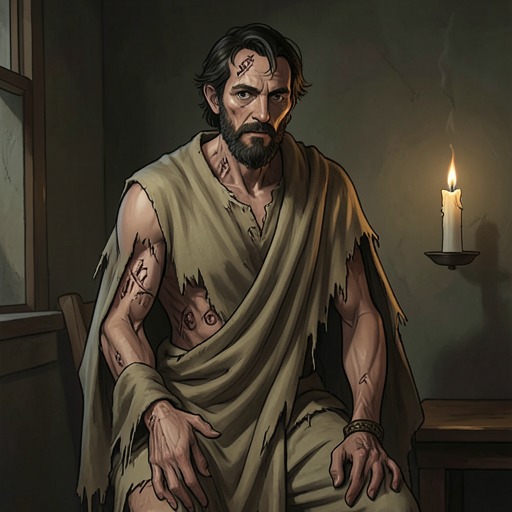
The most extreme solution to the problem of writing arrives when Shem is denied ordinary supplies. After he is boycotted of candles and stationery, he leaves and makes synthetic ink and sensitive paper from his own bodily waste. He then writes across the available surface of his body. The act overturns the distinction between respectable writing materials and rejected matter: what society treats as abject becomes the means by which the writer records and preserves. It is at once an act of survival under exclusion and a grotesque literalization of the idea that a text bears the body of its maker.
The Body as Historical Text
The writing on Shem’s body is described as unfolding a continuous history, cycling through changing moods and forms. The passage makes this history both individual and collective: it begins with a particular person’s body, but is said to become a chaos common to humanity and mortality. The body is therefore not merely a surface on which Shem writes his life. It becomes a medium through which private experience is transposed into a larger, recurring human record.
Yet inscription does not simply secure permanence. As words persist, the self that produced them is said to age and diminish. The text sets the survival of writing against the deterioration of the writer, so that authorship becomes a paradox: the work remains, but its maker changes under the pressure of having made it. Shem’s body is at once the support of the record and the thing worn down by its production.
This image resonates with the manuscript’s other material uncertainties. Stains, punctures, marginal signs, and possible traces of multiple hands all complicate the idea of a text as a pristine expression of one author. Shem embodies that complication in extreme form: he writes with matter drawn from himself, but the resulting history reaches beyond his individual identity. The text’s image of authorship is thus neither pure self-expression nor clean transmission; it is a process in which bodies, materials, readers, and historical recurrence become difficult to separate.
Accusation and Confrontation
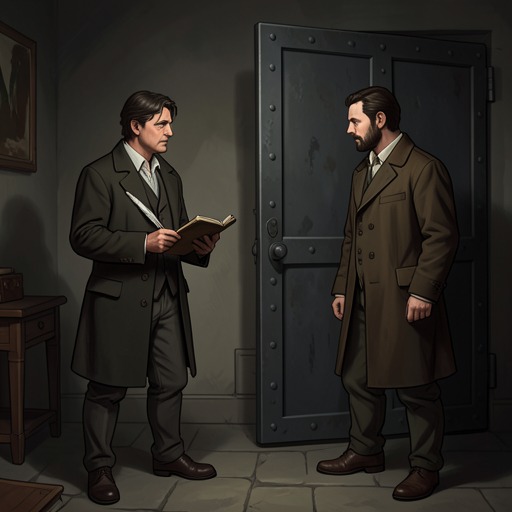
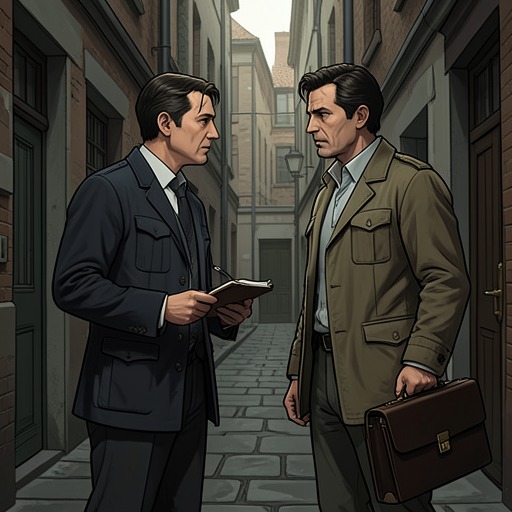
Shem’s literary identity is also staged as a case against him. A direct address calls him by the name Shem Macadamson and asks where he has been, invoking his supposed confession and casting suspicion over his conduct. The speaker presents the case as already darkening around him and imagines that he will need every element in the river to cleanse himself. The language turns judgment into performance: Shem is not simply described but summoned to answer within a rhetorical proceeding whose charges and authority remain part of the scene’s instability.
The confrontation expands the accusation into a moral and religious indictment. Shem is represented as having built a divided kingdom within a doubtful self and as refusing either to serve or to permit service. The speaker’s denunciation treats his independence as both spiritual rebellion and self-division. But because the charge is delivered in an extravagant, prosecutorial voice, it also draws attention to the act of framing a defendant: the scene shows how reputations are produced through accusation as well as through deeds.
Elsewhere, the narrative links Shem’s perceived lowliness to the judgment of others and to his refusal to conform to expected conduct. It recounts predictions of his ruin and describes his resistance to anticipated forms of self-destruction; rather than fulfilling the pattern laid out for him, he survives it. The contrast makes his continued existence another kind of defiance, though the text keeps that survival entangled with mockery and moral censure rather than offering a simple redemption.
Family, Performance, and Recurrence
Shem’s place in the family remains deliberately unsettled. A riverside passage asks whether the tale is being told of Shaun or Shem, then wonders whether they are living sons or daughters and asks again for a story of John or Shaun. The questions do not resolve identity; they make familial naming and narrative inheritance part of the same uncertainty. Shem is not only an individual under judgment but one pole in a shifting family structure where names, roles, and stories can be exchanged or reopened.
The book’s theatrical framing extends this instability into performance. In the announced play, Glugg is presented as a bold, bad boy who is disgraced by the Floras, a group of girls who guard Izod after she has rejected him. Later the contestants meet face to face, and the scene invokes a fated contest and an arresting challenge. These staged roles echo the book’s treatment of Shem without furnishing a straightforward biographical account: the named figure becomes a part to be played, judged, and opposed, and the action belongs to an explicitly theatrical world of repeated performances.
Across these forms, Shem’s significance lies in the contradiction between his low status and his generative power. He is branded a taker of words, yet the text makes his own writing the instrument that converts exclusion into a record. He is exposed to accusation, but the accusation cannot stabilize him; he appears as writer, defendant, bodily surface, and theatrical role. His story therefore gives the book a concentrated figure for its wider concern with texts that are damaged, multiply interpreted, and continually made again.