Shem’s lowness
Finnegans WakeShem’s lowness names more than a reputation for disgrace: it is a condition the narrative makes visible in his body, habits, writing, and repeated expulsion from social life. His supposed degradation is narrated through a deliberately unstable mixture of accusation, comic excess, and mock biography. He is treated as an outcast and a suspected fraud, yet the elaborate verbal performance that condemns him also makes his rejection part of the book’s own inquiry into authorship and authority.
Identity and Construction
Shem the Penman is introduced as an odious notesnatcher, the figure who replaces an earlier, inadequately supported suspicion about another man. The abrupt naming makes his identity arrive already under accusation: his writing is associated with taking, and the surrounding voices present the charge as a public verdict rather than a neutral fact.
The next portrait makes that verdict bodily. Shem’s appearance is assembled from impossible or mismatched features, including an uneven shoulder, artificial tongue, impaired organs, and an unstable collection of limbs and proportions. The catalog does not offer a realistic diagnosis. Instead, it turns the body into a comic indictment and makes physical difference part of the narrative’s language for social and moral rejection.
That bodily caricature is joined to a childhood riddle about when a man is not a man. Shem sets the puzzle for his siblings and supplies its answer himself: he is a sham, specifically a low sham. The episode makes his lowness both an imposed judgment and a self-conscious verbal game, while its many failed answers keep the definition unsettled rather than reducing it to a single literal defect.
Habits, Poverty, and Self-Destruction
Food provides the first everyday measure of Shem’s debasement. He prefers inexpensive tinned salmon to fresh fish and praises canned pineapple over more celebrated fare. The contrast places him outside the standards of cultivated taste and abundance that the passage parodies; his preferences are presented not simply as eccentric but as signs of a life marked by cheap substitutes.
His habits grow more destructive in the account of drink. Rather than choosing ordinary spirits or beer, he consumes a sour, mixed drink until he is sick, while other drinkers are left affronted by his hospitality. The episode makes excess part of the lowness attributed to him, but its comic, extravagant register also exposes the narrator’s relish in enlarging the charge.
The narrative reports that observers expected him to develop pulmonary tuberculosis or to end his own life. It then emphasizes that these expectations do not come to pass: despite heavy debt, Shem does not set fire to his brain, throw himself into the Liffey, or otherwise die by his own hand. He is said to evade even death, and a message sent from an asylum announces that he has gone away and asks his brother to do something. The episode presents survival and disappearance as another reversal in a portrait that repeatedly predicts a final collapse without delivering it.
Social Rejection and Reconciliation
Shem’s social conduct is described as evasive rather than straightforward. When pressed about his alleged misconduct, he distracts listeners with elaborate explanations of foreign expressions and other people’s supposed behavior, leaving aside the matter that prompted the questioning. In arguments, he shifts allegiance to whoever has most recently spoken, offering agreement and flattery to each participant in turn. The pattern suggests a man trying to remain acceptable to everyone, but the narration makes that very pliability evidence of his unreliability.
His exclusion becomes physical during the episode at Tumblin-on-the-Leafy. In heavy rain, rival groups carry him away from Mr Vanhomrigh’s house at 81 bis Mabbot’s Mall toward Green Patch beyond the Salmon Pool brickfields. Though the groups disagree with one another, they eventually stop competing over him, abandon the prospect of taking him back, and become reconciled in friendship. Their alliance is attributed to their shared contempt for Shem’s lowness. The scene makes his rejection a force that can briefly unite people otherwise set against one another.
The narrative nevertheless imagines forgiveness as a possibility: observers might pity him after rolling him in the dirt, if he were properly cleaned. That prospect is immediately denied. He is represented as born low and sinking further, so that the promised recovery through cleansing never arrives. The movement from possible pity to renewed exclusion gives the episode its hard comic turn.
Writing, Fraud, and the Inkbottle
The accusations against Shem extend from his social behavior to his relation with writing. He is represented as learning to imitate the signatures of the households that exclude him, with the purpose of forging a cheque for private gain. The Dustbin’s United Scullerymaid’s and Househelp’s Sorority rejects him and helps drive him out. The episode joins literary imitation to alleged criminal imitation: copying another person’s hand becomes an emblem of the larger suspicion that Shem’s writing takes rather than creates.
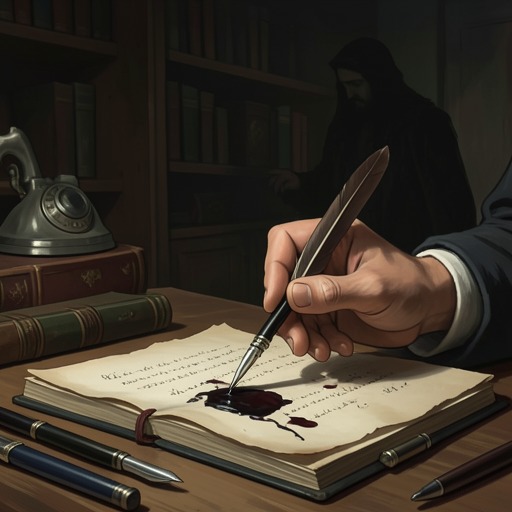
His residence, called the Haunted Inkbottle, gives that association a setting. The house is described as a taxpayer-supported refuge and a place of severe disorder, with Shem’s pen name marked on the door. Its warped floors and walls are covered with an immense assortment of papers, letters, writing tools, discarded objects, and scraps of language. The accumulation makes the room an external counterpart to the portrait of its inhabitant: writing is everywhere, but the disorder and dubious character of its contents prevent it from carrying the authority of respectable authorship.
The account also imagines Shem laboring over an unreadable book by a dim lamp, slowly struggling to memorize even a word. His fantasies transform the marks on the page into visions of luxury and acclaim, while the surrounding depiction of grime, drink, and distraction undercuts them. This contrast does not establish a stable account of his intellectual capacity; it stages the distance between imagined cultural distinction and the derided conditions from which he writes.
Narrative Role and Significance
Shem’s lowness is built through repeated acts of naming, cataloging, and exclusion. The bodily inventory, the humiliating food preferences, the failed predictions of death, the groups that carry him away, and the crowded writing room each return to the same judgment, but they do not settle into sober biography. Their extravagance makes the voice of condemnation itself conspicuous: the more insistently it defines Shem, the more it reveals how much the portrait depends on comic performance.
His position as a writer sharpens that tension. The figure condemned for notesnatching and forgery is also the one around whom the narrative piles papers, signatures, scraps, and verbal inventions. The text therefore binds marginality to literary production without resolving the contradiction into either a vindication or a simple indictment. Shem remains excluded, suspected, and caricatured, while the abundance of language devoted to his lowness makes that exclusion one of the book’s most elaborate acts of authorship.