Taff and Butt
Finnegans WakeTaff and Butt are paired antagonists whose long-running contest ends, provisionally, in a public reconciliation. Their passage from opposed roles to a shared identity turns their conflict into a scene of fellowship, while the surrounding language keeps struggle and accord entangled rather than cleanly separated.
Introduction and Opposition
The pair first appear in a stylized exchange: Taff looks upward through a roof toward a vision of upheaval, while Butt answers in broken, repetitive phrases. Their speech establishes a comic, unstable opposition, with Taff asking what is seen and Butt replying that the sea is vast and still. The exchange gives their conflict the scale of a world in disorder, even as its voices remain playful and fractured.
The opposition persists through the later dialogue. Taff speaks in the register of sorrow and challenge, and Butt responds with an acknowledgment of the blow between them. Their roles are presented as adversarial, but the scene does not reduce the conflict to a simple victory: both figures remain caught in the same struggle.
Reconciliation and Shared Identity
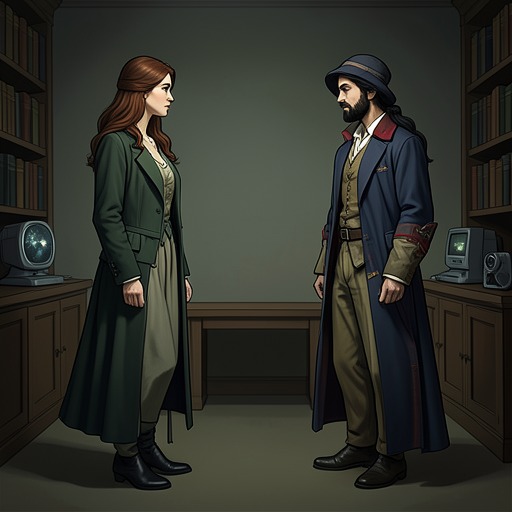
The decisive turn comes when Taff and Butt are described as both opponents and feudal adversaries, yet also as one and the same person. Their fight has been upheld for a time, then baffled and shaken by a larger shadow of conflict. Instead of ending in a clear triumph by either side, they take one another’s hands and make a pledge of fellowship.
The reconciliation is enacted through reciprocal gestures and an exchange rendered in the language of commodity tokens. That commercial image gives their accord a deliberately material form: fellowship is not merely announced but symbolically tendered between former foes. The action changes the relation without erasing the history of opposition that made it necessary.
Cyclical and Communal Significance
The narrative places the handshake beside imagery of an old world renewed: woodland growth and seasonal blooming follow the account of conflict, while the paired figures’ renewed antagonism and accord remain part of a larger cycle. The passage does not present reconciliation as a permanent end to struggle; its surrounding language points toward further recurrence and renewed growth.
Taff and Butt therefore function as a double figure. Their division dramatizes conflict, while their shared identity and exchanged pledge suggest that opposing sides can be understood as parts of a single whole. The episode’s movement from contest to fellowship offers a local resolution, but its cyclical setting leaves open the possibility that discord will return.