Tangos, Limited
Finnegans WakeTangos, Limited appears as a foreign commercial firm in a convoluted dispute over whether a debt was discharged by a crossed cheque. The case makes the company more than a background business: its joint account and rival stockholders become the pivots of a legal argument in which payment is claimed, denied, and never realized as cash.
Identity and Commercial Background
In the account of the case, the firm is identified as Brerfuchs and Warren, a foreign concern later registered as Tangos, Limited, and engaged in selling proprietary articles. The passage does not describe its products or ordinary operations further; instead, it places the firm within a network of trusts, partners, banks, and competing financial interests.
The account invokes a rule attributed to D'Oyly Owens: a joint deposit account in two names carries a mutual obligation. That principle frames the dispute over funds lodged in joint names, even though the cheque was drawn by the senior partner alone. The difference between who made the lodgment and whose name appeared on the account becomes central to the contested claim.
The Cheque Dispute
The litigation began with a trustee of a religious emergency fund seeking payment of tithes. The debt itself was not disputed, and vouchers supported it; the defence instead maintained that payment had been made. The fund's trustee, Coppercheap, counterclaimed that the tender was invalid because it took the form of a crossed cheque, signed in the ordinary course in the name of Wieldhelm, Hurls Cross, and drawn by the senior partner against a deposit held in both partners' names.
The bank refused to pay the draft despite having ample reserves to meet the liability. Coppercheap then negotiated the cheque to a notary acting as his client and received legal relief in exchange. The transaction thus shifted the claim without producing payment in cash: the cheque's passage through intermediaries altered who held the instrument and what relief Coppercheap could claim, but did not settle the underlying monetary question.
Circulation and Legal Aftermath
The cheque was described as a washable pink instrument, embossed with the marking D you D No 11 hundred and thirty 2. For more than thirty-nine years it circulated among holders of Pango stock, a rival concern, without a single farthing changing hands as hard coin or liquid cash. Its long circulation gives the dispute a material emblem: a document can continue to bear a face value and move between holders while remaining detached from actual payment.
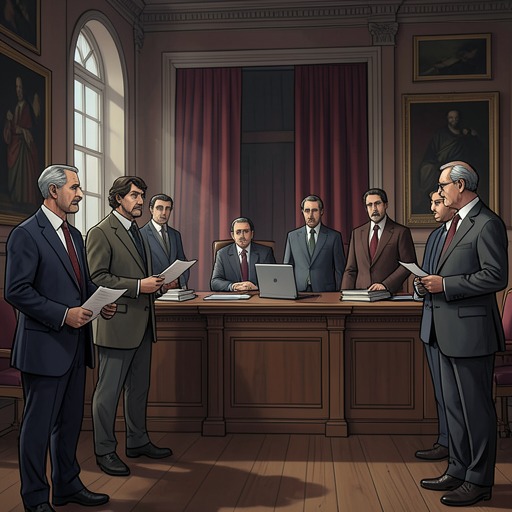
The jury, a dozen men bearing the name Doyle, disagreed jointly and severally. The judge then rejected their divided result and ordered a garnishee attachment against a neutral firm, extending the proceedings beyond the jury's inability to agree. The original firm itself is not shown resolving the matter. Instead, the account follows the depletion and disappearance of the parties associated with it: the former firm could not be located after entering an old moratorium, while only its junior partner, Barren, could be found to appear in court.
Narrative Significance
Tangos, Limited belongs to a larger world in which legal vocabulary and commercial exchange repeatedly overlap. Here a joint account, a disputed tender, a bank's refusal, a negotiated instrument, and a decades-long circulation all make the distinction between obligation and payment unstable. The case presents the company's name amid shifting corporate identities and competing claims, while the pink cheque persists as a transferable object whose value is asserted but never realized in cash.