The Ondt and the Gracehoper fable
Finnegans WakeShaun introduces the Ondt and the Gracehoper as a fable about two radically different ways of inhabiting time: one creature dances and spends without reserve, while the other makes cold space for himself and flourishes. The story makes that opposition concrete through the Gracehoper’s hunger and the Ondt’s comfortable abundance, then complicates its moral when the destitute reveler thanks his judge and answers him with a long, riddling song that turns praise into a challenge.
Framing and Premise
After being asked to sing, Shaun apologizes and chooses to spin a tale from the grim gestures of Jacko and Esaup, calling it both a first fable and a feeble one. His mock-formal introduction promises a moral case, but the language is already unstable: the address to his “dear little cousis” swells into a grotesque string of sounds before he names the two insects at the story’s center. The fable arrives not as an impersonal lesson but as Shaun’s performance, announced with self-deprecation and delivered in a voice that treats solemn instruction as a comic occasion.
The tale first builds its contrast by giving the Gracehoper an abundance of motion and appetite. He is “always jigging ajog,” propelled by joy, and repeatedly invites other insects to play, flirt, and mate. His days also include comic, elaborate funeral festivities and dances. The sequence makes pleasure more than a single indulgence: it is his habitual manner of spending time, with movement, company, courtship, and ceremony all taking precedence over provision for later.
The Gracehoper’s Reversal
The Gracehoper’s easy motion eventually meets material need. After moving through what the narrative calls a jungle of love and debts and a jumble of life in doubts, he falls sick and poor. He cannot find food or a place of refuge, and his complaint gives hunger an unmistakable bodily urgency. His misfortune is not simply a change of mood: he has no money with which to obtain even a little bee bread.
The tale sharpens this reversal by showing how thoroughly the Gracehoper has consumed what might have sustained him. He has eaten paper, swallowed lustres, devoured flights of stairs, chewed up tables and chairs, and consumed records and ephemera. The grotesque inventory makes his appetite seem capable of eating the materials of memory, domestic life, and even space. Yet all that consumption has left him with no reserve. When Christmas is near and the branches are bare, he leaves his cottage, Tingsomingenting, and wanders in harsh weather, uncertain whether his journey is carrying him toward heaven or hell. Seasonal desolation and physical exposure replace the warmth of his earlier play.
The Ondt in His Abundance
Against the Gracehoper’s depletion, the Ondt appears as an established, guarded figure. He is solemn and chairman-like, occupied with making spaces in his psyche; when he makes spaces on his icy window, he seems especially secret and wise. His manner and surroundings project control, distance, and rank rather than spontaneous motion. Where the Gracehoper’s life has spilled outward into debts and pleasures, the Ondt has made room for himself.
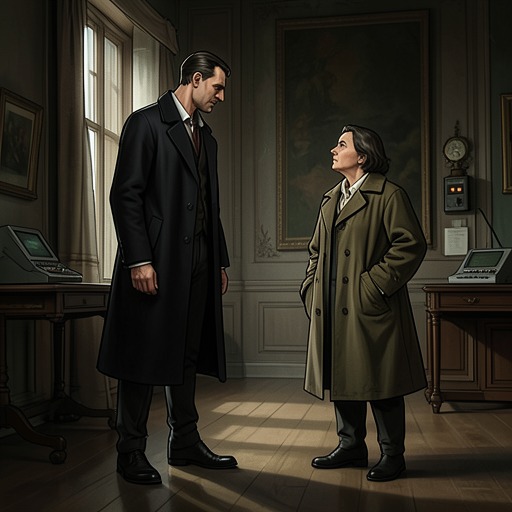
The contrast becomes visible when the Gracehoper encounters the Ondt enthroned in a sunny room. The Ondt sits in Babylonian slippers, smoking cigars and satisfied before a full plate, with four of the insects associated with the Gracehoper’s earlier courtship now in the Ondt’s company. Their positions have reversed: the former dancer is reduced to a light, exposed creature in the mire, while his rival enjoys comfort and attention. The scene makes prosperity look like a victory in the immediate contest, but the fable’s extravagant language also makes the Ondt’s comfort feel theatrical and self-enclosed.
Rebuke, Gratitude, and the Final Challenge
The Ondt has already declared the Gracehoper outside his social circle. His response to the poor creature is shaped by contempt and self-congratulation: he imagines his own reign flourishing as broadly and as high as the realms and heavens he invokes. The rhetoric of his wishes turns private prosperity into a claim to dominion. His security is not offered as shared shelter; it is asserted as a reason the Gracehoper does not belong.
Yet the encounter does not end with a simple victory for the Ondt. In the fable’s most striking reversal, the Gracehoper weeps, forgives him, and calls the Ondt safe in the keeping of those around him. He asks him to teach the other insects dances and to ensure that Vespatilla finds substantial partners, then says that a former piper must now pay the count. The language acknowledges a cost: the Gracehoper’s former mode of living has brought him to a reckoning, and he accepts the rebuke as a “horsegift of a friend.” Gratitude does not erase the inequality between the two; it transforms the scolding into a lesson the Gracehoper can at least recognize.
His closing address then expands far beyond a confession. The Gracehoper praises the Ondt’s worldwide genus and sublime spaces, but ends by asking why he cannot beat time. That final challenge unsettles the apparent moral. The Ondt has money, shelter, social standing, and command of space; the Gracehoper has learned the price of spending without reserve. But neither worldly abundance nor stern self-possession is presented as a complete answer to time. The story closes not by resolving the opposition but by making each creature’s apparent strength expose a lack in the other.
Form and Significance
The fable’s argument is carried by verbal excess as much as by its plot. Its insect vocabulary continually mutates into puns, mock-learning, and phrases that sound at once like moral instruction and comic nonsense. The Gracehoper’s repeated motion and voracious consumption are answered by the Ondt’s cold spaces, throne, plate, and imagined reign; their opposed habits are staged through physical objects and changes of position rather than reduced to an abstract maxim. The later reversal is equally formal: the apparently defeated Gracehoper gains the last word, though not the material advantage.
As a tale told by Shaun after a request for a song, the episode folds a moral fable into a performance that refuses to stay morally tidy. The Gracehoper’s confession recognizes the consequences of his past choices, while his praise of the Ondt culminates in the question of time that the Ondt cannot answer. Prudence and pleasure remain in collision, but the story makes their contest cyclical in feel: one creature’s former freedom ends in need, the other’s present security is exposed to a limit. Its last emphasis is not simply that the improvident must pay, but that success in accumulating comfort does not by itself amount to mastery of time.