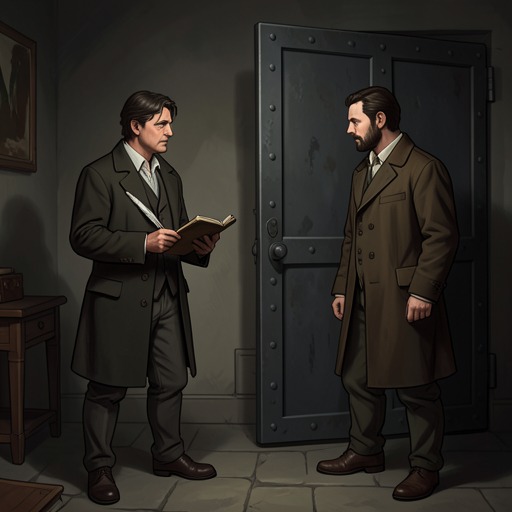
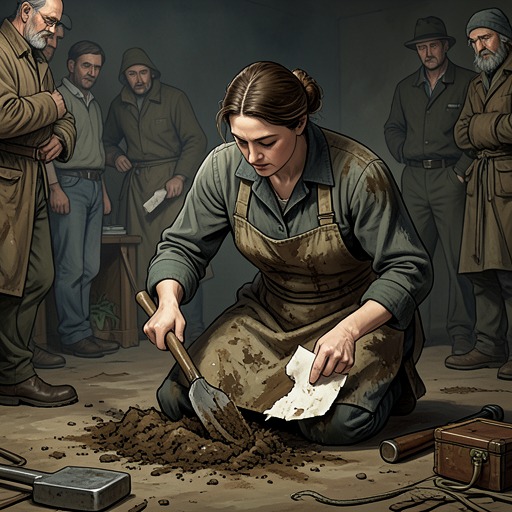
The letter
Finnegans WakeThe letter is not merely a message passed between characters but a changing material object around which the book organizes questions of authorship, family, transmission, and interpretation. It is variously imagined as a lost or damaged document, an addressed envelope, an accumulation of fragments, and a text that can be read in more than one way. Its passage from writer to carrier to audience never secures a final meaning; instead, each new reading turns the letter into another episode in its history.
Identity and Material Forms
One appearance is a large chain envelope written in seven different stages of ink, addressed to a party under a name that itself sounds comic and unstable. The postal inquiry that introduces it wonders whether such writing will appear composed or remain a mixture of black and white, and whether the pouch of fragments will continue to lie dormant inside its pillarbox. The letter is therefore presented not as a transparent container for a settled message but as an object whose envelope, address, contents, and delay all matter.
The text also gives the document a genealogy of material damage and copying. An earlier account imagines a copyist fleeing with a scroll amid disaster, leaving open whether flood, an animal, a thunderbolt, or another cause interrupted the work. Elsewhere, the letter is approached through questions about where, how, and under what conditions its writer made it: upright or seated, with a quill or another instrument, in a clear or troubled state of mind, interrupted by visitors or weather. The narrative offers no authoritative answer, making the missing origin part of the document's identity.
The surviving page bears physical traces that can be mistaken for an account of the people connected with it. Its terminal is described as tea-stained; marks accumulated while it lingered in the past; and the text treats paper, handwriting, penstrokes, and blank spaces as potentially significant signatures. Rather than assume that a single hand guarantees a single mind, the discussion warns that the writer complex may be plural. Even the absence of a signature does not settle authorship, since a letter's marks and habits may identify its writer as readily as a name.
Authorship, Carriage, and Family
A particularly explicit description identifies the letter as carried by Shaun, written by Shem, and uttered for their mother, ALP, as well as for the family represented by Hek. This arrangement divides the act of communication among writer, messenger, and intended voice. Shaun is not the author simply because he carries the document, and Shem's authorship does not make the letter a private statement in only his own interest. Its circulation makes family identity a matter of mediation.
The exchange between the brothers turns the letter into a point of rivalry. Asked about the use of money and the relation between Shaun's speech and Shem's hesitant penmarks, Shaun rejects the implication that his brother's writing has greater authority. He disparages Shem as an illegible writer, accuses him of drawing on other people's language, and claims that he himself could write with extraordinary fluency if he chose. Yet he also says that undertaking the work would be too much trouble. His defense thus both attacks the letter's author and acknowledges the power that authorship might carry.
Shaun's relation to the document is not wholly hostile. He says that he can reproduce what he considers the letter's language and that he has its contents in memory; he also insists that he would prevent anyone from harming his mother. His boastful claims give way to visible feeling for her, and he becomes emotionally overwhelmed before trying to recover his composure. The letter consequently draws together antagonism toward Shem, attachment to their mother, and Shaun's own claim to be capable of writing.
Circulation and Public Meaning
The book repeatedly makes the movement of written matter part of its story. It describes a chain envelope passing through a postal system and asks whether Shaun will eventually carry an open letter. Elsewhere, Shem is imagined preparing a letter in an elaborate, improvised manner and sending it out toward readers and the public press. Such circulation changes the document's scale: writing that begins within a family can become a message whose audiences and destinations are uncertain.
The letter's public life has a counterpart in the public performance of Hosty's ballad. The song gives the disgraced figure a series of names, settles on Persse O'Reilly, and proceeds through a chorus that turns his fall into communal entertainment. Later, the narrative groups the letter with a crowd of voices and writings, then calls attention to how it has been folded, sealed, opened, and read. The contrast is instructive: a song can make public humiliation immediately audible, while the letter's accumulated marks and disputed authorship keep its meanings difficult to fix.
The text also treats writing as ubiquitous rather than exceptional. It says that the world is always writing its own marks, and imagines the entire world as wanting to write or carry letters: a person writes to a place about a thing, and a letter may travel to a king concerning treasure. The sequence of possible writers multiplies through sound-play, expanding the private document into a model of communication shared across people and generations. No single correspondent controls the whole process.
Reading a Damaged Document
The letter's meaning depends on its material surroundings as well as its words. The discussion of the addressed envelope insists that its outside is not incidental: the surface, address, and circumstances around the document affect how its contents can be understood. To read only literal sense or psychological content is to neglect the envelope that carries and frames them. The document's exterior is evidence, not packaging to be discarded.
Its marks can also produce competing interpretations. In one account, an unpunctuated script is examined against a light, and punctures on the page are interpreted as a system of stops and requests. In another, the page's stains, omissions, unusual marks, and writing habits are treated as traces from which readers might infer something about its making. Yet these procedures do not restore an uncontested original: interpretation depends on deciding what counts as a mark, what it indicates, and whether a gap belongs to the writer or the transmission.
The work's account of documents further resists a single stable authorial identity. It proposes that different personalities or traits may be imposed on the same document, while apparent contradictions can coalesce into one socially legible figure. Its observations about the letter therefore concern both forensic reading and narrative form: a document may invite the reader to identify a person, but its competing signs can make that identity a construction rather than a final discovery.
Recurrence and Significance
The letter returns in altered forms across the book: as a chain envelope, a message sought by a carrier, a family document, fragments brought together under the name of letter and litter, and a self-penned work described as forever planned yet never perfect. Each recurrence changes the emphasis without resolving the object. At one moment it is a practical communication awaiting delivery; at another, it is a damaged relic whose traces invite prolonged examination; at another, it becomes a way to describe the book's own relation to writing and reading.
That movement is captured by the juxtaposition of a letter written to one's other and an all-night diary or newsreel. The document belongs to an intimate relation, but its form also resembles serial public record: something revisited, revised, and relayed rather than concluded. Likewise, the expectation that Shaun may ultimately carry the open letter leaves delivery suspended as a possibility, not a completed guarantee.
The letter's decisive significance lies in its refusal to separate message from medium. Ink, stains, address, handwriting, carrier, audience, and acts of interpretation all participate in what it can mean. Its transmission makes family relations public and contested; its damaged state makes reading an act of inference; and its recurrence turns the uncertain document into a figure for the book's own multivoiced, unfinished composition. The letter survives not by becoming perfectly legible, but by continuing to be handled, disputed, and read.