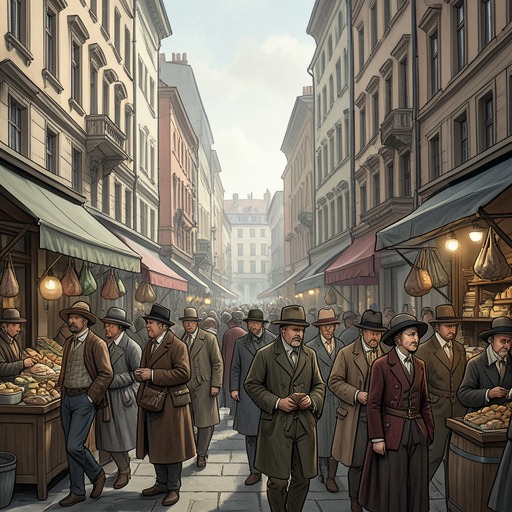
The merchant's bankruptcy
Finnegans WakeThe merchant's bankruptcy is presented not as a single failure but as the culmination of a long, unstable commercial rise. A fortune assembled through speculation, credit, property, and trade is successively undermined by losses and reversals until the merchant is left on his bankrupted account, weeping and stripped of power. The episode’s final emphasis on payment and a vow of “Never again !” turns economic collapse into both public reckoning and another turn in the book’s recurring cycle of fall and recovery.
Rise, Credit, and Commercial Power
The merchant’s ascent is described through a blend of finance and social display. He pushes himself ahead like a blazing urban orb, amassing wealth through commercial dealings and making party capital out of landed self-interest. His dealings combine giving and taking, gambling on enormous sums, and operating at once lightly in relation to domestic service and heavily on the stock exchange. Sons return from afar while daughters remain at his side, making the fortune appear to sustain a family and a public position as well as a business. The portrait is not of wealth detached from its methods: money, property, and influence are bound together in the same ambitious expansion.
The narrative asks how the merchant built up his wealth and points to a guinea set against a groat, an index finger on the balance, and a windfall taken in a baggage coach ahead. The imagery makes calculation and opportunism part of the ascent. Yet the account also casts this prosperity as vulnerable: the rise is followed by an exposition of failures, and even the merchant’s apparent advantage depends on a succession of transactions and fortunes that can be reversed.
A Sequence of Reversals
The collapse unfolds in episodes rather than as one isolated shock. First, a change in his seven-day license draws him away from the health of his farm and costs him his early parish life. A later, sudden disturbance in the fenland damages his fortunes and disrupts the court and poultryyard, where only two of a feather are left with room to wade. The precise events are conveyed through compressed, dreamlike images, but their cumulative effect is clear: the merchant’s resources and settled position are repeatedly reduced.
After a temporary reflotation, four violent gales smash the plate-glass walls of his house and interfere with the accounts being prepared by his keeper. Three boy bugle-horners then counteract and outmaneuver him. Later that evening, two men abscond through a breach in his bylaws, leaving him to absorb the loss himself. Each reversal changes the terms of the next: apparent recovery gives way to damage to property, compromised accounts, failed control, and liabilities that return to the merchant.
The final blow is the explosion of his distilleries. It deafens and dumps his dry goods onto his favored associate and leaves the once-powerful figure reduced to a distressed remnant of himself, tearful and financially ruined. The sequence gives the bankruptcy its force through accumulation: farm and parish standing, fortunes, house, accounts, and goods all enter the downward course before the final image of insolvency.
Payment, Reputation, and the Cycle of Failure
After the collapse, the passage turns to payment: the demand is made to the bearer, before an honest policeman, and the merchant swears on Lloyd’s that he will not return to the same course. His promise of “Never again !” sounds like a declaration of finality, but the surrounding imagery keeps that finality uncertain. The merchant is recognized as a chameleon, displaying changing colors, and his last attempt to pass through a triumphal arch ends with his reign’s power spent. The language of public recognition therefore accompanies the loss of commercial authority.
The bankruptcy also belongs to a broader social world in which ordinary prices, wages, credit, and shortages register the instability of economic life. Elsewhere, the account notes that meat prices fell when Reilly-Parsons failed, coal was scarce though turf remained plentiful, and barley prices rose again. At a pawnbroker’s, a singer’s false teeth are redeemed so he can perform; drink is bought on credit or for celebration, while a postman later threatens to recover unpaid professional postage fees from a squire. These distinct transactions do not explain the merchant’s specific losses, but they place his collapse within a book persistently attentive to debt, exchange, and the uncertain value of goods.
Narrative Significance
The bankruptcy is shaped as a cyclical fall rather than a conclusive ending. Its sequence of temporary reflotation and renewed disaster gives the merchant’s rise no secure endpoint, while the closing movement toward dawn and a final tableau places the exhausted figure within the novel’s larger pattern of night, ending, and possible renewal. The recurrence of commercial failure across generations is made explicit in the image of one generation telling another. In that frame, bankruptcy is both a concrete loss of fortune and a repeatable social story: wealth is accumulated, tested, lost, and remembered, with the promise never to repeat the past sounding against the possibility that the cycle will begin again.