The wake
Finnegans WakeThe wake is both a funeral gathering and a pattern of recurrence in which death is mourned, celebrated, and imagined as reversible. Around the fallen figure of Humphrey Chimpden Earwicker, communal lament becomes noisy festivity; elsewhere, burial gives way to the promise that the sleeping hero may rise again. The motif makes the book’s central passage from ending to renewal a public ritual, a bodily image, and a structure of time.
Mourning as communal celebration
The wake begins in sound and assembly. The mourners’ cries for the dead mingle with an exuberant celebration that is to continue until his final extinction; keening and conviviality occupy the same scene rather than canceling one another. The congregation lays him down on a broad bed, with drink at his feet and an abundance of food above his head. Funeral observance becomes a feast, and the dead body is at once the focus of grief and the center of social gathering.
The ritual’s language makes mourning inseparable from appetite and comic excess. The body is figured as a great, edible presence, and the meal is dismissed as finished only for someone, while the scene keeps turning death into a shared occasion. This grotesque abundance does not resolve grief; it gives grief a collective form in which lament, drinking, eating, and celebration can coexist.
The body between burial and return
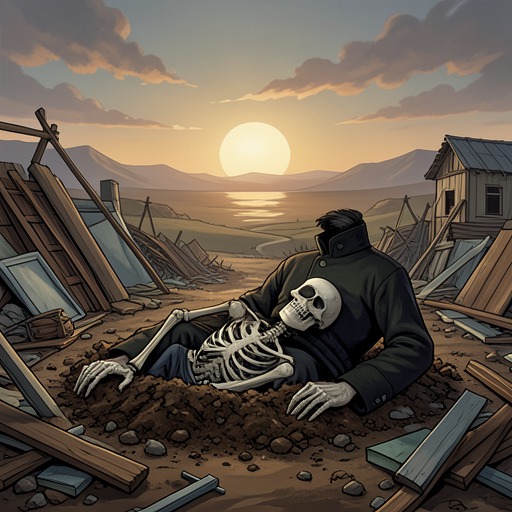
The wake repeatedly shifts from the public bier to the image of a buried giant whose form remains visible in the landscape. His clay feet stick up where he fell near the Magazine Wall, while the surrounding imagery connects the sleeper to Anna Livia and to the streamside world. The fallen figure is therefore neither simply absent nor fully restored: earth covers him, but the narrative continues to outline his presence in the night.
The same tension appears in the claim that the ancestor worked for himself and his dependants, labored with and under his crew, and became a mighty liberator. That ancestral figure is imagined as capable of waking again when the fiery bird dismembers, and of returning through what elders tell the young. The wake thus joins bodily persistence to inherited narration: the dead may re-enter the present not only through resurrection imagery but through repeated stories and names.
A ritual of recurrence
The wake’s time is not a straight movement from life to burial. A fallen figure is remembered as a sleeping one; a sleeping hero is projected toward a future awakening; and the feast’s end is made provisional by the expectation of return. At Howth and other named sites, silent cairns stand as testimony from the dead to the living, while the text gathers these stones as though they belonged to the same ancestral herd. Landscape, monument, and story all preserve what an ordinary funeral would consign to the past.
The promise of the heroes’ return is paired with a horn rolling across hill and dale, turning the anticipated awakening into a public, acoustic event. Yet another passage insists on the body’s decline: its brains cool, its skin is damp, its heart inactive, its blood crawling, and its extremities wasted. The contrast keeps the ritual from becoming a simple assurance of life after death. The body is dead or deathlike in material terms, even as communal memory and recurring language make its return imaginable.
Narrative significance
As a motif, the wake binds the book’s funeral scene to its larger pattern of fall and renewed possibility. Its social noise turns private death into public story, while its images of feasting, burial, sleep, and the returning ancestor prevent any one state from remaining final. The wake is consequently not only an episode of mourning: it is a model for the narrative itself, which keeps revisiting the fallen figure and reopening the question of whether he is gone, sleeping, or about to rise.