Thunderword
Finnegans WakeThunderword is the name for the book’s immense, compound word-form, a verbal event that joins sound, rupture, and recurrence. It appears amid accounts of a great fall and a clash of forces, and later passages extend its significance from explosive language to the unstable marks of a damaged, interpretable document. Rather than behaving as a fixed label, it exemplifies how a word in Finnegans Wake can function at once as sound, image, and contested writing.
Appearance and Narrative Setting
The earliest appearance is embedded in the account of the fall of an old wall and the consequent fall of Finnegan. The word’s extravagant accumulation of syllables gives the fall a sound-form of its own; the narrative then turns from that collapse toward an inquiry and the search for Finnegan’s feet in a park where oranges have lain to rust. The word thus belongs to a passage in which catastrophe, bodily consequence, and the landscape are compressed into a single verbal surge.
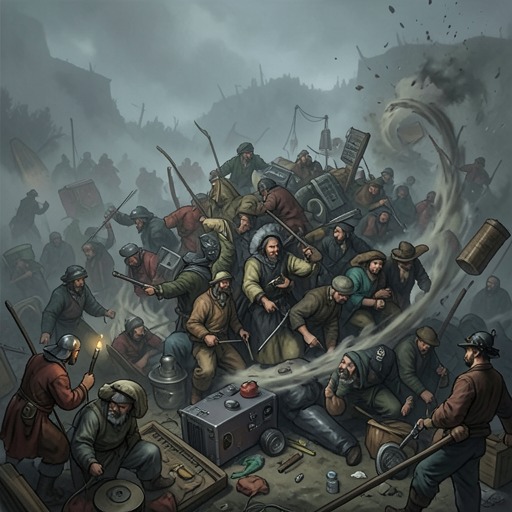
A later passage places another long, emphatic compound word in a scene of clashing wills and forces. Its repeated, percussive syllables sit among partisans, opposing groups, weapons, alarms, and tolling, making language itself seem to participate in the conflict. The passage does not settle into a straightforward account of one battle: its crowded sound and shifting images turn opposition into a verbal tumult.
Recurrence, Fall, and Reversal
The fall is not presented as an isolated occurrence. It is told early and carried through later life and Christian tradition, while the surrounding language repeatedly insists on the possibility of rising after falling. This pattern gives the Thunderword a place in a larger movement of collapse and renewal: the word sounds like an ending, but the narrative makes endings liable to recur and reverse.
That rhythm returns in the account of Finnegan’s wake, where the sleeping or fallen patriarch is imagined amid watchful figures and a prolonged silence. The passage is speculative rather than conclusive, asking whether he foresaw later events and whether his descendants would form a dynasty. The word’s force therefore resonates with a narrative that keeps the boundary between an event, its recollection, and its possible return unsettled.
Writing as Material and Unstable Evidence
The book’s reflections on a protean document broaden the device beyond sound. The writing is described as a many-sided, changing text whose marks gather different personalities and possible crimes into a single, shifting figure. The account refuses a stable origin for the document, asking under what conditions it was written and by whom. In this context, the Thunderword belongs to a work where language is not merely a transparent report of events: its forms are themselves part of what must be interpreted.
The document’s graphic details make that instability concrete. Its damaged initials, corrections, marginal signs, repetitions, and omissions invite conflicting readings; even the warning sign before the ancestral words permits those words to be taken in any order. Elsewhere, a separate document’s missing punctuation and pattern of punctures become clues that investigators interpret as different forms of interruption. These scenes do not establish a single key that would resolve every ambiguity. They show instead how marks, gaps, and material damage shape what can be read.
Significance
Thunderword condenses the book’s collision of sound and sense. It gives language the scale of an event, while the surrounding passages show that events, documents, and identities are repeatedly reassembled through uncertain narration and interpretation. Its force lies not in a settled definition but in its recurrence among falling, fighting, reading, and the possibility of rising again.