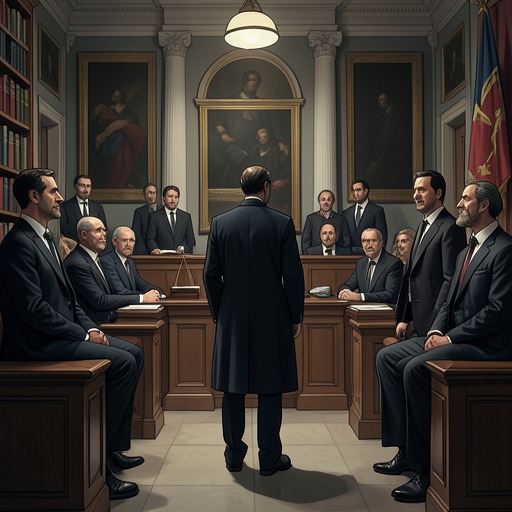
Trial of Festy King
Finnegans WakeThe Trial of Festy King stages law as a struggle over who can make an account of events stick. Festy King, a man from Maam in Mayo whose family is associated with tar-and-feather work, faces a confused indictment and a succession of witnesses, rival explanations, and theatrical denials. The courtroom ends not with a clear resolution of the allegations but with King acquitted under a formulaic verdict, while the narrative’s competing voices leave the facts unsettled.
Charges and Background
The trial is presented as a development in an unresolved crime story: the narration says that little progress has been made in solving the crime’s riddle before King is brought before the Old Bailey. His indictment is described as incompatibly framed, combining two counts whose opposing points of view blur the distinction between accuser and accused. The charges are rendered in deliberately tangled language, so that even the alleged conduct resists a stable summary.
King’s origins and appearance are offered as part of the spectacle surrounding the case. He is identified as a child of Maam, in Mayo, and as coming from a family long associated with tar and feathers. When brought to the court, he is soaked in methylated spirits and wears a fight shirt, straw braces, a sou’wester, and a policeman’s trousers, along with stains, rents, and patches. The account says that he had deliberately torn his country-made clothes. His clothing therefore enters the case not simply as description but as disputed evidence: the Crown treats his changed appearance as part of an alleged disguise, while King explains his condition differently.
Witnesses and Competing Accounts
A witness described as an eye, ear, nose, and throat observer gives evidence after being questioned. He says that he slept with a bona fides and would remember a date in November, but the testimony quickly becomes less a dependable chronology than a parody of the witness’s authority. Another account attributes to Hyacinth O’Donnell, a mixer and wordpainter, an attempted attack on two men identified as Gush Mac Gale and Roaring O’Crian, Jr. Their hostility is variously linked to a trespass involving a bull, a dispute about hair, or an argument over a drink and a story. The explanations multiply rather than converge.
The court’s setting and the alleged time of the attack further complicate the testimony. Supporters of the litigants are described as urging them on, while cries from the courtroom and nearby streets call for O’Donnell to be produced and his supposed relics exhibited. Under cross-examination, the witness places the ambush near an exceptionally prominent tree, in a period described as roughly half an hour between dusk and dawn. He also says the moon provided scarcely any light. The testimony thus supplies particular circumstances while making confident identification harder, not easier.
Questioned about whether the world could be perceived through the senses, the witness insists that he is cognitively certain of what he hears, sees, and feels. The interrogation then ranges across his identity, reliability, intoxication, religion, and personal history in a sequence of distorted questions and answers. He is described as drunk, and his claims to knowledge are repeatedly subjected to ridicule. Instead of resolving the testimony into a coherent account, the questioning exposes how readily courtroom certainty can become a performance.
King’s Denial and the Verdict
The proceedings change when Pegger Festy, called the senior king, gives an oath-backed declaration through a Brythonic interpreter. He denies that he stole anything and swears that he never threw a stone, before or after his birth. The denial expands into an extravagant pledge that he would not raise a hand to harm anyone. Its comic impossibility does not make it legally irrelevant within the scene: the declaration becomes the episode’s most emphatic counterclaim to the prosecution’s version.
A second assertion concerns King’s departure from Dublin. He claims that, if he were ever to take or throw a stick or stone at a person, he would never again ask to see either this world or another. The courtroom responds with laughter and commotion; King, initially reluctant, joins in. His defense therefore shifts the mood as well as the argument. What has been framed as a prosecution becomes a public performance in which the accused’s declarations, the audience’s reaction, and the testimony’s comic instability compete for authority.
The four justicers confer but issue their standing verdict, “Nolans Brumans.” The narration presents King as having murdered all the English he knew, picked their pockets, and nevertheless left the tribunal scotfree. That grotesque, internally contradictory summary refuses to clarify whether the proceedings have established guilt or merely staged its accusation. The legal outcome is nevertheless definite at the practical level: King is not convicted and leaves free.
Public Spectacle and Narrative Significance
The courtroom is not sealed off from popular judgment. The crowd cheers, the barmaids celebrate King, and women praise and kiss him; one young woman’s attention is singled out as a silent, seemingly mutual admiration. These responses do not supply evidence about the alleged crime. They instead show how quickly the accused becomes a public figure whose reception can be shaped by charm, spectacle, and the crowd’s appetite for a story.
The episode repeatedly sets formal authority against unruly interpretation. The bench, the oath, the interpreter, the cross-examination, and the verdict all invoke legal procedure, but the language in which they appear is unstable and comic. Competing witnesses give incompatible explanations, King’s denials exceed ordinary plausibility, and the audience’s laughter interrupts the solemnity of judgment. Law remains capable of producing an outcome, but the narration withholds the reassurance that its outcome rests on a transparent reconstruction of events.
The trial also anticipates the book’s recurring concern with the circulation and alteration of stories. Its ending turns from courtroom noise toward “The letter! The litter!” and an account of a text folded, sealed, opened, and interpreted by different hands. That transition places the trial’s disputed testimony within a wider pattern: what is heard, recorded, and believed is repeatedly reshaped in transmission. King’s acquittal closes the immediate proceeding, while the surrounding narrative leaves accusation and evidence in circulation.