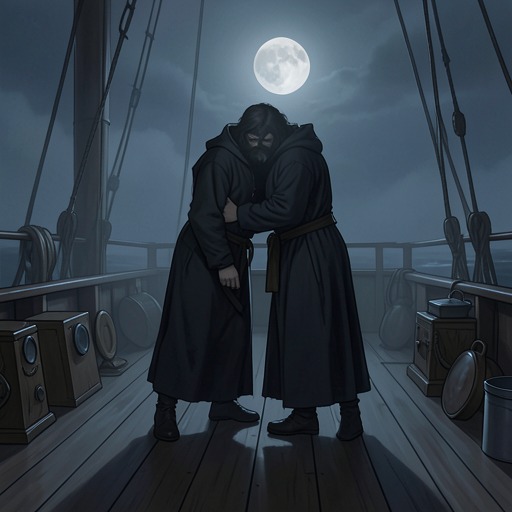
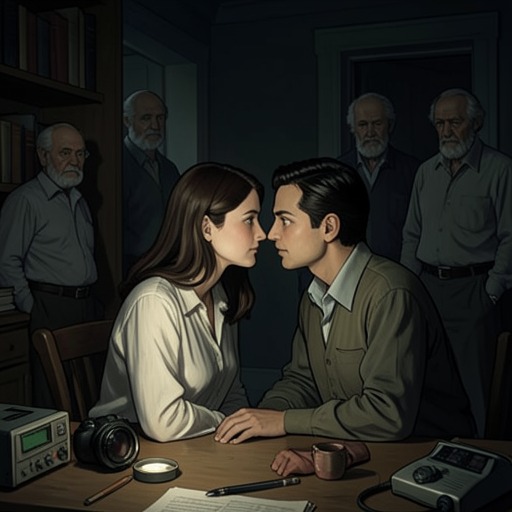
Tristan and Isolde’s tryst aboard ship
Finnegans WakeTristan and Isolde’s tryst aboard ship turns a legendary lovers’ encounter into a scene of conspicuous intimacy and covert listening. As the ship moves through the dark, four old men strain to hear Tristan cuddling and kissing Isolde; the episode joins erotic closeness to public scandal and to memories that recur across generations.
The lovers aboard ship
The scene presents Tristan and Isolde as physically close on a ship at sea. A flock of sea birds accompanies the account, from seahawks, seagulls, curlews, and plovers to kestrels and capercallzies, as though the encounter draws the creatures of the ocean into its orbit. The lovers’ embrace and kisses are rendered in deliberately exuberant, unstable language, which makes the tryst at once vivid and difficult to separate from the book’s comic verbal performance.
The encounter is not a discreet exchange that remains between two people. The lovers are on a small seat behind the chief stewardess’s cabin, with Isolde dressed in blue and netting embellished with gold. Tristan is described as handling her with dexterity and whispering about the Tristan story. The narration marks his conduct as palpably wrong and improper, making the scene’s erotic charge inseparable from the suspicion of transgression.
The four listeners
Outside the lovers’ private space, the four old men listen from the dark while the ship moves slowly under light winds. Their attention is painstaking: they strain their ears and remain there sighing and sobbing, listening to the sounds of kissing. The contrast is central to the scene. The lovers’ bodily closeness is set against the watchers’ distance, and what might have been private becomes a performance for an unseen audience.
The listeners are identified as the four masters of the waves of Erin: Matt Gregory, Marcus Lyons, Luke Tarpey, and Johnny MacDougall. Their number and identity are repeatedly reaffirmed through an echo of saying grace together before fish. The recollected formula insists that they are four and no more, turning their listening into another recurrence of an established group ritual. Here their shared attention is directed not at a meal but at the lovers, and the old companions’ collective presence makes the scene feel simultaneously intimate and public.
Memory and repetition
The watchers’ response opens into recollection. The passage recalls earlier courtship and kissing beneath a mistlethrush, after an oyster supper in Cullen’s bam, and associates those memories with the theatrical world of Dion Boucicault’s Arrah-na-Pogue. The present tryst thus does not stand alone: it awakens a layered past in which desire, performance, and listening return in altered forms.
The old men also remember a farback, pitch-black age when they were collegians together, alongside Nush, the carrier of the word, and Mesh, the cutter of the reed. Their schooldays and sexual joking merge with the current act of overhearing. The narrative does not offer a clean boundary between a remembered episode and the scene on the ship; instead, the old men’s listening seems to summon a succession of earlier scandals and entertainments, as though the present encounter were another turn in a repeating story.
Scandal and public spectacle
The tryst is repeatedly judged through the language of impropriety. In a later recollection, Marcus Lyons recalls Tristan making scandalous advances to a maid in single combat beneath sycamores, near the Queen’s Colleges. The setting and action differ from the shipboard embrace, but the parallel sustains the pattern of sexual pursuit witnessed or remembered by others and cast as wrong. The scene’s romance is therefore never insulated from accusation: its intimacy draws a watching audience and becomes material for communal judgment.
The passage enlarges that judgment into mock public history. Matt Gregory and Marcus Lyons are associated with grand lectures on anarchy and with college audiences, including scholars, the old senate, saints and sages, and the Plymouth Brethren. The solemn machinery of teaching and historical authority sits beside the lovers’ supposed scandal, so that private erotic conduct and public moralizing occupy the same comic field. The four old men are both listeners to desire and participants in its retelling.
Narrative significance
The scene’s meaning lies in its collision of closeness and surveillance, legendary romance and comic embarrassment, present action and repeated memory. Birds, listeners, remembered courtships, and accusations gather around the lovers, making the tryst less a self-contained romantic episode than a story passed through multiple voices and eras. The old men’s listening turns desire into communal knowledge without resolving it into a stable account.
The passage offers no straightforward aftermath for the shipboard encounter. Instead, it leaves the lovers’ kisses suspended within the four men’s listening and within a wider cycle of recollection, scandal, and performance. Romance persists, but it arrives already overheard: the lovers’ private moment is made public by the ears around it and renewed by the stories they recall.