Wakean multilingual wordplay
Finnegans WakeWakean multilingual wordplay is the book’s governing way of making meaning: languages, dialects, idioms, names, and invented compounds collide inside words, opening several readings at once. From the opening movement’s “commodius vicus of recirculation” to a multilingual exchange that ends in broken, comic English, this method turns language into a scene of recurrence and dispute. Its words do not settle into a single translation; they keep sounding against one another.
A language that circles back
The opening sentence establishes the principle in miniature. The riverlike “riverrun” moves from “Eve and Adam's” through a “commodius vicus of recirculation” back to “Howth Castle and Environs.” Familiar words remain visible, but their altered spellings and recombinations make the sentence turn as it advances. The circular motion is therefore both a described return and a verbal one: language itself doubles back, carrying earlier sounds into new forms.
The book’s opening also compresses history and myth into compounds and phonetic echoes. Sir Tristram is a “violer d'amores” who has “rearrived”; places and names deform into “North Armorica,” “Europe Minor,” and “doublin.” The passage does not pause to separate its allusions into orderly layers. Instead, recognizable fragments coexist inside a fast-moving verbal surface, where arrival already suggests return and geographical names become sounds as well as locations.
That method is also a theory of language in the book. The text describes the world as continually making its own “wrunes,” and insists that written material “hides and hints and misses in prints.” A word is not a transparent label but a trace open to renewed reading. The claim that each word carries “three score and ten toptypsical readings” makes multiplicity part of the novel’s stated poetics: interpretation is built into the language, not added afterward by a reader searching for a single concealed answer.
Sound, dialogue, and misrecognition
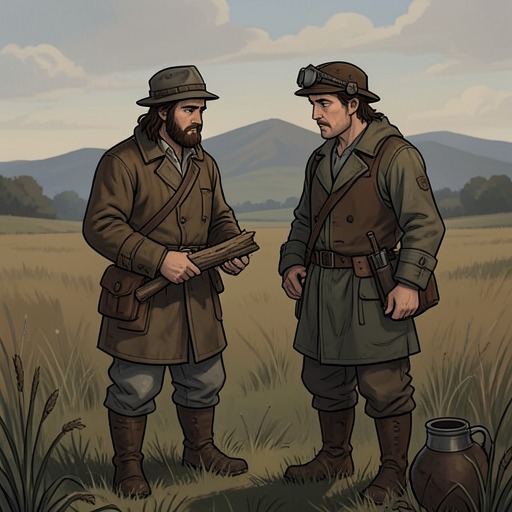
The encounter between Jute and Mutt makes linguistic uncertainty dramatic. Jute tries a succession of language labels and greetings, while the exchange answers each attempted recognition with a differently distorted sound. After the comic sequence of questions, the narrator identifies the stranger as a Jute; the speakers then trade short, mutually altered greetings. Dialogue becomes a test of whether speech can establish common ground, but its sounds continually slip into new shapes.
The exchange is not simply unintelligible. Its distortions keep recognizable words and linguistic cues in play, so that recognition and confusion arrive together. The reader hears a language being negotiated without receiving a stable, neutral vocabulary that would stand outside the negotiation. The comic effect depends on that double condition: speech communicates enough to sustain an encounter, while refusing to become a transparent channel.
The same method produces deliberately mixed registers elsewhere. In the account of the encounter in the park, a man’s question to HCE arrives as an altered, comic English greeting, while HCE’s answer is entangled with clocks, military language, religious sound, and the narrator’s unstable account of events. The incident is presented through reported speech and retrospective reconstruction rather than as a clean transcript. Linguistic excess thus accompanies uncertainty about what happened and how it became public knowledge.
Many voices, unstable testimony
Public speech does not escape this instability. Hosty’s song about Persse O’Reilly gathers competing names for its subject before turning to a refrain that celebrates Hosty as the one who can rhyme the song. The performance is at once a communal chorus and an argument over naming. Its staged cues—spoken, together, and the crowd’s calls and answers—make language social: identities circulate through what a group sings, repeats, and disputes.
A series of purported witnesses to the scandal likewise speaks in sharply different idioms. A dustman, a cabdriver, a barmaid, officials, and other figures offer assessments in voices shaped by their own verbal registers; their statements do not combine into a simple, consistent account. Later, the narrative itself questions whether reported outrages were planned, carried out, or recorded accurately. The language multiplies testimony while exposing the instability of the evidence each voice supplies.
The opening also makes the written word an object in circulation. A huge envelope is described as written in seven stages of ink, its lettering and language shifting in ways that make it appear to be both composed and improvised. The question is not only what the letter says, but how its signs can be read and who may claim to have written it. This problem converges with the description of the text as a “proteiform graph”: a document whose multiple personalities and possible meanings coalesce, provisionally, into “one stable somebody.” The language offers temporary coherence without cancelling the contradictions that produced it.
Open form and comic transformation
The multilingual method can change not only a word’s meaning but also its apparent genre. When Shaun begins a fable, he presents it as a story from the “grimm gests” of Jacko and Esaup and introduces the Ondt and the Gracehoper. Even the announcement is a verbal transformation: familiar story-telling and moralizing forms are bent into the book’s hybrid idiom. The opening of the tale proceeds through lively sound and invented compounds rather than a plain explanatory frame.
A contrasting register appears when a speaker claims to know only a particular kind of English and asks for another song another time. The request is delivered through a deliberately fractured, caricatured voice. In such passages, multilingual play makes speech difference audible, but it also leaves the reader with a formal tension: the same verbal flexibility that releases words from one fixed meaning can turn a voice into a comic performance. The book’s polyphony is therefore not a guarantee that every voice speaks with equal clarity or authority.
The method’s significance lies in how it binds sound, meaning, and narrative uncertainty together. Repeated phrases, altered names, borrowed registers, and invented compounds make language behave like the book’s recurring history: what seems new bears traces of what came before, and what seems settled can return in another form. Multilingual wordplay does not resolve every ambiguity. It makes ambiguity the working condition of the narrative, inviting readings that remain grounded in the words’ audible collisions without reducing them to one final paraphrase.