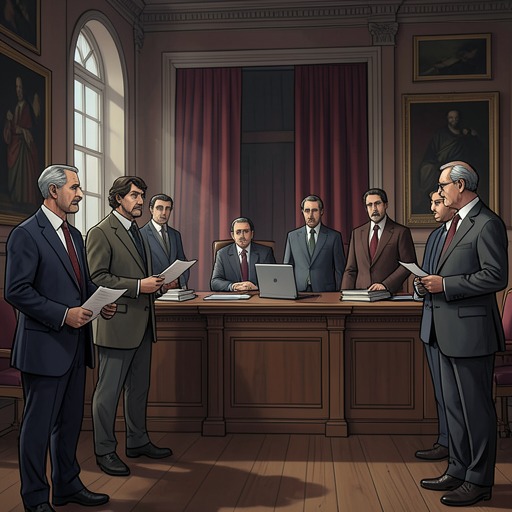
the four justicers
Finnegans WakeThe four justicers are a collective tribunal whose authority recurs amid the novel’s shifting accounts of accusation and dispute. Named as Untius, Muncius, Punchus, and Pylax, they deliberate over Festy King, deliver a verdict that frees him, and later reassemble in their chambers to talk the matter over again. Their scenes make legal judgment both an institutional act and part of the book’s broader pattern of repetition and uncertainty.
Identity and judicial role
The tribunal appears as four judges who confer together rather than as separately developed characters. When the case against Festy King comes before them, they lay their wigs together and pronounce a standing verdict. The account associates this judgment with King’s release from the tribunal, presenting the decision as a collective act even as the language around it turns procedure into comic, unstable performance.
Their authority is framed through recognizable legal settings and objects: wigs, a tribunal, judges’ chambers, and traditional tables of law. Yet these markers do not settle the facts. The surrounding narrative repeatedly makes the alleged events difficult to distinguish from rumor or fabrication, so the justicers’ formal role stands in tension with the uncertainty of the account they are asked to judge.
The Festy King case
The case is introduced amid doubt about whether the reported outrages took place as described. Festy King, identified as a child of Maam and a member of a family associated with tar-and-feathering, is brought before the Old Bailey under an indictment whose two counts are described in deliberately tangled terms. The narrative then presents competing claims about his appearance and conduct, including the Crown’s attempt to show that he used disguises and false names.
The four justicers’ deliberation yields the verdict rendered as “Nolans Brumans.” The account says that King, after killing all the English he knew, picked their pockets, and left the tribunal scotfree; the language is so distorted and extravagant that the passage resists a stable reconstruction of either the accusations or the ruling. The episode’s legal outcome is nevertheless clear at the level the narrative supplies: King is acquitted or released, and the judgment becomes another episode in the book’s unstable circulation of allegations, testimony, and public response.
Reassembly and recurrence
After the proceedings, the four justicers appear again together in their judges’ chambers, in the muniment room of their marshalsea. They sit around their old traditional tables of law and talk the matter over again. The return does not provide a new resolution or a clarified account; instead, it makes deliberation itself recur after the case has apparently ended.
That reassembly gives the tribunal a structural as well as judicial function. The verdict closes one hearing, but the judges’ return to discussion reopens its meaning, echoing the novel’s recurrent movement from apparent conclusion back into renewed telling. Their authority persists, while certainty about what the law has judged remains elusive.
Narrative significance
The four justicers stand where formal law meets the novel’s unstable public record. Their court is surrounded by allegations, contested accounts, and elaborate verbal transformations; the proceedings therefore expose a gap between the desire to classify events and the difficulty of establishing what happened. The judges’ collective verdict supplies an outcome without supplying dependable clarity about the case.
Their later return to the chambers turns that gap into a pattern: legal review, like the narrative around it, circles back rather than settling permanently. The tribunal’s repeated presence links institutional judgment to the book’s wider cycles of accusation, retelling, and reconsideration.